Photo of Steph and the Man in the Background
I'm Thinking of Ending ThingsThe Photo of Steph and the Man in the Background is a framed image in Jake’s room that turns an ordinary object into an unsettling piece of evidence. It depicts a blond woman in a field and, behind her, a man who is not Jake. When the narrator asks about the woman, Jake identifies her as Steph; when asked about the man, he tentatively identifies him as his brother. The photograph matters not because it resolves Jake’s history, but because it exposes how much of that history the narrator has not been told.
Appearance and Placement
The narrator finds the photograph on a shelf among other images in Jake’s room. She lifts the frame and brings it close to her face to examine the woman: blond, short, and wearing a blue bandanna tied at the front. The woman stands in a field or at its edge. The narrator initially wonders whether she might be Jake’s high-school girlfriend, whose past relationship with him has been described as unequal in intensity.
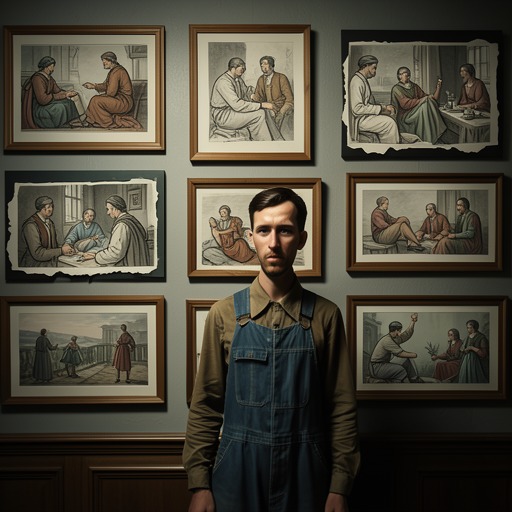
The rest of the room contains photographs of scenes, flowers, trees, and people whose faces the narrator does not recognize. She has seen only one supposed photograph of Jake in the house: a picture downstairs by the fire that he claimed showed him as a child. She is certain it did not. Against that uncertain family archive, the framed image offers a face that seems specific but raises more questions than it answers. Jake has told the narrator that he enjoys photography, saved for a good camera, and took art lessons outside school; those details make the photographs part of his known interests, but they do not establish who took this one.
The Narrator’s Reading of the Image
The photograph first appears to confirm a story Jake has already told, then contradicts its details. Jake had described his high-school girlfriend as brunette and tall, whereas the woman in the frame is blond and short. The narrator notices the mismatch before she knows the woman’s name. She also sees, in the background, a man who is close to the woman and looking at her. His presence shifts the image from a possible portrait of Steph into a scene whose relationships are unclear.
The narrator’s attention is unusually physical and deliberate: she brings the photograph almost to her nose and studies the background rather than accepting the central figure as the whole subject. That act of looking produces no certain account of what happened in the scene. The man appears to be lying on the ground, and the narrator reads his gaze and proximity as signs that he is connected to the woman. Whether he is a participant, a bystander, or simply someone captured in the frame remains unknown. The photograph preserves the visible arrangement while withholding its explanation.
Jake’s Identification
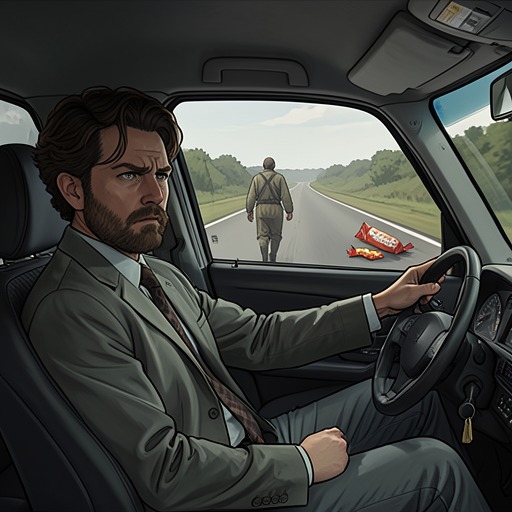
Later, while Jake is driving, the narrator asks who the blond woman is. He first responds as though he does not know which photograph she means, then identifies her as Steph. He describes her as attractive, but says he never regarded her as beautiful. Asked whether the relationship worked out, he says it did not. His account is brief, and he looks straight ahead while biting his thumbnail. The narrator considers pressing him for more, but does not: she believes the relationship is already headed toward its end and sees no point in insisting.
The narrator then asks about the man behind Steph, emphasizing that he was lying on the ground and was not Jake. Jake does not immediately answer. After a pause, he says the man was probably his brother and that he thinks he remembers his brother appearing in one of those pictures. The uncertainty in his identification is important: the image suggests a family connection but does not conclusively establish the man’s identity. Even so, the answer reveals something more consequential to the narrator than the identity of Steph. She had not known Jake had a brother.
Significance and Limits
The photograph changes the meaning of a private collection by making its absences visible. The narrator has found many unfamiliar photographs, yet has never seen a reliable image of Jake himself. Now one picture presents a woman whose appearance conflicts with Jake’s earlier description and a possible brother absent from the narrator’s understanding of his life. The object supplies visual details, but Jake’s hesitant explanations leave the people in it only partly known.
Its narrative force lies in that gap between what can be seen and what can be said. Steph is named, but the narrator cannot reconcile her appearance with the earlier account. The man is noticed before Jake identifies him, and even then the identification remains qualified. The photograph does not prove who took it, what relationship the figures had, or what the scene means. It does, however, make the narrator’s limited knowledge concrete: a framed image on a shelf brings an undisclosed family relationship into the conversation and leaves the past more complicated than it seemed.