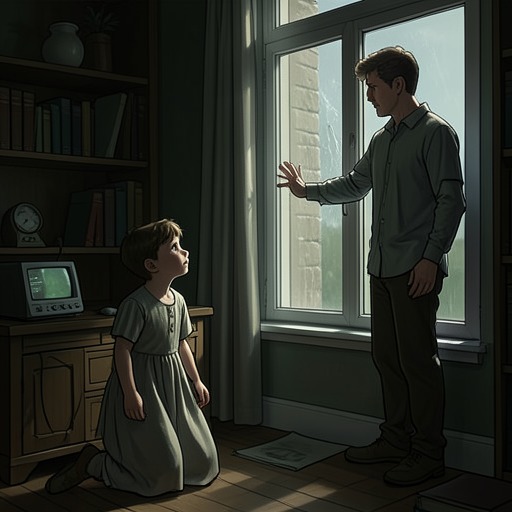
The Narrator Sees a Strange Man Outside Her Window as a Child
I'm Thinking of Ending ThingsThe Narrator Sees a Strange Man Outside Her Window as a Child is a remembered encounter that leaves its central question unresolved: whether the narrator saw an actual stranger, misread an ambiguous figure, or remembers the event through fear that has grown over time. The man’s stillness, his position at a low bedroom window, and a gesture the narrator takes as malicious make the childhood sighting feel less like a completed incident than the beginning of a lasting sense of being watched.
The Memory Returns
The narrator recalls the event while lying alone, though she cannot say why it comes to mind at that moment. She places herself at about six or seven years old and describes the recollection as patchy and nebulous, despite the vividness of particular details. She rarely speaks or thinks about it, and does not know what to make of it. The memory is therefore presented not as a settled account but as something that resurfaces without explanation and resists a confident interpretation.
That uncertainty deepens with time. The narrator says that the memory still terrifies her when she wakes alone at night, and that it seems more sinister as she grows older. She allows that remembering may itself have made the event worse in her mind. Fear and recollection cannot be cleanly separated: the sighting is vivid enough to feel real, but the narrator also recognizes that each return to it may alter its meaning. The account gives the reader both the remembered scene and the adult narrator’s doubt about how faithfully the scene has survived.
The Bedroom and the Figure
On the night of the sighting, the narrator wakes abruptly, already alert rather than slowly coming to consciousness. Her position is unusual for her: she is on her back, beneath covers pulled tightly around her. She is hot and sweating, and her pillow is moist. The bedroom door is closed, the night-light she usually leaves on is off, and the room is dark. An overhead fan spins rapidly, its motor and blades the only sound she can hear. In a house where pipes or creaks usually break the night’s quiet, that silence feels conspicuous.
The bedroom is at the back of the house and is the only ground-floor bedroom. Its window is neither wide nor tall, and it stands directly in front of the narrator. Outside it, close to the glass, is the man. The window frame hides his face and the upper part of his body; the narrator sees only part of his torso. He is very tall and thin, and sways slightly as his hands rub together from time to time, as if warming them. She remembers his worn black belt especially clearly: its loose end hangs down in front like a tail. The precise details make the figure memorable, while the blocked view of his face prevents the encounter from becoming an ordinary recognition of a stranger.
The narrator and the man remain still for a long time. She does not move, and he stays close to the window, rubbing his hands. The narrator thinks he looks as if he has paused during physical work, but this impression supplies no explanation for why he is there. She comes to feel that he can see her even though his eyes and head are above the window frame and beyond her view. The contradiction is central to the scene: she cannot see his eyes, yet experiences herself as watched. She is certain it is not a dream, while also describing the experience as difficult to distinguish from one.
The Gesture and Its Meaning
Soft music becomes audible from outside only after the narrator has seen the man. She cannot remember it clearly or determine whether it was recorded music or humming. Its late arrival in the recollection makes it another uncertain element rather than a clue that settles what happened. The narrator estimates that she watched the man for a long time, perhaps many minutes or even an hour, but the duration is itself qualified by the limits of memory.
Then the man moves his hand. The narrator cannot be certain that he waves; it may only have been a wave-like gesture. Yet that movement changes the emotional meaning of the encounter. She experiences it as malicious, as though it conveyed that she could never be entirely alone and that the man would remain around or return. Before the gesture, the figure is already unnerving, but his stillness leaves his purpose unknown. After it, the narrator reads a threat into his presence. The account does not establish that the man intended this message; it establishes that the child experienced the movement as one.
The narrator closes her eyes. She wants to call out but does not, and eventually falls asleep. When she opens her eyes in the morning, the man is gone. The scene ends without a confrontation, an explanation, or confirmation of how he arrived or left. Its immediate physical outcome is simple—the window is empty by morning—but the narrator’s fear survives that disappearance.
Aftermath and Lasting Significance
The man never reappears at the window, despite the narrator’s expectation that the encounter would recur. That absence does not restore a feeling of safety. The narrator says she has always felt that he was there, and sometimes thinks she sees him again: a tall man sitting motionless on a bench outside her house at night, legs crossed and apparently facing her. Those later impressions are infrequent, and distance makes it difficult to see his face or know for sure whether he is looking her way. She cannot identify anything he is doing wrong; what troubles her is that he sits there doing nothing, without reading or talking, and gives her no answer to the question of why he is present.
The episode’s lasting force comes from the gap between what can be seen and what can be known. The man’s face and eyes remain out of view; even the apparent wave is uncertain; and the later bench sightings may have been in the narrator’s head. Nevertheless, she insists that the fear and visual impressions feel real to her in the present. The memory thus preserves both conviction and doubt rather than resolving one into the other. A stranger outside a child’s window may be an event, a distorted recollection, or an image that fear keeps returning to; the narrator cannot determine which. What endures is the sense that solitude can be interrupted by an unseen gaze, even after the figure itself has disappeared.