The Stranger Outside the Narrator's Childhood Window
I'm Thinking of Ending ThingsThe Stranger Outside the Narrator's Childhood Window is a remembered childhood encounter that becomes a lasting source of fear without ever becoming fully verifiable. The narrator recalls waking to find The tall man just beyond her bedroom window, watching from outside; a possible wave transforms the still scene into a threat of continued presence. The account holds on to precise sensory details while questioning what memory can establish, leaving the figure's identity and even the exact nature of the gesture unresolved.
The Memory and Its Return
The narrator remembers being very young, perhaps six or seven, when the encounter occurred. Years later, while lying alone after Jake gets up to use the bathroom, she considers telling him about The Caller but cannot bring herself to do so. The childhood memory comes to mind instead. She does not know why it surfaces at that moment, and describes it as a hazy, patchy recollection whose remembered parts nevertheless feel clear. The event is therefore presented both as a childhood experience and as a memory returning within a later scene of withheld disclosure.
The narrator says she rarely talks about or even thinks about the episode. It is not a story she offers casually, in part because she does not know what other people would make of it and in part because she is unsure what to make of it herself. Its return does not settle its meaning. Rather, the telling exposes a gap between the vividness of the images and the uncertainty about what happened: the details feel sharply retained, while their interpretation remains unsettled.
The Encounter at the Window
The narrator wakes abruptly, already fully alert, rather than gradually coming to as she usually does. She is lying on her back, which is unusual for her; the covers are pulled tightly around her, she is hot and sweating, and her pillow is damp. The bedroom door is closed, the night-light is off, and the overhead fan turns rapidly above her. Its motor and blades are the only sounds she can hear. In a house where pipes or creaks usually make themselves heard, that silence adds to the scene's strangeness.
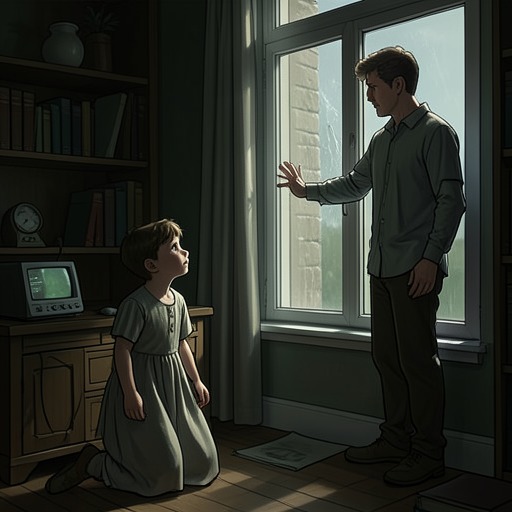
The bedroom is at the back of the house and is the only ground-floor bedroom. Its window is neither wide nor tall. The man stands outside it, close to the glass. The narrator cannot see his face: the upper part of him is beyond the window frame, leaving only part of his torso visible. He sways slightly and rubs his hands together as though trying to warm them. She remembers him as exceptionally tall and skinny, and recalls his worn black belt, whose excess length hangs down at the front like a tail. His posture suggests to her that he might be taking a break from physical work, but the scene offers no explanation of who he is or why he is there.
The narrator watches without moving, and the man remains by the window. As the encounter continues, she feels that he can see her despite the fact that she cannot see his eyes. The apparent impossibility does not dispel the feeling; she becomes convinced that he is watching her. Soft music, or perhaps humming, eventually becomes audible from outside. She cannot tell which it is, and says it was not noticeable when she first woke. The stretch of time seems to last many minutes, perhaps as long as an hour, though that duration too belongs to an uncertain recollection.
The Gesture and Its Aftermath
At some point, The tall man moves one hand. The narrator cannot say with certainty that he waves; it may only have been a wave-like gesture. Its effect, however, is decisive. She experiences it as malicious, as if it means she can never be entirely alone and that he will remain nearby or return. The ambiguous movement changes the scene from a strange sight into an enduring threat. The fear is not confined to the childhood moment: when recounting it later, the narrator says that the feeling and the images remain as real to her as they were then.
She closes her eyes, wants to call out, but does not. She falls asleep and finds the man gone when she opens her eyes in the morning. Afterward, she expects him to appear again at the window, but he does not. That absence closes the encounter as a visible event without ending its emotional force. The narrator says she has always felt that he was there.
Repetition, Watching, and Uncertainty
The memory's threat returns in altered form. The narrator sometimes thinks she sees a tall man outside her house, usually at night: he is sitting on a bench with his legs crossed, still and facing her way. She cannot see his face well enough to know whether he is looking at her, and she questions how a man merely sitting on a bench could seem dangerous. Yet his inactivity is precisely what troubles her. He is not reading or talking; she cannot account for why he is there. She also allows that the sightings may be in her head, without dismissing the fear they produce.
The episode's force lies in this unresolved tension between a concrete remembered image and an interpretation that cannot be proved. Recollection itself changes the narrator's sense of the event: she says it grows worse and more sinister each time she remembers it, while also wondering whether remembering has made it worse. When she tells Jake the story, he suggests that memory is heavily edited and fictional in character; she does not fully agree, though she recognizes his point. His later account of memory as something that is its own thing each time it is recalled gives their exchange a broader frame. The remembered man remains fixed in a few striking details—the dark window, the rubbing hands, the hanging belt, the possible wave—while the meaning of those details shifts. The encounter thus makes watching persist beyond the moment of sight: the man disappears from the window, but the narrator continues to feel observed.