The narrator is trapped inside the school
I'm Thinking of Ending ThingsThe narrator’s entrapment in the Rural High School transforms an ordinary public building into a place of confinement. After entering, the narrator discovers that the door has been chained and locked from inside; Jake’s car then vanishes, and the narrator finds a message that makes the danger feel deliberate. The ensuing search for safety moves through empty corridors, a cafeteria, stairwells, and an art room, where both escape routes and communication prove unavailable. The episode’s central reversal is spatial: the school that should open toward growth and a future instead restricts movement and leaves the narrator alone with an unidentified pursuer.
From Open Entrance to Confinement
At first, the narrator considers returning to the car, where there might be a chance to regroup and decide what to do. That possibility depends on reaching the entrance and on Jake being there. The narrator passes the main office and sees a chain looped through the door, secured with a lock. The entrance used moments earlier is no longer an exit. Because the chain is fastened from inside, the obstruction signals that someone has altered the building’s access while the narrator was within it.
The narrator looks back down the hall and reasons that Jake must have locked the door, but cannot understand why. Calling out for Jake and asking who is there produces no answer. The narrator leans against the glass, wanting to be back at the apartment, and looks outside for the black pickup. It is still visible at first. When the narrator runs to the windows at the front of the school, however, the car is gone. This change removes the most immediate plan for escape and deepens the uncertainty: the narrator rejects the idea that Jake would have left, yet cannot see where he is or what has happened to him.
The Message and the Approaching Threat
At the chained entrance, a small folded paper is caught in a loop of the chain. It contains a single line connecting the annual number of violent crimes in America—more than one million—to the question of what happens in the school. The note does not identify its writer or explain the situation, but its placement makes the locked door seem less like an accident. The narrator fears that Jake has been harmed and that the person responsible is now after the narrator. Those conclusions remain fears rather than confirmed facts; the note provides no direct account of Jake’s whereabouts or the pursuer’s identity.
The narrator recognizes that shouting could reveal their location and decides to hide rather than remain in the open hall. Then footsteps approach from another corridor, described as the sound of rubber boots. The threat is conveyed through an approaching sound without a visible pursuer. The narrator runs away from it, through double doors into the cafeteria, past the long tables and vending machines, and through a door at the far side into a stairwell. With no windows there, the narrator listens for signs of pursuit before continuing upward. The building’s ordinary rooms and connecting passages have become parts of an improvised escape route.
A Building Without a Way Out
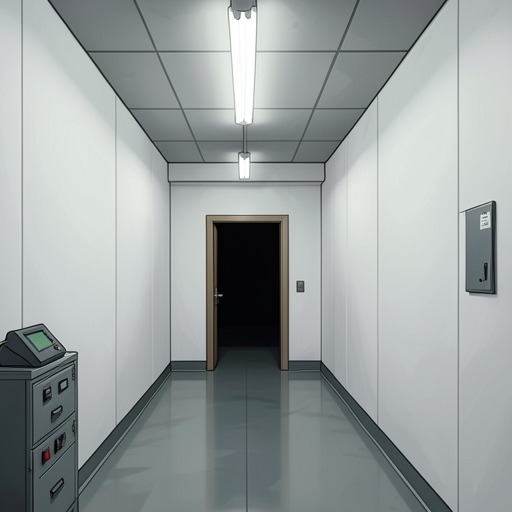
The narrator later gets away from a bench and cautiously explores another corridor, trying several doors and finding them locked. The halls seem to repeat and turn back on themselves, making it difficult to establish a reliable route. This maze-like impression is reinforced by the absence of signs of student life on the walls. Even the garbage cans offer no useful object: they contain only fresh, empty bags. The narrator reaches what seems to be the science wing and looks through the doors at the lab stations, but no available exit or refuge is identified there.
An upstairs art room provides a temporary opening because its door is not locked. The narrator enters and closes it slowly without latching it, preserving the possibility of listening or moving again. A wall-mounted phone cannot complete a call: dialing more than three digits brings a tone, and attempts to call emergency services fail. In the teacher’s desk, the narrator finds a plastic retractable X-ACTO knife, but its blade has been removed, leaving it useless as a tool. When a sound comes from the hall, the narrator ducks behind the desk. The room offers concealment for the moment, but neither working communication nor a means of protection.
Reversal of the School’s Promise
The narrator reflects that school is supposed to be safe and associated with potential, progression, and the future, but now feels like a prison. The contrast is made concrete by the building’s layout: a chained entrance, locked doors, corridors that seem to fold into one another, and a room phone that cannot connect help. Familiar institutional features do not protect the narrator; they become obstacles to movement and escape.
The episode does not resolve who chained the door, why Jake’s car disappeared, or whether Jake has been harmed. Instead, it sustains the narrator’s uncertainty through failed plans and incomplete information: the car is first visible and then gone, a message suggests violence without explaining it, and footsteps indicate an approaching person without revealing who is there. The confinement is therefore both physical and epistemic. The narrator cannot leave the building and cannot establish what has happened, while each attempt to find a safer place yields only temporary concealment rather than a confirmed route out.