Waiting for the ideal moment and deferring life
I'm Thinking of Ending ThingsWaiting for the ideal moment and deferring life is a recurring pattern in which action is postponed until an occasion seems worthy enough to justify it. The narrator’s deep-red elephant candle gives that pattern a concrete form: a gift kept for a future special moment, still unlit after the hoped-for moment never arrives. Later, the refrain “What are you waiting for?” widens the image from one unused object into a challenge about how a life is lived and whether a decision can be left indefinitely for later.
The Candle and the Ideal Occasion
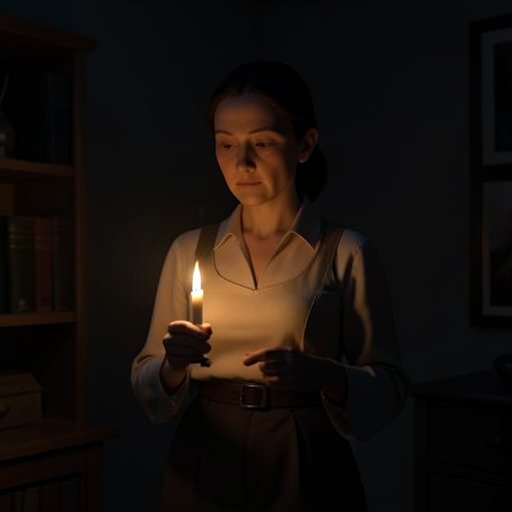
The pattern is first made visible in the narrator’s room, among books, a desk, and a familiar blue chair molded by repeated use. Against these marks of ordinary inhabitation sits a single candle, deep red and shaped like an elephant, its white wick rising from the animal’s back. The narrator’s parents gave it to her after she graduated from high school at the top of her class. Its origin links it to achievement and a milestone, but its continued presence turns it into a marker of what has not happened since.
The narrator had always expected to light the candle one day. As time passed, however, the decision became harder: when an occasion seemed special enough, using the candle felt like settling, so she waited for a better one. The logic is circular. A moment must be exceptional to qualify, yet choosing an available moment risks making it seem insufficient; postponement preserves the candle’s imagined future value while removing every actual occasion from consideration. The object remains on top of a bookcase, untouched. Its wick is physically available, but the standard for burning it keeps moving beyond reach.
This is not simply an account of saving a gift. The candle’s untouched state records duration: the narrator does not describe one missed opportunity but an accumulating history of occasions judged inadequate. The contrast with the blue chair sharpens the point. The chair has been used hundreds or thousands of times and has taken the shape of the narrator’s body; the candle, by contrast, has been preserved from use. One object bears the evidence of living through repetition, while the other carries the expectation that life’s meaningful use must wait for a uniquely worthy moment.
From Private Habit to Refrain
Near the novel’s end, the language of waiting returns in a different form. A notice advertises dancing for ten dollars and ends with the words “What are you waiting for?” The phrase is then repeated over and over, extending far beyond the short invitation that first presents it. Its ordinary function as promotional encouragement is transformed by sheer recurrence: a familiar slogan becomes difficult to treat as incidental, and the question seems to press on the accumulated delay represented by the candle.
The shift in scale matters. The candle scene is quiet and private, attached to one room and one decision; the repeated refrain occupies the page insistently. The text does not explain that the advertisement causes the narrator’s thoughts, or reduce the pattern to a single explicit lesson. Instead, the recurrence creates an echo between a deferred, supposedly special use and a blunt demand for action. The reader must connect the two: the candle waits for an occasion, while the refrain asks what waiting itself is doing.
Waiting at the School
After the refrain, the narrative returns to the Custodian's Room, describing the return as inevitable and as the only remaining possibility. The narrator and Jake pass the woodworking and auto classrooms, the Dance Studio, Student Council, and the drama department, but do not try the doors. These are concrete alternatives along a route, yet the pair move past them; the narrator remarks that the doors and even the dust have become familiar after years of passing them. The episode gives deferred action a spatial counterpart: doors are present, but familiarity and exhaustion have displaced the impulse to enter or explore them.
That movement does not simply repeat the candle’s private postponement. At the school, the narrator states that a choice exists and that everyone has one. The thought turns the refrain toward a decision with larger stakes, asking what gives life significance and shape, and why people wait for an ending rather than make it happen. The wording makes waiting difficult to regard as neutral: delay is placed beside agency, and the possibility of acting is named without making the choice easy or its outcome certain.
Meaning and Unresolved Ending
The candle and the school sequence frame the same tension at different scales. In the room, waiting protects an imagined ideal occasion from the disappointment of an ordinary one. At the school, repeated passage through familiar corridors and the return to one room make delay feel like a narrowing path. The refrain supplies a verbal link between them, changing waiting from a private habit into a problem of choice. The contrast is not between a clearly correct action and a clearly wrong one; the evidence instead emphasizes the cost of allowing an ideal standard to prevent any action at all.
The final threshold preserves that uncertainty. The narrator expresses regret about not having done better or more, closes her eyes, and hears rubber boots identified as Jake’s and as her own. When he stands at the door and it opens, the narration gathers him, the narrator, and “us” together. This convergence gives the ending a language of unity, but it does not erase the preceding question of choice or specify what decision has been made. The ideal-moment motif therefore ends not with the candle finally lit, but at a charged threshold where waiting, action, regret, and togetherness remain bound together.