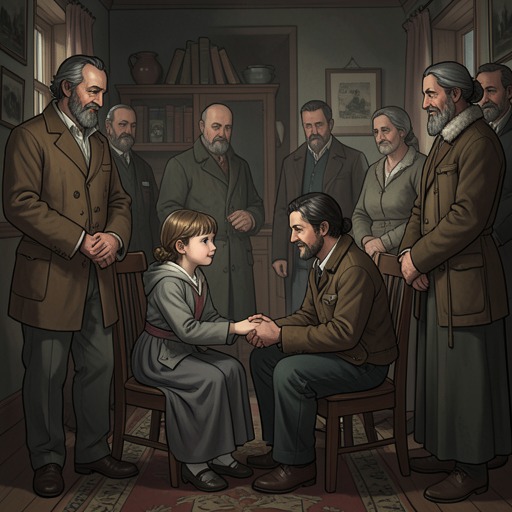
“I’m going to build us a table”
If Beale Street Could TalkThe expression “I’m going to build us a table” is Fonny’s final promise to Tish: a declaration of love that joins his identity as a maker to an imagined future of shared work, family, and community. Its confidence does not erase the distance between them; the closing passage lets hope and separation occupy the same moment.
A Maker’s Self-Definition
Fonny describes himself as an artisan rather than an artist, rejecting a label whose meaning he does not trust. His alternative is concrete and physical: “Like a cat who makes – tables,” he says, defining his work through the hand and the body. The table is therefore not an abstract emblem detached from his practice; it grows directly out of the kind of making he claims for himself.
That claim carries uncertainty as well as conviction. Fonny says he understands what his work is about now, “Even if I go under,” but immediately adds that he does not think he will. The exchange gives his confidence a hard-won quality: the future remains uncertain, yet he speaks as someone who has found meaning in the work and intends to continue it.
The Promise of the Table
Fonny’s promise expands from a piece of furniture to a future involving many people: “I'm going to build us a table and a whole lot of folks going to be eating off it for a long, long time to come.” The table is both something he will make and something others will gather around. His vision moves beyond a private declaration between himself and Tish toward a provision that can be shared and endure.
Tish answers, “Where you lead me,” and promises, “I'll follow.” The exchange makes the table part of a mutual commitment: Fonny describes what he will build for them, while Tish affirms her place beside him. When he repeats “Baby” and tells her he loves her, the practical image of the table becomes inseparable from their intimate bond and their hope for a life beyond the present moment.
Distance and an Open Future
The promise is not presented as a guarantee that suffering or separation has ended. Tish sees Fonny as “very far from me” even while he is with her, and recognizes that he always will be. That perception places a limit around the scene’s hopeful declaration: love makes closeness possible, but it does not abolish the distance she perceives.
The passage closes with Fonny’s belief that people will eat from the table for a long time to come. Its future tense gives the expression its force, while Tish’s recognition of lasting distance keeps that future emotionally unresolved. The table stands as a specific act of craft and an expansive promise, not proof that hardship has disappeared.