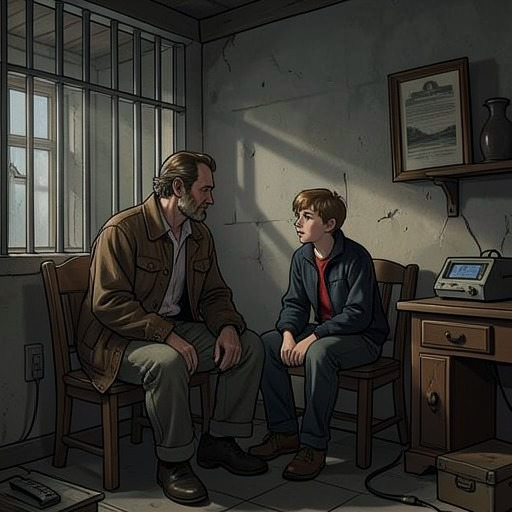
Fonny Resists Rape in Prison and Is Placed in Solitary Confinement
If Beale Street Could TalkFonny Resists Rape in Prison and Is Placed in Solitary Confinement is a decisive episode in Fonny’s imprisonment. His refusal to submit to sexual assault is met with solitary confinement and physical harm; the experience hardens him, but also gives his struggle a concrete purpose in the face of a system he increasingly understands as designed to hold men captive.
Confinement and Its Conditions
Fonny is first held alone in a cell at the top of the prison, with a move to a larger cell among other men expected soon. The temporary cell and uncertain transfer leave him afraid both of being alone and of what awaits him among the other prisoners. The hours and days seem indistinguishable, while his shoes, without laces, sit beside the narrow cot. He tries to find a reason to act, but cannot escape the feeling of being suspended between retreating into himself and facing the place around him.
The prison’s restrictions reach beyond the cell. During visits, Fonny and Tish sit on opposite sides of glass and speak by telephone; they cannot hear one another without it. Tish keeps her eyes on him, conscious that each visit might be the last time she sees him. The barrier makes their contact both intimate and sharply limited, a physical reminder that Fonny’s confinement also shapes the lives of those who love him.
Refusal and Solitary Confinement
Fonny is placed in solitary for refusing to be raped. The account does not dwell on the assault; it makes the consequence clear: his resistance is answered by further isolation. During his imprisonment he loses another tooth and nearly loses an eye, bodily costs that register the danger he faces without diminishing the significance of his refusal.
The episode changes his relation to the prison. Fonny has known that he is not there for anything he has done, but comes to understand that injustice as part of a wider order: the men held around him have little power, while others possess the authority to place them in prison and keep them there. He begins to look at the other prisoners and listen to them, seeing their captivity not as a set of unrelated cases but as evidence of an arrangement that sorts people into the powerful and the condemned.
Survival and Resolve
Tish brings Fonny books, and they manage to get him paper so he can sketch. Once he begins to face the reality of the prison, he also starts speaking with the other men, making a place for himself among them. These small acts do not remove the danger or promise an escape; they give him ways to remain engaged with the world around him rather than turn away from it.
The prospect of his child becomes central to his determination. Fonny sees the baby’s face before him and thinks of the birth as an appointment he must keep. Even in solitary, he commits himself to being alive when the child arrives. His resolve does not erase fear or the lasting change wrought by prison, but it redirects his struggle: survival becomes an obligation to a future relationship as well as a defense of his own life.
Narrative Significance
The episode joins the prison’s physical controls—cells, transfers, solitary confinement, and the glass partition at visits—to the wider isolation Tish experiences outside it. On the bus, she finds that she cannot readily tell strangers that Fonny is jailed, that she loves him, and that she is afraid for the father of her child. She understands trouble as a condition that can leave a person alone even among other people. Against that separation, her visits and the books and paper supplied to Fonny become practical forms of care.
Fonny’s refusal exposes the violence built into his confinement, while his growing attention to the other prisoners turns private endurance toward recognition of a shared condition. The baby gives that endurance a future-directed purpose; the visit across glass makes its cost visible. Solitary confinement is therefore both a punishment imposed for resistance and a point at which Fonny recommits himself to living and facing what surrounds him.