Six O’Clock Visits
If Beale Street Could TalkSix O’Clock Visits are the recurring meetings between Tish and Fonny during his imprisonment, a ritual whose importance lies less in what it can practically change than in what it lets each of them know. The prison controls where they meet and how they speak, while the hour itself gives their separation a daily shape. At first, Tish struggles to keep working and to reach Fonny consistently; later, supported by her family, she is present at six every day. Her visits become both an act of care and a form of resistance to the isolation imposed by imprisonment.
The Visit as a Prison Routine
The visits take place across a wall of glass, with Tish and Fonny seated on separate benches and communicating by telephone. They cannot hear one another through the barrier, so the telephone is necessary, but it does not remove the distance. Tish has learned to pick up the receiver as soon as she arrives and keep her eyes on Fonny. She knows how easily a caller can look down while speaking, and makes a deliberate effort to look at him instead. At one visit, she calls his name; he glances down, looks up, smiles, and waits with the phone in his hand. The small exchange carries the tenderness of recognition while making visible the constraint around it.
For Tish, the glass is not simply a feature of the visiting room. It is the condition under which she must see someone she loves while fearing that she may lose him. The visit offers contact, but not touch, and its limited means of communication sharpen rather than settle her awareness of separation. That tension gives the repeated meeting its emotional force: she arrives to be with Fonny, but the prison makes the boundary between them impossible to ignore.
The hour also belongs to the institution’s schedule. Fonny waits to be called from his cell and led downstairs; a visitor’s arrival depends on that process. If someone comes regularly, he can understand that a person outside cares for him, and that knowledge may help him endure the night and reach the next day. If nobody comes, his situation becomes more dangerous in an emotional as well as physical sense. Thus the six o’clock visit is not merely an appointment on Tish’s calendar. It is a recurring sign that Fonny has not been abandoned beyond the prison walls.
Work, Pregnancy, and the Cost of Keeping the Appointment
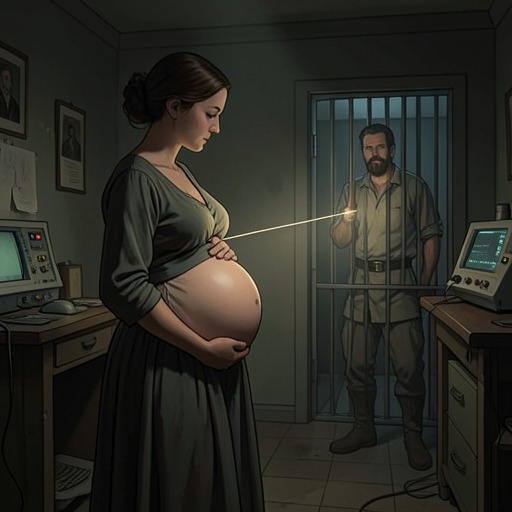
At first, Tish is afraid to leave her job because the family needs the money. Her pregnancy is advancing, however, and the demands of working and travelling become harder to meet. The baby begins kicking at night; Tish is often sick, and she worries about managing the journey to work as she grows heavier. On the crowded subway, she fears that if she were to faint, other passengers might trample her and the baby. She continues to think of Fonny as counting on her to bring their child safely into the world, even as the daily commute makes that responsibility feel precarious.
The visit schedule therefore competes with necessities that cannot simply be set aside. Tish often misses six o’clock because she is still working, and she explains the situation to Fonny. He understands why she cannot always be there, but understanding does not make the wait disappear. He still has to wait to hear his name called and to be taken downstairs; what Tish knows about his patience cannot substitute for her presence at the appointed hour.
When Tish is unable to continue working, she initially feels the loss of routine sharply. Being left with nothing to do forces her to recognize that she had also held on to the job to avoid facing her trouble. Without work to occupy her, she confronts her life with Fonny and the baby more directly. The change makes it possible for her to be with Fonny far more consistently, but it is not presented as an easy or uncomplicated choice: her time outside prison remains shaped by pregnancy, money, illness, and fear.
Family Support and a Changed Pattern
Joseph makes the stakes plain to Tish. He tells her that she must see Fonny every day and promises that the family will take care of the rest. His intervention turns visiting from an individual burden into a shared family responsibility. When Tish is especially ill, Joseph tends to her while Ernestine is away at a rush job. After Sharon goes to Puerto Rico, Joseph and Ernestine also keep watch over Tish as the baby grows more active. Their care helps make her continued presence at the prison possible.
Once Tish is no longer working, the pattern changes decisively. On days when she does not see Hayward, she sees Fonny twice; she is always there for the six o’clock visit. The regularity means that Fonny can count on her appearance rather than merely hope for it. Tish comes to understand that her presence, although of no practical use in securing his release, has a value that practical work cannot replace. Her face tells him again that she loves him, while also showing that other people love him enough to free her to be there.
Their conversations retain humor as well as reassurance. As Tish becomes visibly pregnant, Fonny jokes about the size of her belly and wonders whether they may be having twins or triplets. He laughs while holding the telephone and looking at her. The exchange does not erase confinement or anxiety, but it lets the couple address the child as part of their shared future. The visits hold together the realities that imprisonment tries to separate: Fonny’s cell, Tish’s pregnancy, and the family’s continuing life outside.
Meaning and Later Continuity
The six o’clock ritual is defined by repetition, but its meaning changes as Tish’s circumstances change. At first, the hour exposes how her work can keep her from reaching Fonny. Later, family support and her departure from the job allow her to make the visit reliably. In both patterns, the visit measures the reach of imprisonment into ordinary life: it reorganizes work, travel, care, and the expectations of a pregnant woman, not only the movements of the person held inside.
The routine continues even when Fonny’s conditions worsen. He is held alone in a cell before being moved to a larger cell, and the monotony and fear of confinement weigh on him. After he resists being raped, he is placed in solitary confinement and suffers further harm. Yet when he is brought down to see Tish at six, he remembers to pick up the telephone, grins, and asks how she is doing. The gesture reconnects the present visit to the earlier pattern: even after prison violence has changed him, the appointment still gives him a person outside to address and a reason to remain oriented toward life beyond the cell.
As a recurring structure in the narrative, Six O’Clock Visits make care legible through time and action rather than through abstract assurances. The prison dictates the barrier, the call, and the hour; Tish and her family answer by making her attendance dependable. The visit cannot free Fonny, and Tish knows that it has no direct practical effect on his case. Its consequence is relational: Fonny knows that he is loved, Tish sustains their connection, and neither is left to experience the separation as though the other had vanished.