The Unborn Child as a Source of Hope
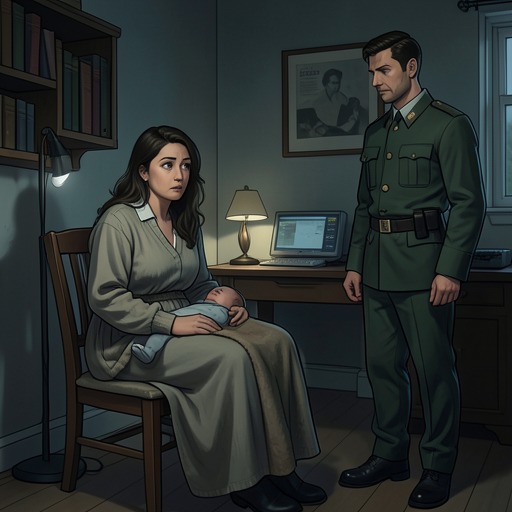
If Beale Street Could TalkThe unborn child in The Unborn Child as a Source of Hope turns a private pregnancy into a shared promise, without making the danger around Tish and Fonny disappear. The baby is welcomed by the Rivers family as a new life and a bond among generations; for Tish, that same life becomes a responsibility she must carry through work, public spaces, and the uncertainty of Fonny’s imprisonment. Hope here is not an escape from hardship but a reason to keep acting within it.
Announcement and Family Bond
The pregnancy becomes public in the Rivers family kitchen, where Sharon declares that Tish is going to have Fonny’s baby and presents the gathering as a sacrament. The announcement changes Tish’s place in the room: she feels present to her family not only as herself but as the bearer of a life just beginning to awaken. Fonny, though absent, is part of the family’s shared moment through the child they expect together.
Joseph’s first response is halting. He struggles to speak, then asks Tish to drink to the baby. When he later takes her onto his lap, kisses her forehead, and tells her he is proud, tenderness becomes a physical answer to the news. Ernestine teases that Tish will not forget her father’s approval, while Sharon smiles and looks ahead. Their differing gestures make the welcome collective rather than ceremonial alone.
The family’s laughter carries relief as well as joy. Joseph’s hand rests on Tish’s belly, and the baby becomes, in her understanding, his child too: without Joseph, there would have been no Tish. The moment links the coming generation to the father and daughter already present, even as Fonny remains separated from them. Tish imagines the child as promised safety, but the surrounding danger is not resolved; the family’s laughter is a response to what they cannot control, not proof that its fears have vanished.
A Responsibility Carried by Tish
Sharon later takes Tish’s hands and speaks plainly about suffering: it can end in ways that are not better, and imprisonment has taken many loved ones. Her comfort does not depend on pretending otherwise. She reminds Tish that she is not alone, that Fonny is counting on her, and that the child depends on her to arrive safely. Tish answers that she will have to find strength somewhere, despite not feeling that she has any. The baby gives Sharon a concrete way to call on that strength, while Tish’s response makes clear that hope is labor as well as feeling.
That labor enters Tish’s ordinary commute. Before work, she walks through streets marked by garbage, sees people heading to jobs or furnished rooms, and considers whether she may have to seek money through sex work if Fonny is still imprisoned when the baby comes. The thought is conditional, not a decision. On the subway, as pregnancy makes her heavier and sicker, she fears that she could pass out in the packed car and that other passengers might trample her and the baby. She holds the rail more firmly, aware that the journey to work is itself a risk she must manage.
The crowded subway also sharpens the difference between being surrounded and being seen. Tish compares its confined space and impersonal movement to depictions of slave ships, while recognizing that the passengers around her are struggling through their own workdays rather than attending to her. Her pregnancy does not protect her from public indifference. It makes the consequences of that indifference more immediate: her safety and the baby’s are joined in a body that must keep moving through an environment offering little room or attention.
Signs of Life and Acts of Protection
At a bar with Ernestine, Tish recognizes the place as one where others might misread the two women, and acknowledges that their circumstances may worsen. Then the baby moves beneath her ribs. The small physical signal does not promise that events will improve in a simple or permanent way; it lets her imagine that worsening and improvement can follow one another. The child is still in the water and preparing for transformation, and Tish understands that she, too, must prepare. She tells Ernestine she is not afraid, and Ernestine urges them onward.
The idea of protection also appears in Tish’s response to danger around Fonny. At the vegetable shop, a young man blocks her way and grabs her arm while Fonny is away. Tish strikes back, and when Fonny enters, he attacks the man. Seeing a police officer approach, Tish places herself between Fonny and the officer and tells the watching people that the man had attacked her in the shop. Nobody supports her account aloud. The scene shows Tish acting under racialized public scrutiny, with Fonny’s freedom at stake; it does not establish that her pregnancy determines her intervention. Her act nevertheless belongs to the same pattern of care: she uses the action and testimony available to her to try to keep Fonny from further harm.
Motherhood, Injustice, and the Limits of Hope
Sharon’s confrontation with Victoria Rogers offers a harsher counterpoint to the family’s expectation of a child. Sharon addresses Victoria as a daughter and tells her that her identification has put a young Black man she had seen only in a police lineup in jail. When Victoria breaks away and cries for Sharon to leave, an older woman takes her into her arms and leads her away. The encounter does not undo the accusation or secure Fonny’s release. It places motherhood and care within a world where women can be vulnerable, where one person’s account can carry devastating consequences for another, and where an appeal to kinship cannot guarantee repair.
Across these moments, the unborn child is neither a magical rescue nor merely a symbol detached from daily life. The baby gives the Rivers family a shared future to welcome, gives Sharon a reason to insist that Tish draw on her strength, and gives Tish a new measure of what public and economic hazards may cost. Its first movement offers a brief, bodily assurance of presence amid uncertainty. Hope remains demanding and unfinished: Tish must carry the child safely, while the family continues to face the conditions that separate Fonny from them.