Tish and Fonny Reconcile After a Childhood Fight
If Beale Street Could TalkTish and Fonny Reconcile After a Childhood Fight is a remembered childhood episode that establishes the origin of Tish and Fonny’s lasting bond. What begins as a chaotic dispute among children leaves Tish frightened and Fonny injured; what resolves it is not a victory or punishment, but a shared apology and a doughnut. Tish recalls that small exchange as the point at which the two became, in effect, sister and brother to one another.
Background and the Children’s Rivalries
Tish remembers meeting Fonny on the streets of New York City when she was about six and he was about nine. Their families lived across the street from each other, and Fonny’s father, Alonzo Hunt, ran a tailor shop. The neighborhood and its children were familiar to Tish, but she did not initially feel close to Fonny. Her friend Geneva disliked him and repeatedly mocked his appearance; Tish went along with her, though she privately found some of Geneva’s insults unconvincing and liked Fonny’s eyes. Fonny, meanwhile, spent much of his time with boys whom Tish regarded as unruly. Before the fight, he had already lost a tooth.
The immediate conflict involved the children around them. Daniel, Fonny’s friend, was interested in Geneva, while Geneva was hostile toward Fonny. When Daniel and Geneva ended up struggling on the ground, Tish tried to pull Daniel away. Fonny pulled at Tish as she intervened. The episode is recalled as confusion that escalates quickly, rather than as a deliberate confrontation between Tish and Fonny: her attention is on stopping the others, and the blow she lands on him is unintended.
The Fight and Its Aftermath
Trying to free herself, Tish grabbed a stick from a garbage can and struck Fonny. The stick had a nail, and Fonny was injured. Tish was shocked by what had happened and ran. Fonny caught up with her, but he did not hit or otherwise hurt her. Instead, he spat at her, and the other children began shouting about the possibility that Fonny might die from the injury. Geneva and Daniel, who had been at the center of the initial quarrel, were unhurt; Fonny and Tish were left to bear the fear and confusion that followed.
As the children’s alarm mounted, Fonny began to cry too. Geneva and Daniel took him away, leaving Tish alone. For the next couple of days, she believed the frightening talk that Fonny might have lockjaw and die, and Geneva added that the police would arrest Tish. Tish watched the tailor shop, where Alonzo continued working and joking with people who came in. The ordinary activity there gave her no sign that Fonny was gravely ill. Worried by his absence, she eventually went to the shop and asked Alonzo what had happened.
Alonzo told her that Fonny’s mother, Alice Hunt, had sent him to relatives in the country for a little while because she believed he got into too much trouble in the city. He also joked that Fonny might find trouble there as well. The explanation reassured Tish that Fonny had not died, though she still had to wait for his return. The episode links her childhood fear not only to the injury but to the rumors surrounding it: she is made to imagine death and arrest before she has the information to distinguish either from the other.
The Apology and the Beginning of Their Bond
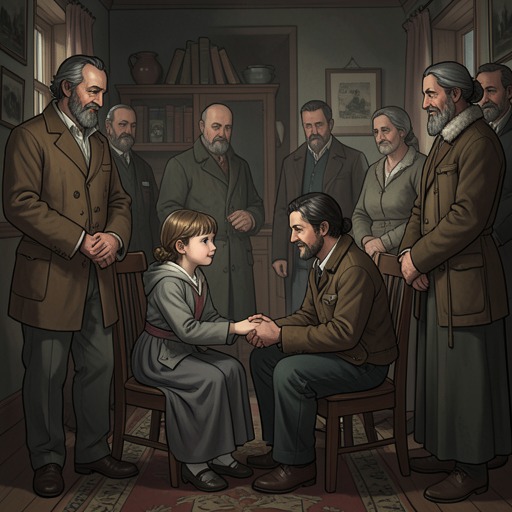
Fonny came back about four or five days later and sat down on Tish’s stoop. He had no visible scar and brought two doughnuts. He apologized for spitting in her face and gave her one. Tish apologized for hitting him. They then ate without saying anything more. The simplicity of the exchange matters: neither child offers a long explanation, and their reconciliation does not depend on assigning blame for every part of the earlier disorder. Each acknowledges the hurt he or she caused, and the food they share gives the moment a quiet, practical close.
Tish remembers that they became friends after this. She also describes the bond in more intimate family terms: Fonny did not like his sisters, and Tish had no brothers, so each became for the other what was missing. Their closeness is therefore presented not simply as a friendship following an argument, but as a relationship that supplies a form of sibling companionship. The unevenness of the fight gives way to mutual recognition; the child who had run away and the child who had chased her can sit together on the same stoop.
Changed Alliances and Later Significance
The reconciliation also changes the children’s other friendships. Geneva became angry with Tish and stopped being her friend; Tish later understood that she, too, had already turned away from Geneva once Fonny had become important to her. Daniel became angry with Fonny, called him a sissy for spending time with girls, and stopped being his friend for a long period. The resulting split shows that the new bond has social consequences: Tish and Fonny do not merely return to the arrangements that preceded the fight. Their attachment draws them away from the pairings that had organized their childhood circle.
In the larger narrative, Tish recounts this memory from a later moment when her relationship with Fonny carries adult stakes. She is pregnant while he remains jailed, and she worries about how she can keep working and bring their child safely into the world if he is not released. Another later scene shows her stepping between Fonny and a police officer after Fonny intervenes when a boy harasses her at a vegetable shop. These moments do not make the childhood episode the cause of every later choice, but they make its first pattern legible: Tish and Fonny repeatedly face danger in circumstances shaped by other people, and their closeness is expressed through practical protection as well as affection. The stoop, the apology, and the shared doughnuts mark the modest beginning of that enduring loyalty.