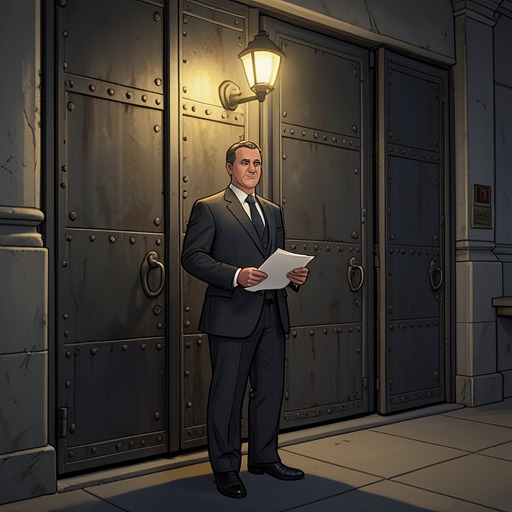
Andoche Finot
Illusions perduesAndoche Finot is a Paris newspaper director whose rise from precarious literary work to a prosperous and influential position exposes the commercial machinery behind journalism. He is not merely an editor: he assembles ownership, hires writers, brokers theatrical access, and seeks to shape what the press praises or attacks, often while keeping his own control discreet.
Work and Early Position
When Lucien seeks work at Finot’s newspaper, the director is away at his home on Rue Feydeau. An employee explains that the journal is made across several sites: in the street, among authors, and at the printing house, with work continuing late into the night. The description places Finot at the head of a hurried, distributed operation rather than a settled editorial office.
Finot’s newspaper belongs to a world where written material is scarce even as deadlines approach. In typographical slang, the manuscript awaiting composition is called copy; a regular supply of advance material is an unrealized ideal. The working paper therefore depends on writers who can deliver quickly, and on a director able to turn their contributions into a finished issue.
Editorial Authority and Commercial Deals
At a bookseller’s shop, Finot appears with Félicien Vernou and tells Étienne Lousteau that he has arranged a box for Lousteau’s evening at the theater. When Lousteau asks whether he sold it to Braulard, Finot treats the arrangement as an ordinary transaction. The exchange shows his ease in moving between newspaper work and the theater’s commercial and social networks.
Finot also participates in deciding which authors the press should promote. In a discussion about a publisher’s plans, he proposes that Paul de Kock be pushed, despite Victor Ducange’s refusal to supply a novel, and that the newspaper place de Kock above Ducange. Editorial judgment here is inseparable from the publisher’s proposed list and the market position he wants to create.
His ambitions become explicit in the proposed ownership of a weekly journal. Finot says he has agreed to acquire a one-third interest for 30,000 francs, on condition that he become editor-in-chief and director. He then asks Lousteau to persuade Matifat to buy half of that share—one-sixth of the journal—for another 30,000 francs. Lousteau would receive a monthly salary and serve as the public front, while Finot retained the power to direct the paper behind the scenes.
The arrangement also makes editorial labor a source of profit. Finot proposes paying writers at a higher column rate than the rate at which Lousteau would pay them, leaving Lousteau to keep the difference; he adds a monthly salary and the value of writing supplied without charge. In return, Finot insists on remaining master of the paper’s attacks and defenses, allowing Lousteau to pursue only those personal grudges and alliances that do not interfere with Finot’s political interests. He says he may align himself with either ministerial or ultra positions while preserving liberal connections behind the scenes.
Rise, Wealth, and Influence
Lousteau describes Finot’s transformation as evidence of what the newspaper trade can yield. Three years earlier, Finot was dining cheaply, writing a prospectus for ten francs, and wearing an ill-fitting coat. By Lousteau’s account, he now owns a journal valued at 100,000 francs and earns 20,000 francs a year through paid subscriptions, subscriptions that are not fulfilled, and indirect contributions collected by his uncle. His new prosperity is made visible in sumptuous dinners and a cabriolet.
Lousteau further says that Finot is about to head a weekly journal, with a share in its ownership and a monthly treatment, while arranging to charge associates for editorial work he obtains for free. These figures are presented through Lousteau’s account, but their accumulation makes the point unmistakable: Finot’s authority rests not only on what appears in print, but on subscriptions, contributions, unpaid labor, and the ability to organize other people’s money and writing.
Networks and Narrative Significance
Finot’s reach extends beyond the newspaper office. Braulard later says that Finot has sold his journal, and invites Lousteau and Lucien to a dinner attended by writers, actors, and theatrical associates. The sale marks another turn in Finot’s capacity to convert a publication into a transferable business asset, while the dinner reveals the social network gathered around that trade.
Through Finot, journalism emerges as both an editorial gate and a marketplace. He can help determine which authors are promoted, who receives paid work, and which interests the newspaper serves; he can also keep his own hand concealed behind a nominal editor. His rise contrasts sharply with Lucien’s dependence on access to publishers and newspapers: Finot’s advantage lies in controlling the channels through which literary reputation and commercial value are made.