Angoulême
Illusions perduesAngoulême is a fortified city in the Charente region, perched above the Charente River and divided from its industrious suburb, L’Houmeau, by a steep social as well as physical boundary. Its elevated old town gathers government, church authority, justice, and aristocratic society, while commerce and production cluster below. That geography governs the lives of Lucien de Rubempré and David Séchard: the city can promote a young poet into its highest circles, yet its inherited hierarchies and limited opportunities make advancement precarious.
Setting and Urban Structure
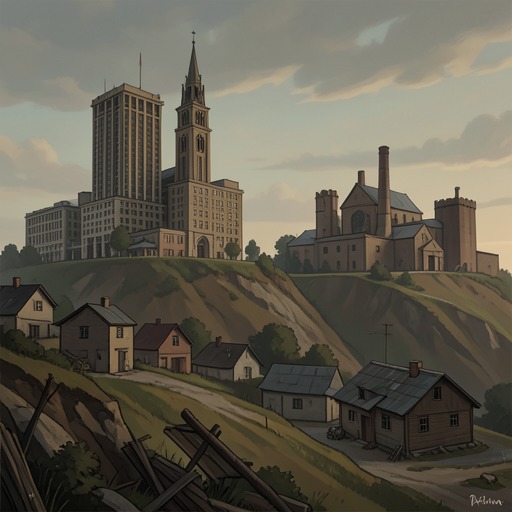
Angoulême stands on a steep, sugarloaf-shaped rock above meadows along the Charente River. A long ridge extends toward Périgord, and the rock ends abruptly beside the road from Paris to Bordeaux, forming a promontory shaped by three valleys. The city’s walls, gates, and the remains of a fortress recall its importance during the French Wars of Religion, when its position made it strategically valuable to both Catholics and Calvinists.
The fortifications that once made Angoulême powerful later constrained its growth. The walls and the precipitous slope restricted expansion toward the river, leaving the city, in the novel’s account, condemned to immobility. The lower ground nevertheless offered a different kind of opportunity. Tanneries, laundries, and other water-dependent trades remained close to the Charente River; warehouses for brandy and raw materials, along with transport and transit businesses, grew along its banks. L’Houmeau became a prosperous industrial settlement, almost a second town, but remained subordinate to Angoulême.
This separation gives the local landscape a political and economic meaning. The upper city retains government, the bishopric, courts, and aristocracy; below are commerce and money. The two zones are described as rival social worlds, each hostile to the other. The Restoration, after nine years, had sharpened a division that had been relatively calm under the Empire. The city’s physical arrangement therefore does more than provide a setting: it makes rank and power visible in where people live and work.
Printing and Provincial Industry
The city’s traditional printing trade is another sign of its distance from the capital. At the time represented in the novel, small provincial printers had not adopted the Stanhope press or mechanical ink-distribution rollers. Angoulême’s printers still used wooden presses, leather inking balls, and a stone bed called a marble. One pressman dabbed the ink onto the type while another worked the machinery. This was a laborious method, but the narrative connects it to the production of celebrated books by the Elzevir, Plantin, Aldine, and Didot presses.
David Séchard’s history links the town’s old trade to a more ambitious technical culture. After distinguished studies at the lycée in Angoulême, he was sent by his father to Paris to learn advanced printing. He was expected to save money rather than rely on paternal support, and he completed his education while training for the trade. He left Paris near the end of 1819 without costing his father a sou and returned to take charge of the family business. His expertise thus came from outside the province, but his working life and later experiments remained tied to Angoulême.
The local printing economy also connects to the ambitions of the Cointet brothers. Boniface Cointet directs their papermaking and commercial affairs, while Jean manages the printing works. The division of labor is presented as a hierarchy of command: Jean is capable, but Boniface is the strategist. Boniface meets the young lawyer Pierre Petit-Claud beside the water intake serving the brothers’ large paper mill, a scene that locates commercial power in the city’s industrial landscape. Meanwhile, David’s efforts to develop cheaper paper and the Séchard family’s attempts to keep their printing business alive expose the vulnerability of a small provincial enterprise competing against better-resourced interests.
Salons, Rank, and Lucien’s Rise
Angoulême’s social life is organized around influential households and the protection they can offer. When Lucien, the son of a pharmacist, is introduced into Madame de Bargeton’s circle, his admission is treated as a small revolution. Her interest in literature and the arts is regarded locally as an eccentricity, but the literary world she opens to him includes writers and public figures from different political camps. Her influence changes Lucien’s prospects, making the salon a channel through which cultural distinction can challenge, and also become entangled with, provincial rank.
At a poetry gathering, the city’s high society is less confident in its own literary judgment than in the opinions of powerful families such as the Rastignacs and the Pimentels. Guests draw near to them because their influence in the department is recognized in important affairs and their protection may be useful. Literary reception in Angoulême is therefore not simply an assessment of a poem: it is also a social contest shaped by whose judgment carries authority.
Rumor magnifies the consequences of such encounters. After an exchange involving the bishop and Madame de Bargeton, the story spreads through Angoulême, where minor events are altered, enlarged, and embellished. Lucien becomes the hero of the moment. As he passes through Beaulieu on his way to Madame de Bargeton’s, the envious attention of young men and the fragments of conversation he overhears feed his pride. Provincial reputation forms through a collective process of gossip, amplification, and display.
By early September, Lucien’s position has altered dramatically. Formerly a printer’s apprentice living in a poor garret in L’Houmeau, he is now Monsieur de Rubempré, lodged comfortably in upper Angoulême and dining with Madame de Bargeton nearly four times a week. He has been welcomed at the bishop’s palace, and his occupations place him among the city’s elevated society. His historical novel, The Archer of Charles IX, and his literary ambitions appear to promise a future among France’s celebrated figures. Yet the rise has a material cost: Lucien takes thirty francs a month from the wages his sister and mother have struggled to earn. His advancement in the upper city depends, in part, on the sacrifices of the family he has left below.
Return, Production, and Confinement
Angoulême remains the destination against which Lucien’s Parisian fortunes are measured. On his return journey, he walks for days after reaching Orléans, spends only a few francs on the boat journey to Tours, and continues on foot toward Poitiers. When he finally identifies himself to people at a mill near Marsac, he describes himself as a poor, exhausted young man who has come on foot from Paris. He names his father’s former pharmacy in L’Houmeau and his sister’s marriage to David, the printer in the Place du Mûrier. These details restore his provincial origins at the moment when his assumed social distinction has given way to poverty.
His return is also received through the town’s appetite for news. The doctor and priest who come to the mill have heard of his former relationship with Madame de Bargeton and of her marriage to the new prefect, Sixte du Châtelet. They are curious about why she did not marry the poet with whom she had eloped, and whether Lucien has come back to help David. Curiosity and concern combine to bring assistance to the exhausted traveler. Angoulême’s public gaze can humiliate or elevate, but it can also mobilize practical aid.
The family’s economic life unfolds in the same local setting. After Lucien’s departure, David works toward the rapid fortune he once hoped to make for Ève and Lucien. Ève takes an active role in the printing business, including coloring illustrations. With Kolb’s help, she sells three thousand illustrated sheets within twelve leagues of Angoulême in two months. The sheets cost thirty francs to produce and bring in three hundred francs at two sous apiece. When the local market is saturated, she turns to the images and blocks for a Shepherds’ Almanac, a book designed for people who cannot read and one that David’s father had once printed profitably. The venture reveals how household labor, local distribution, and an inherited printing trade can briefly create an opening for the family.
That opening exists beside coercive institutions. When David is detained for debt, the province has no separate detention house for debtors; he is placed in a lower room of Angoulême’s prison, where debtors share the institution used for people accused or convicted of crimes. The account stresses the way legal categories and ordinary language collapse within this arrangement. In the city that once seemed to offer Lucien social ascent and David professional independence, the prison makes economic failure a form of confinement.
Narrative Significance
Angoulême’s importance lies in the contrast between its promise of recognition and the limits built into its social and economic structure. The town’s elevated salons can transform Lucien’s standing, but their judgments depend on influential patrons and volatile rumor. Its printing trade gives David a vocation and a base for invention, yet outdated equipment and stronger commercial rivals narrow his room to maneuver. The prosperous lower town remains subordinate to the institutions and families of the heights, just as the Séchard household’s labor underwrites ambitions that do not always benefit it.
The city also gives the novel a recurring measure of distance. Paris is where Lucien seeks literary success and where David learned advanced printing; Angoulême is where their family ties, debts, work, and reputations return to consequence. Lucien’s journey back ends not in the triumphant standing he once enjoyed, but in a homecoming shaped by exhaustion and dependence. David’s imprisonment, by contrast, shows how provincial economic and legal structures can make a local crisis feel inescapable. Through its rock, river, divided neighborhoods, presses, salons, and prison, Angoulême becomes an active force in the narrative: a place where social mobility is staged, tested, and finally constrained.