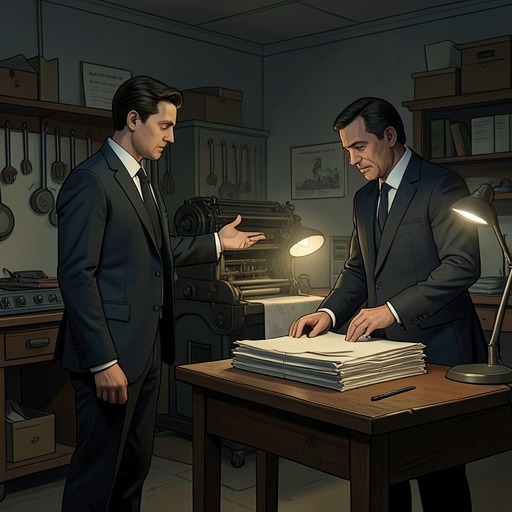
Benoît-Boniface Cointet
Illusions perduesBenoît-Boniface Cointet is the strategist behind the Cointet brothers’ business, a papermaker and printer whose dealings with David Séchard turn a promising invention into a contest over leverage and ownership. He does not prevail through open force: he watches for financial vulnerability, cultivates dependence, and makes commercial and legal pressure serve the same end.
Identity and Character
Benoît-Boniface runs the papermaking and business side of the brothers’ concern, while Jean Cointet directs the printing operation. The narrator distinguishes their capacities through a military comparison: Jean is capable and intelligent, but Benoît-Boniface is the general who retains command. The contrast is not simply a matter of temperament. Jean’s work is operational; Benoît-Boniface assesses opportunities, directs the larger strategy, and decides when to act.
His appearance and habits sharpen the portrait of concealed calculation. Thin and slightly taller than average, he looks taller still because of his leanness; he wears dark clothes and blue-tinted spectacles, ostensibly to protect his eyes from the strong light of Angoulême. His narrow mouth, catlike eyes, and controlled manner accompany a mind described as continually at work. He hears insults without visible anger and answers softly. He attends Mass, confession, and Communion, yet the narrator presents his religiosity as compatible with indifference to religion and with an intense pursuit of riches and honors. His humility, like his piety, is part of a public manner that can bend before powerful people without surrendering his aims.
That adaptability has a political dimension. As early as 1820, he wanted the gains that the bourgeoisie would obtain in the Revolution of 1830 and felt hostility toward the aristocracy. Yet he could make himself small, deferential, and obliging before the nobility and the administration. The apparent contradiction is useful to him: his ambitions are substantial, but his conduct changes according to the power he must negotiate.
Recognizing David’s Invention
When Ève Séchard confronts the brothers about their competing almanac venture, she recognizes that their knowledge of her plan came from Cérizet. Her accusation draws Benoît-Boniface’s gaze and makes him lower his eyes, giving her direct evidence of the betrayal. The exchange exposes the unequal contest already under way: the Cointets have not merely entered the same small business independently; they have used information supplied by someone close to the Séchard household.
Benoît-Boniface then asks David what he is seeking. David answers that he wants to make paper at half the current cost. He leaves without seeing the brothers’ exchanged looks, which register their immediate recognition that he is an inventor and their decision to exploit what he knows. Benoît-Boniface’s response is characteristic: the discovery is first assessed as an opportunity, and only afterward as a question of how to obtain it.
He turns that opportunity into a plan by making the Séchards’ present livelihood part of the trap. After they lease the printing equipment to the Cointets, the rent gives the household enough income to get through the winter, but it also encourages reliance on payments the brothers control. Benoît-Boniface predicts that within six months they can refuse to renew the lease and then offer to rescue David by entering into a partnership to exploit his discovery. The promised partnership is therefore presented not as a straightforward offer of support but as the next move in a strategy built on dependency.
Debt and Commercial Pressure
The plan gains force when the Cointet brothers receive the three thousand francs in forged bills sent from Paris by Lucien de Rubempré. Benoît-Boniface constructs a formidable mechanism against the already poor and patient inventor on the basis of that debt. The timing links two kinds of vulnerability: the Séchard household’s reliance on the Cointets and the financial liability created by Lucien’s actions. Benoît-Boniface’s advantage lies in recognizing how one exposure can be made to intensify another.
The commercial world around him helps explain the reach of that pressure. The Cointet and Métivier houses combine papermaking, printing, commission business, and banking, and move substantial sums among Paris, Bordeaux, and Angoulême. The narration also describes the additional charges that can be accumulated through a protested bill, including fiscal, legal, and banking fees. These details place Benoît-Boniface’s maneuver within a system in which a debt can grow through procedure as well as through its original amount. He is not shown personally calculating every charge, but the narrative identifies the financial machinery that his campaign against David can mobilize.
At seven the next morning, he waits by the water intake serving the Cointets’ large paper mill for Pierre Petit-Claud, a young lawyer who had attended school with David. The meeting makes the next instrument of pressure visible: Benoît-Boniface is not relying on the debt alone but arranging for legal expertise to enter the conflict. The scene’s setting, beside the water that powers his industrial enterprise, joins the two resources of his position—the business he controls and the strategy he is assembling around David.
Negotiation and Narrative Role
Benoît-Boniface’s caution is also apparent when Jérôme-Nicolas Séchard asks what will be required to finance David’s work. He insists that the invention must be tested on a large scale: what succeeds in a cooking pot may fail in industrial production. He cites the expense of a patent, travel to Paris, and the need to risk whole batches by manufacturing a thousand reams before committing further funds. The warning has a practical basis, but it also frames invention as costly and uncertain, making the Cointets’ resources appear indispensable while David is imprisoned and unable to act freely.
The eventual accommodation does not erase the imbalance. Ève reports the proposed terms and David accepts them, preferring a quiet life near L’Houmeau to continued anxiety. He recognizes that the Cointets will profit from his discovery, but says that if his secret benefits his country, he is content. That acceptance belongs to David’s values, not to any demonstrated change in Benoît-Boniface’s. The inventor can relinquish his claim to commercial mastery; the businessman’s pursuit of advantage has already shaped the conditions under which he must choose.
Benoît-Boniface thus connects the novel’s account of invention to its account of commerce and law. David’s ingenuity produces the possibility of cheaper paper, but the Cointets possess the capital, business organization, and access to legal pressure needed to turn that possibility into a source of power. Benoît-Boniface’s composure is not passivity: it is the outward form of a strategy that lets dependence deepen before the decisive offer arrives.