Charente River
Illusions perduesThe Charente River is both the material axis of Angoulême and a charged landscape in the lives of its inhabitants. Its waters support the industries that enrich L’Houmeau below the old city, while its banks provide a setting for a tentative courtship and, later, for Lucien de Rubempré’s plan to disappear by drowning. The river links the town’s social geography to the novel’s most intimate turns: livelihood, love, and the prospect of death all converge along its course.
Landscape and the Shape of Angoulême
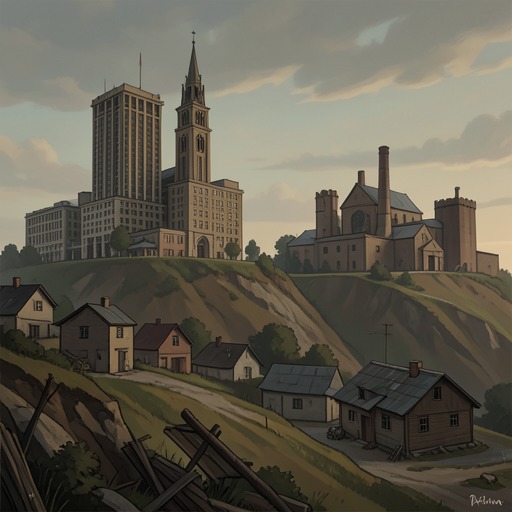
Angoulême rises on a steep rocky height above the meadows through which the Charente River winds. The rock extends toward Périgord as a long hill, ending abruptly beside the Paris-to-Bordeaux road and forming a promontory between three valleys. The river lies below this elevated old town, part of a landscape whose dramatic difference in levels is also a practical obstacle: the steep slope and the old ramparts that once defended the city constrain its expansion toward the water.
The fortifications recall Angoulême’s strategic importance during the French Wars of Religion, when the position mattered to both Catholics and Calvinists. Their former strength, however, becomes a source of later stagnation. The river-facing lowlands offer routes and resources that the upper town cannot easily absorb. The government attempts to encourage growth toward Périgord by building along the hill and preparing roads, but commerce has already gathered more decisively at the river’s edge.
The River as an Economic Artery
For centuries, paper mills had been established on the Charente River and its tributaries, where they could use the falls. The river is therefore not simply a boundary beneath the old city: it supplies the conditions for a durable industry and helps make the lower settlement a center of production. The movement of goods along the water also draws in the businesses that depend on transport and exchange.
L’Houmeau grows at the foot of Angoulême beside the river and the main road. Carriers, postal services, inns, wheelwrights, and public-carriage businesses cluster there, avoiding the difficult approaches to the hilltop. Tanneries, laundries, and other water-related trades remain close to the Charente River; brandy warehouses, stores for transported raw materials, and other transit businesses line its banks as well. The result is a prosperous, industrious lower town—effectively a second Angoulême, though still treated as an annex of the older city.
That division gives the river a social as well as an economic significance. The upper town retains government, the bishopric, the courts, and the aristocracy; below, commerce and money accumulate around the route formed by the river and road. The physical descent from the height to L’Houmeau thus crosses a sharp division of status and interest. The two parts depend on the same regional setting, yet the wealth generated along the water does not dissolve the rivalry between them.
A Setting for Private Conversation
The Charente River also appears in a quieter, more personal scene. After Lucien has gone to fetch a volume of poetry for a gathering at Madame de Bargeton’s, David Séchard is left alone with Ève Séchard. He is so embarrassed by the prospect of her praise that he can hardly speak and begins to twist his hat as if preparing to leave. Ève offers instead to spend the evening together and suggests a walk along the river, where they can talk about Lucien.
The invitation turns an ordinary riverside walk into a decisive gesture between them. David understands her tender tone as more than praise: it is the first favor of love. The riverbank offers a space away from the gathering and its social expectations, where their conversation can begin on the pretext of discussing Lucien. In this scene, the Charente River is associated not with commerce or danger but with the tentative opening of a relationship.
The River in Lucien’s Suicidal Crisis
Much later, the river becomes the first means of death Lucien considers. Having resolved to kill himself, he initially thinks of throwing himself into the Charente River. But as he descends the Beaulieu promenade for what he believes may be his final journey, he imagines the consequences of that visible act: the noise surrounding his death, his body returned on the water, and a judicial inquiry. He wants to avoid being found and exposed in death as he feels exposed in life.
A memory provides another possibility. During a day spent at Courtois Mill, Lucien had noticed a deep, still pool in a small stream. Its smooth surface concealed the depth beneath it, and its secluded banks suggested a death in which his body might never be recovered. He decides to head toward Marsac, intending to keep the circumstances of his death secret. The Charente River is thus not where he ultimately plans to drown himself; his imagined destination is a concealed pool elsewhere. The distinction matters: the river first brings death to mind, but his fear of discovery drives him away from the obvious scene.
On the road, Lucien is diverted from this plan when he encounters a darkly dressed stranger and is drawn into conversation. The encounter leads him away from the solitude he had sought and ultimately into a carriage with the stranger. Meanwhile, Ève finds Lucien’s farewell letter and fears that he has gone to end his life. She asks Marion and Kolb to make discreet inquiries and watch the course of the Charente River. Her search follows Lucien’s first stated idea, even though his intention had already shifted toward a hidden pool and his journey had been interrupted.
Narrative Significance
The river’s roles gather the novel’s contrasting geographies into one place. It helps explain why industrial wealth and transport concentrate below an old, socially exclusive city; it provides a setting where affection can emerge outside formal society; and it becomes the imagined witness to a private catastrophe that Lucien hopes to conceal. The Charente River is at once a source of work, a path beside which people can walk together, and a feared surface on which a body might return to public view. Its changing significance follows the characters’ changing relation to the world around them, without making the river itself a simple emblem of either hope or despair.