Cointet Brothers Printing Works
Illusions perduesThe Cointet Brothers Printing Works is the Angoulême printing and paper-making concern that turns the Séchard family’s long-established press into a subordinate competitor. Its rise rests not on a single advantage but on the coordinated use of political affiliation, institutional patronage, control of newspaper printing, and a shrewd assessment of David Séchard’s temperament. The firm’s success makes commercial rivalry in the novel a contest over access and influence as much as over presses and paper.
Origins and Position in Angoulême
The Cointet brothers are paper manufacturers who enter the local printing trade by acquiring the second printer’s license available in Angoulême. Until then, Jérôme-Nicolas Séchard had kept that potential rival inactive. He had not bought the license himself, in part because military crises under the Empire had suppressed industrial activity and in part because of his parsimony. The Cointets’ arrival therefore changes the structure of the local market: the old press is no longer protected by the absence of a competitor, and the Séchard family must now contend with a firm able to combine paper manufacturing with printing and bookselling.
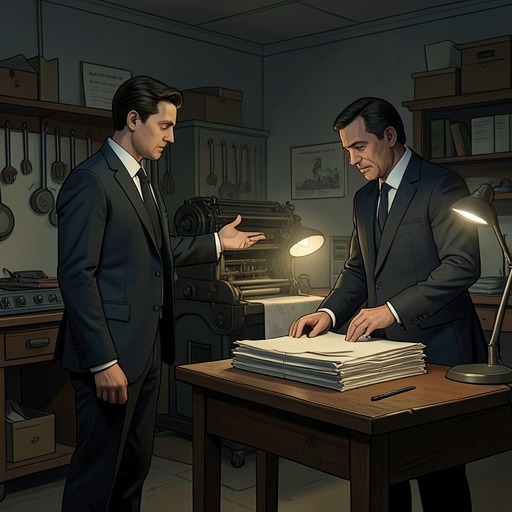
The contrast is sharpened by the setting. Provincial printing still relies on wooden presses, leather inking balls, and a stone bed for the type. The Séchard workshop is an old establishment, while the Cointets are described as printer-booksellers connected to the bishopric and later as owners of the department’s sole newspaper. The evidence does not attribute a particular printing technology to the Cointets; their advantage is instead shown through the scale and organization of their business, their command of valuable clients, and their ability to shape local demand.
Political Alignment and Institutional Clients
During the Bourbon Restoration, provincial merchants needed a public political identity to attract customers. David remains politically neutral, but the Cointets adjust their conduct to the market. They display Royalist sympathies, attend the cathedral, cultivate priests, and reprint religious books as demand for them grows. The business results are immediate: they gain ground in a profitable line of printing and secure the printing privileges of the Charente Prefecture and the Diocese of Angoulême.
The brothers also attack David through political insinuation. They depict him as a Liberal and an atheist, and invoke his father’s reputation as a former revolutionary, a drunkard, a Bonapartist, and a miser supposedly destined to leave his son a fortune. They present themselves as poor men with families to support, contrasting their supposed need with David’s expected inheritance and unmarried status. These claims help turn political identity into a commercial weapon: influenced by the accusations, the prefecture and bishopric transfer their printing work to the Cointets.
Once the brothers have institutional patronage, they establish a second newspaper of announcements. The Séchard paper’s advertising income is cut in half, and the old press is reduced to printing work for the town. The sequence shows how the Cointets convert political alignment into business access, then use that access to weaken a rival’s income and position.
Rivalry with the Séchard Printing House
The Cointets’ advantage is measured against the very different circumstances of David’s shop. The Cointet business is said to produce annual gains of fifteen to twenty thousand francs, while the Séchard Printing House brings in only about three hundred francs a month before expenses. After the foreman’s wages, Marion’s pay, taxes, and rent are deducted, David is left with about one hundred francs a month. The comparison is not simply between two levels of income: it exposes how little room David has to reinvest or withstand a decline in orders.
David and his foreman are absorbed in intellectual work and do not undertake the practical changes that might strengthen the business. They do not renew the type, acquire iron presses, or seek books from Paris that could be printed cheaply. The Cointets understand David’s character and, after their initial attacks, cease to slander him. Instead, they maintain the appearance of fair dealing while ensuring that his business survives only at a modest level. They send him ordinary town printing jobs, a form of apparent generosity that also prevents the establishment from passing into the hands of a more formidable competitor.
This policy makes the rivalry more subtle than outright exclusion. David continues to operate, but the Cointets’ calculation determines the narrow conditions of that survival. The narrative compares their simulated competition to a transport company feigning rivalry to forestall a genuine challenger. Their restraint is therefore strategic: they do not need to destroy the old press if they can keep it commercially weak and harmless.
The Charente Journal and the Sale
The brothers’ newspaper strategy culminates in their offer to buy The Charente Journal. They want to consolidate the department’s announcements and legal notices under their control, removing the remaining competition in that market. Jérôme-Nicolas Séchard recognizes their interest and intervenes in the negotiations, insisting that David should not give up the paper without securing a substantial price. He eventually extracts twenty-two thousand francs from the Cointets for the journal.
The sale carries a restrictive condition: David undertakes never to print another newspaper, on pain of thirty thousand francs in damages. In practical terms, the transaction ends the Séchard press’s chance to compete in newspaper publishing. The Cointets acquire the journal and its department-wide business, while David receives no comparable freedom to re-enter that field. The narrator treats the sale as the suicide of the old printing business, though the immediate bargain is negotiated by David’s father and the money is intended for the father’s own purposes.
Commercial Power and Significance
After the purchase, the Cointets own the department’s sole newspaper, the Courrier de la Charente, and their position in printing, bookselling, and paper manufacture gives them several linked sources of advantage. Their rise illustrates how business power in Angoulême depends on controlling institutions and distribution as well as producing printed matter. Religious work, public contracts, advertising, and newspaper ownership reinforce one another; each success helps secure the next.
The Cointets are consequently not just a rival workshop but the organizing force behind the market conditions that constrain David. They exploit the political neutrality that leaves him without a dependable client base, then profit from the modesty of his commercial ambitions. Their later decision to keep his press alive on selected town jobs reveals the same logic as their earlier campaign: David is most useful to them when he is neither a strong competitor nor entirely absent. The firm embodies a form of commercial dominance that can operate through patronage, reputational attack, contracts, and managed dependence, making the decline of the Séchard Printing House a result of both David’s limitations and the Cointets’ deliberate advantage.