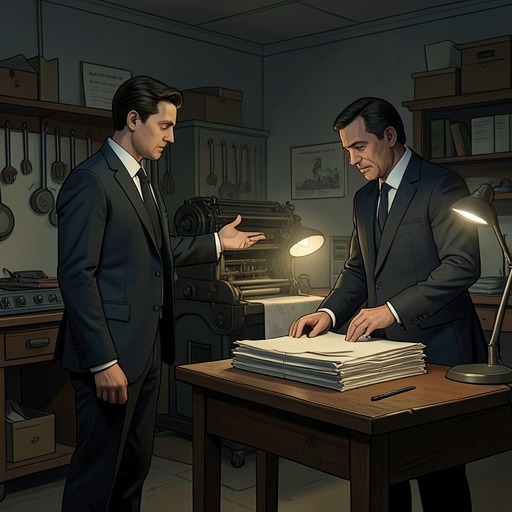
Cointet Brothers' Paper Mill
Illusions perduesCointet Brothers' Paper Mill is both the workshop of David Séchard’s papermaking experiments and the setting for the Cointets’ quiet appropriation of his technical knowledge. David’s progress there produces promising paper, but the mill’s commercial operations and the Cointets’ concealed methods turn his labor into an advantage for the partners who control the premises.
Setting and Industrial Context
The mill belongs to the Cointet brothers, manufacturers of paper whose interests extend beyond papermaking into printing and finance. Their establishment is therefore not simply a place where paper is made: it is part of a broader commercial enterprise, with access to newspaper contracts and the means to invest in machinery. That scale contrasts with David’s concentrated work on the materials and processes themselves.
The Cointets’ plans reach beyond Angoulême. During a trip to Paris to obtain a paper-making patent in his own name, Boniface Cointet arranged for Métivier to pursue newspaper-paper contracts, promising lower prices and better stock. Paris newspapers consumed two hundred reams a day, and Métivier secured their supply for ten years without competition. That market helps explain the mill’s strategic importance: David’s experiments take place inside a business already positioning itself to dominate paper supply.
David’s Experiments
David works at the mill with Kolb and Marion, keeping the preparation of his materials secret from other workers. In an early stage of the trials, he produces a first batch of paper without sizing that is superior to the newspaper paper then in use, followed by a fine vellum paper for high-quality printing. The Cointet printing works uses the latter for an edition of the diocesan prayer book, an early instance of the mill’s experimental output entering commercial production.
The investigation then narrows to the problem of sizing. For three months David sleeps at the paper mill and observes how different mixtures behave. He tests batches made wholly from his own ingredients against batches made wholly from rags, then works through combinations of materials and glues. During the first six months of 1823, he lives at the mill with Kolb, neglecting his food, clothes, and personal care as he pursues the process. By about August he has made tub-sized paper resembling a modern kind used for printers’ proofs, though the available grades remain uneven and the sizing unreliable. The result has cost ten thousand francs, and David believes the remaining difficulties can still be solved.
Partnership and Appropriation
The experiments unfold under the watch of Boniface Cointet, whom David has ceased to distrust. In fact, the Cointets use the ingredients David has identified while encouraging him to concentrate on tub sizing; meanwhile, they install continuous-paper-making machines and send thousands of reams of newspaper paper to Métivier. The mill thus divides David’s work from its commercial use: he labors to resolve a technical problem, while the owners quietly turn his materials and their own investments toward large-scale production.
Rumors in Angoulême and L’Houmeau claim that David is ruining the Cointets with costly experiments and producing bad paper. The Cointets allow this impression to circulate even as they equip the mill for manufacture. In September, Boniface tells David to stop and rest, presenting the experiments as a financial risk and invoking their agreement. David accepts the explanation, believing that his partner is right and failing to recognize how the mill’s activity has already moved beyond the account given to him.
The mill’s significance lies in this gap between invention and control. David’s secluded trials produce distinct paper grades and a promising method, but the Cointets’ command of the workplace, machinery, and commercial channels lets them benefit from knowledge he has developed there. The place that enables his work also exposes its vulnerability to partners whose interests are not the same as his own.