Daniel Bianchon
Illusions perduesDaniel Bianchon, also known as Horace Bianchon, is a physician whose career and friendships place him at the meeting point of professional ambition and intellectual solidarity. An intern at the Hôtel-Dieu de Paris when introduced, he is described from a later vantage as one of the leading lights of the École de Paris. Within Daniel d’Arthez’s circle, his character is defined not only by medical work but by a steadfast willingness to turn friendship into action.
Identity and Medical Career
At the time of his introduction, Bianchon is an intern at the Hôtel-Dieu de Paris. The narrative looks forward to his subsequent standing as a prominent figure of the École de Paris, marking a substantial ascent from hospital training to professional distinction. His medical identity also connects him to Desplein: when the circle needs money to help Lucien, Bianchon has taken work caring for a wealthy patient on Desplein’s behalf.
Place in the Circle
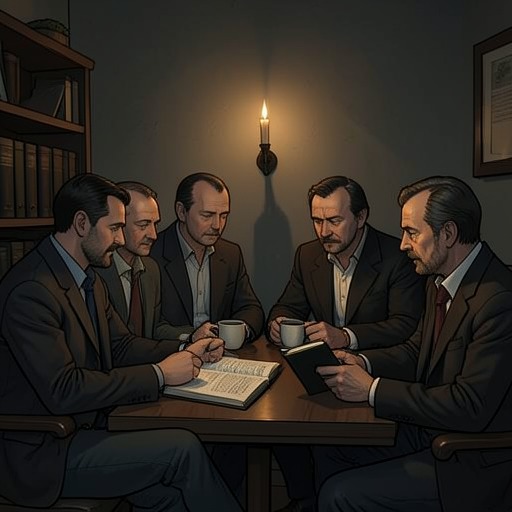
Bianchon belongs to the close-knit group that gathers at d’Arthez’s rooms and admits Lucien only after a period of reserve and private opposition. The circle’s members share their troubles and ideas freely, and their loyalty is more than a matter of affection: they treat an attack on one as an injury to all. Bianchon embodies this ethic as a practical, dependable presence among writers, artists, and thinkers whose vocations differ but whose mutual commitment binds them together.
When Lucien’s friends raise two hundred francs for him, Bianchon explains some of the work each member has undertaken to secure the money. His own contribution is a medical assignment: caring for a rich patient for Desplein. The account makes the assistance collective without making it abstract; the group’s generosity is assembled from specific acts of labor, and Bianchon helps turn that labor into immediate relief for Lucien.
Loyalty to Michel Chrestien
Bianchon’s friendship is tested most gravely after Michel Chrestien dies in 1832. Despite the danger of the undertaking, Bianchon joins d’Arthez, Léon Giraud, Joseph Bridau, and Fulgence Ridal in recovering Chrestien’s body from Saint-Merry and accompanying it at night to Père-Lachaise Cemetery. He takes charge of overcoming the practical obstacles, even approaching ministers and openly declaring his longstanding friendship with the dead man, who had been a federalist.
The friends mark Chrestien’s grave with a simple black wooden cross bearing his name in red letters. Their plain memorial suits the simplicity they wished to honor in him; Bianchon’s part in securing the burial gives their private bond a public and costly form. His conduct demonstrates that the circle’s solidarity persists when loyalty carries political risk, not merely when it offers companionship or help in hardship.
Character and Narrative Role
Bianchon is presented through deeds and professional promise rather than through an extended personal history. His work as a physician gives him a concrete means of helping Lucien, while his intervention for Chrestien shows the same readiness directed toward a friend in death. In both episodes, medical and social responsibility meet: Bianchon uses his labor and standing to serve people bound to him by friendship.
As a member of d’Arthez’s circle, he helps establish the contrast between the group’s durable intellectual fellowship and the precarious ambitions of literary life around it. His later eminence in medicine does not displace that fellowship; the recollection of his youth presents professional achievement and loyal friendship as parts of the same life.