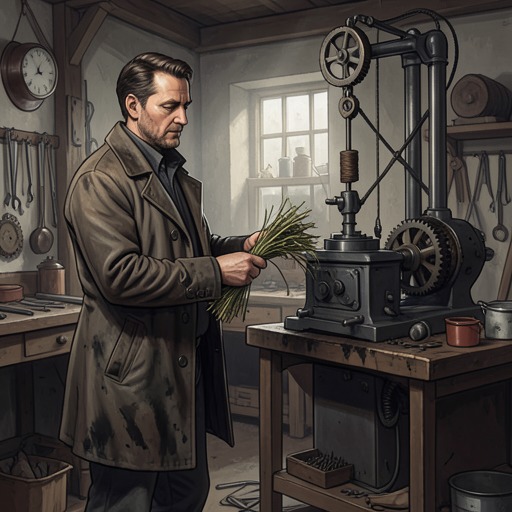
David’s Paper Made from Plant Fibers
Illusions perduesDavid’s Paper Made from Plant Fibers is the experimental product of David Séchard’s attempt to make inexpensive paper from plants that grow on marshes and poor land. Its significance lies both in the material itself and in the difficult passage from a fine-looking sheet to a repeatable, affordable manufacturing process: each improvement brings David closer to success, while also exposing how dependent that success is on money, testing, and others’ cooperation.
Materials and Early Samples
David’s first samples are made from common reed, arundo phragmitis, using an old horsehair sieve borrowed from Marion. He shows Eve Séchard white sheets of paper and estimates that a ream in large-rais in format could cost no more than five francs. The sieve leaves the different strengths of its hairs visible as watermark-like lines in the finished sheets, making the humble tool part of the paper’s appearance as well as its manufacture.
David sees the reed as only a first step. To keep the raw material cheap, he intends to use plants that can grow in marshes and poor soil, including nettles and thistles. The crucial problem, as he explains it to Eve, is not simply making paper but reducing the cost of the pulp and preparing the stalks effectively. He regards his method as unfinished: the preparation is not yet simple enough, and the price of the material remains a central obstacle.
The experiment also belongs to a longer history of attempts to find alternative paper materials. David recalls that Madame Masson had succeeded in turning printed paper into white paper in 1794, but at too high a cost. Around 1800 the Marquis de Salisbury tried using straw in England, while Séguin pursued the same material in France in 1801. David’s proposed nettles and thistles extend that search toward plants obtainable cheaply from otherwise poor ground; the challenge is to make their stems yield pulp that is both usable and economical.
From Plant Stems to Usable Pulp
The paper’s development depends on solving a specific material problem: plant-based pulp may lack binding strength. David observes that straw paper can be brittle, almost metallic, and sonorous. He seeks processes that will break down the stems effectively without relying on the transformations associated with macerating, weaving, or turning fibrous plants into thread, linen, or rags. The objective is not simply to substitute one plant for another, but to make the fibers bind into a sound sheet.
One of David’s advances emerges while he is preoccupied with his debts and the distress caused by Lucien de Rubempré’s actions. He has put a nettle stalk in water to try to prepare it for the pulp. As he walks from home to Petit-Claud’s office, he chews the softened stalk absent-mindedly; a ball of pulp forms in his mouth. He spreads it on his hand and recognizes a mixture better than the compositions he has previously obtained, because it addresses the weakness of binding in vegetable pulps. The discovery is accidental, but David immediately thinks in practical terms: a machine and a chemical agent might reproduce the effect he has achieved mechanically.
That discovery does not finish the work. At four in the morning, after making samples in the burning room and removing the traces of his operations, David brings his father about thirty sheets. Their fineness, whiteness, consistency, and strength satisfy the visible tests; the horsehair sieve’s stronger lines appear as marks in the paper. Old Séchard tests them as a printer would, touching them with his tongue, handling, crumpling, and folding them. Even with no evident defect, he withholds praise and asks what the sheets will be like under a press.
Sizing, Cost, and Proof
The remaining technical hurdle is sizing the pulp in the vat. David tells his father that he can size it there, but the glue does not penetrate evenly, leaving the paper rough like a brush. He also worries that the paper still costs too much. Old Séchard offers money only if David perfects the vat-sizing process, so the quality of the sheets and the availability of capital remain tied to one another.
David’s next breakthrough is announced in a secret letter to Eve, written on the first sheet produced by his process. He reports that he has solved vat sizing and calculates that a pound of pulp costs five sous, even allowing for special cultivation of good land for the plants. A twelve-pound ream would therefore require three francs’ worth of sized pulp. He also expects the lighter material to reduce the weight of books by half. The envelope, letter, and samples accompanying the message represent different kinds of paper, showing Eve that the result is not confined to a single sheet or finish. David connects the prospect of fortune with the relief it could bring the family, while Eve presents samples to his father and urges him to invest the value of his harvest.
The samples then receive a more commercial examination at the Cointets’ establishment. The brothers and Old Séchard inspect and test papers both sized and unsized, marked at prices ranging from three to ten francs per ream. Some have a metallic purity; others are as soft as Chinese paper; the samples show several shades of white. The range demonstrates that David’s process can produce materially different papers, but it does not yet establish that every result can be made profitably at industrial scale.
Scale, Investment, and Uncertain Promise
Old Séchard asks the Cointets to pay his son’s debts. They acknowledge that David is on a promising path, but distinguish promising samples from a successful large-scale manufacture. Their response identifies expenses and risks that the small experiments cannot settle: an invention patent would cost two thousand francs, travel to Paris would be necessary, and a prudent maker should first produce a thousand reams and risk entire batches to discover how the process performs in production. They also say that they cannot readily advance money, since they themselves buy rags for cash and still give their supplier bills.
The paper therefore remains both an achievement and a proposition. David has moved from reed sheets made with a borrowed sieve, through the problem of pulp binding and uneven sizing, to a claimed solution whose cost and variety can be demonstrated in samples. Yet the transition to a patent, large batches, and dependable manufacture still requires resources he does not possess. Its promise is measured not only by whiteness, strength, softness, or the prospect of lighter books, but by whether those qualities can survive the press and the economics of production.