Félicien Vernou
Illusions perduesFélicien Vernou is a journalist and literary critic in Paris whose acerbic reputation makes him both a gatekeeper and a weapon in the press’s contests over authors and public standing. He advises whether Lucien de Rubempré can enter a journalistic coterie, helps define the terms of that entry, and later joins the chorus that dismisses Lucien’s work. The novel also sets Vernou’s public severity against his constrained domestic life, while making clear that some of the harshest explanations of his character come from Étienne Lousteau, a rival with his own interests.
Identity and position in the press
When Lucien de Rubempré first encounters him, Vernou is introduced as a young man of talent whom Lousteau describes as malicious. Vernou quickly confirms his unsentimental view of literary ambition: when he learns that Lucien has come to sell a poetry collection, he says that anyone who had spent much time in the book trade would already have hidden the manuscript in the most remote corners of his home. The sneer makes the commercial obstacle plain. A writer’s confidence is no guarantee of a hearing, and Vernou treats hopeful submission as evidence of inexperience.
Vernou operates within a network where editors and journalists exchange access, favors, and attacks. Finot reports that Vernou has offered to forgo his salary for a year and pay twenty thousand francs for a third share in the paper; Finot, however, insists on remaining its absolute master. The proposal places Vernou not merely among the paper’s contributors but among those competing for a stake in its ownership. His financial offer also contrasts with the dismissive posture he adopts toward aspiring writers: in this world, literary authority is inseparable from bargaining power and control of the press.
Home life and the portrait of a critic
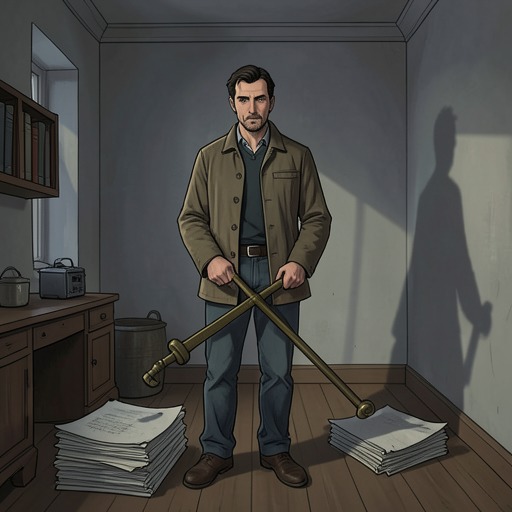
Lucien visits Vernou at his home on Rue Mandar and finds a setting sharply unlike the world of polished literary reputations. Vernou’s dining room has cheap brick-patterned wallpaper, regularly spaced decorative motifs, and aquatint prints in gilt frames. His two small children sit in high chairs with rails; Vernou himself wears a dressing gown made from the remnants of his wife’s printed cotton dress. The details place the critic amid domestic demands and plain surroundings rather than the glamour associated with influential journalism.
The narrator lingers on Vernou’s wife and the children, but the most consequential interpretation of the household comes through Lousteau. He presents Vernou as trapped in a marriage he resents yet cannot leave, and as a man whose literary gifts coexist with enduring dissatisfaction. Lousteau links that domestic frustration to Vernou’s envy of success and to the pointed, bitter quality of his writing. This explanation is not a neutral diagnosis: Lousteau is speaking to Lucien about a fellow journalist in a competitive trade, and his mockery is part of the scene’s portrait of the press. Still, the visit gives concrete force to the contrast between Vernou’s cultivated public criticism and his ordinary, crowded private life.
A small exchange turns this tension into personal animosity. When Vernou says he works beside his wife, Lucien replies that Vernou has a great deal of imagination. Vernou takes the remark as an insult and becomes Lucien’s mortal enemy. The slight is revealing precisely because it is so small: in a milieu where reputations are shaped by conversation, a casual observation can become a lasting grievance.
Alliances, politics, and mutual service
Lousteau tries to recruit Vernou to help establish Lucien in journalism. He frames Lucien’s admission as membership in a coterie whose members attack one another’s enemies in several newspapers and support one another in return. Vernou accepts the principle conditionally: if Lucien will join them, attack their enemies, and defend their friends, Vernou will speak for him that evening at the Opéra. The offer gives Lucien a route into print, but only through reciprocal service. Vernou’s influence is therefore practical and conditional, not an open endorsement of independent literary merit.
Vernou also voices suspicion of political and intellectual doctrines. On seeing Royalists and Liberals shake hands, he calls attention to their unexpected alliance. Later, during a discussion of the theories associated with the Cénacle, he warns that ideas treated as idle talk may eventually become gunfire or the guillotine. The juxtaposition shows his alertness to the political force that can gather around intellectual movements, as well as his habit of casting debate in sharp, threatening terms. His public position is not reducible to one party allegiance: he notices expedient alliances and stresses the possible consequences of ideas.
The press’s capacity to turn argument into commercial advantage is also visible around the journal with which Vernou is associated. Lousteau coaches Lucien in shaping criticism of Raoul Nathan’s book and of Dauriat’s publishing decisions, using national literary loyalties and established names to make the attack persuasive to readers. The episode demonstrates the rhetorical environment in which Vernou’s paper competes, though it does not make every element of Lousteau’s proposed strategy Vernou’s own. In this setting, criticism can address a book while also serving the interests of a journal, its allies, and its battles for influence.
Conflict with Lucien de Rubempré
Vernou’s relationship with Lucien shifts from reluctant potential sponsor to active critic. Their first exchange over Lucien’s poetry establishes Vernou’s contempt for an inexperienced author’s expectations. Later, when Lucien becomes entangled in journalism and literary rivalry, Vernou describes The Archer of Charles IX as anti-national, alleging that it sides with Catholic persecutors against Calvinist victims. He also invokes Lucien’s passion for gambling. The dispute grows more bitter over the following eight days, amid a wider rupture between Lucien and former allies in the press.
The circumstances complicate Vernou’s criticism. Lucien had relied on Étienne Lousteau, who owed him a thousand francs and had made secret arrangements with him, but Lousteau becomes his sworn enemy. Lousteau’s break is connected to the struggle over Florine: Raoul Nathan seeks to draw her away from Lousteau, and Lucien’s part in arranging an opportunity for her helps provoke condemnation from the journalists who regard friendship and alliance as obligations. Vernou’s attack on Lucien’s novel belongs to this increasingly partisan conflict. The novel’s political label does more than assess its subject; in a press culture organized around factions and personal loyalties, it helps turn literary judgment into a public weapon.
Vernou’s role as a critic is clearest when Lucien’s reputation collapses. Along with Merlin and other hostile journalists, he describes Lucien as having had nothing substantial in him beyond his novel and early articles, and dismisses the work Lucien now sends out as pitiful. The judgment circulates in publishing and theatrical circles and, without Lucien’s knowledge, damages him. A phrase of professional slang functions as a final verdict: it converts a contested assessment into something that seems authoritative and difficult to appeal. Vernou’s influence lies not only in what he writes, but in his participation in a community that can make a dismissal travel.
Narrative role and significance
Vernou is drawn through a productive tension between the precision of his professional attacks and the instability of the social judgments around him. His skepticism toward Lucien’s manuscript anticipates the obstacles facing any newcomer who must pass through commercial gatekeepers. His conditions for helping Lucien reveal that access to journalism comes with reciprocal obligations, while the later attack on Lucien shows how readily those obligations can be replaced by hostility.
At the same time, the account does not present Vernou’s bitterness as a simple, independently verified explanation of his work. Lousteau interprets him through domestic resentment and failed ambitions, but Lousteau’s portrait is itself a performance of journalistic malice. The gap between Vernou as a participant in the press and Vernou as described by his rival mirrors the larger world of the novel: criticism claims to judge literature, yet its authority is entangled with private grievance, financial interests, and alliances. Vernou’s consequence is therefore both personal and structural. He helps Lucien glimpse the means of entry into the press, then helps demonstrate how the same press can turn against him.