Hôtel de Bargeton
Illusions perduesHôtel de Bargeton is both a provincial mansion and the social salon of Madame de Bargeton, whose welcome to Lucien de Rubempré unsettles the hierarchy of Angoulême. The house’s modest, old-fashioned rooms stand in striking contrast to the immense social importance attached to entering them: for Lucien, admission is the threshold between an obscure provincial identity and the possibility of recognition.
A salon in a divided city
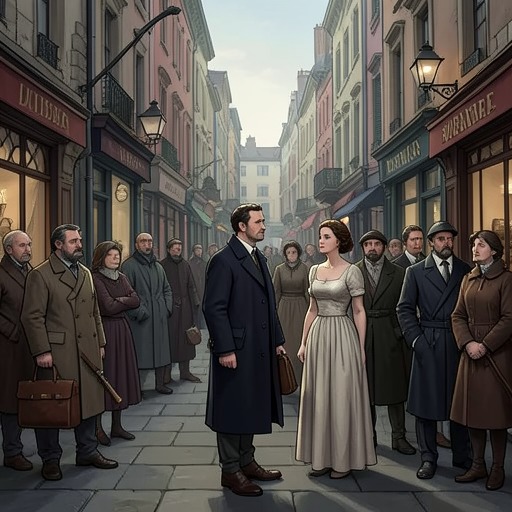
Madame de Bargeton’s gatherings occupy a conspicuous place in Angoulême’s closed social world. The city’s divisions reach beyond geography: the wealthy commercial quarter and the poorer nobility look down on one another, while inhabitants of L’Houmeau are treated as social outsiders. Under the Restoration, aristocratic exclusiveness sharpens these boundaries. In that setting, the Hôtel de Bargeton is difficult for strangers to enter, and its mistress’s acceptance carries more weight than the physical scale of the house might suggest.
Madame de Bargeton’s love of arts and letters makes her salon unusual in a town where such interests are regarded as eccentric. Its company is presented as a meeting place for literary and artistic reputations across political divisions. The salon’s cultural distinction does not dissolve the town’s class barriers, but it gives literary recognition the power to cross them: an obscure young man from L’Houmeau can be introduced there because his poetry has attracted notice.
An interior of provincial restraint
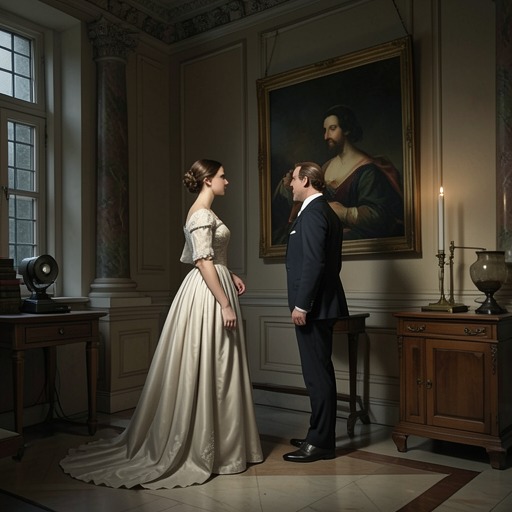
When Lucien arrives, the mansion proves far less grand than the image he has built of it. Its exterior is made of local soft stone, darkened and gilded by time. Inside, a cold, neat courtyard and restrained, almost monastic architecture lead up an old staircase with chestnut balusters; beyond a small antechamber and a dim large salon lies the smaller reception room where Madame de Bargeton sits.
The room’s furnishings register age and economy rather than aristocratic splendour. Carved panelling is painted grey, the door panels carry monochrome decoration, and faded red damask is sparsely set among old-fashioned furniture hidden beneath red-and-white checked covers. Madame de Bargeton receives Lucien from a sofa beside a round table covered in green cloth, lit by an old-fashioned candlestick holding two candles. The contrast is deliberate: the house is physically plain, but its social meaning has been magnified by the distance separating those admitted from those kept outside.
Entry, welcome, and resistance
The salon’s influence becomes visible when Madame de Bargeton makes Lucien’s admission a public act. She has him summoned to an evening gathering where guests play whist at four tables, welcomes him graciously, and presents him with the authority of a hostess who expects to be obeyed. Her decision defies the local aristocracy’s resistance to a young man whose origins make him socially suspect. The company accepts him grudgingly, treating his presence as an intrusion to be tested with impertinence; some dissidents even attempt to withdraw from Madame de Bargeton’s circle.
The controversy exposes the salon as a contested social space, not merely a private sitting room. Madame de Bargeton answers her visitors’ objections by defending the possibility that talent may arise among people of humble occupations and backgrounds. Her act does not erase the hierarchy, but it forces that hierarchy to respond to a new claim: literary ability can warrant entry where birth alone would have barred it. A rival gathering hosted by Amélie de Chandour further shows that social allegiance around the house can become a point of faction.
Lucien’s threshold
Before Lucien’s first visit, his sister, Ève Séchard, spends part of the family’s small reserve on fine shoes and a new suit, adds a carefully prepared jabot to his best shirt, and reminds him not to lean habitually against furniture. These preparations make the approach to the Hôtel de Bargeton a lesson in the visible codes of class as well as a journey to a particular house. Ève sees his admission as the dawn of prosperity; the narrative instead marks the beginning of a movement in which ambition will strain their simple loyalties.
The mansion’s decisive narrative function is therefore to make social access concrete. Its worn rooms, guarded entrance, and commanding hostess give physical form to the barriers separating Angoulême’s groups. Once the door opens to Lucien, the house becomes the scene of his first public recognition in aristocratic society—and of the resistance that recognition provokes.