Hector Merlin
Illusions perduesHector Merlin is a journalist who treats literary reputation as a contest of calculation, injury, and access to power. Small, dry, and habitually watchful, he makes himself useful by exploiting divisions and adapting to political and commercial opportunity. His dealings with Lucien de Rubempré trace the career’s central irony: Merlin teaches Lucien to succeed by wounding others, collaborates with him in manufactured criticism, and eventually joins the press campaign that helps destroy him.
Identity and Character
At a dinner attended by journalists and writers, Merlin is described as the most dangerous journalist present. He is physically slight, with pinched lips, but his ambition is immense and his jealousy seemingly without limit. He takes pleasure in the misfortunes around him and profits from divisions he has helped foster. The portrait combines a sharp intelligence with little force of will: where sustained purpose is lacking, instinct guides him toward places illuminated by money and power.
His method is not simply to attack. Merlin watches for openings created by other people’s quarrels and turns their disagreements to his advantage. The resulting portrait makes opportunism a practical skill: the journalist need not command the world around him if he can identify where influence and profit are gathering.
Advice to Lucien
Merlin and Lucien dislike one another from their first encounter. The narrator explains their mutual recognition through a pointed reversal: Merlin voices aloud what Lucien is thinking privately. Yet by dessert, the two men appear to be bound by the most touching friendship, while each continues to believe himself superior. The company’s conviviality does not erase rivalry; it gives rivalry a flattering social disguise.
When Lucien asks why Merlin is not laughing, Merlin warns him that the literary and journalistic worlds do not offer dependable friends. Alliances shift with circumstances, he says, and people use against one another weapons ostensibly reserved for their common enemies. Good feelings, in his account, bring no reward. He advises Lucien to become malicious by calculation and to wound everyone’s pride—including that of friends—if he wants to make a fortune in literature. Even in love, Merlin recommends leaving a mistress in tears so that she will remain attached. The counsel compresses his social theory into a technique: create hurt, then let the injured person’s attention and response serve the aggressor’s purposes.
Merlin’s advice is both a warning about the press and an instruction in its conduct. It offers Lucien a cynical rule for interpreting the apparent warmth of professional camaraderie, but it also presents cruelty as something one can deliberately practice. The later course of their association tests that rule in action: the same world that teaches Lucien to hurt others proves ready to make him its target.
Journalism and Manufactured Criticism
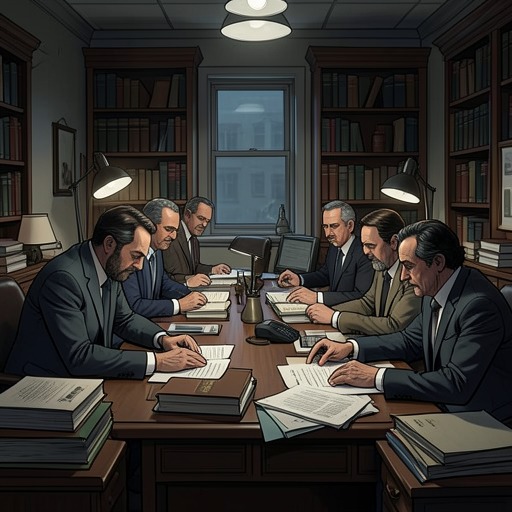
Merlin participates in a collective attack on Nathan’s book. After Lousteau and Lucien agree to mount a full-scale assault, the journalists gather in the newspaper’s attic office on Rue Saint-Fiacre. Merlin takes a slip of paper and drafts a notice announcing that a second edition of Nathan’s book is expected. The notice claims that the paper had intended to remain silent but must now respond to the appearance of success, shifting attention from the work itself to the supposed tendency of young literature. Its irony allows the paper to present an attack as reluctant necessity while using the book’s apparent success as its pretext.
The group’s treatment of signatures further reveals how criticism operates as a collective arrangement rather than a straightforward expression of conviction. Lousteau tells Lucien that his article is unsigned, while Félicien Vernou has placed a C beneath it so that Lucien can sign pieces in Vernou’s paper, associated with the pure Left. In Merlin’s Centre-Right paper, Lucien can use an L. The group’s maxim is that attacks remain anonymous while praise can be signed. Merlin’s editorial world thus accommodates more than one political alignment, and a writer’s signature can be assigned according to the outlet and the purpose of the piece.
At a later gathering, Merlin says that restoring the right of primogeniture accords with his own opinions. Finot nevertheless cautions that the party might regard Merlin’s involvement as compromising, and proposes that Vernou write a well-paid brochure on the subject while its sponsors remain concealed. The exchange places Merlin’s stated conviction beside the group’s willingness to manage political advocacy through secret sponsorship. The evidence establishes his position in the discussion, not that he wrote the proposed brochure.
Political Alliances and the Campaign Against Lucien
During the winter, Merlin and Théodore Gaillard find the capital needed to establish Le Réveil, whose first issue appears in March 1822. The business is conducted at Madame du Val-Noble’s salon, where bankers, aristocrats, and royalist writers meet to handle affairs that cannot be settled elsewhere. Merlin is promised the editorship, with Lucien as his right hand; Lucien is also promised the feuilleton of a ministerial paper. His change of political position is being prepared quietly amid the pleasures of his life, while he expects ministerial generosity to help resolve his financial troubles.
Merlin’s alliance with Lucien, however, does not protect Lucien when professional and financial interests turn against him. After a dispute involving the secret of an operation against Matifat, Finot blames Lucien for preventing him from making fifty thousand francs, and Lousteau resents the loss of a thousand écus. Vernou, who already hates Lucien, takes responsibility for keeping him under attack. The episode reveals a press circle in which political labels and public friendships coexist with private bargains, money disputes, and retaliatory grievance.
For the first fifteen days of the ensuing assault, Lucien writes a torrent of articles for royalist newspapers and shares the burden of criticism with Merlin. Martinville is the only journalist said to serve Lucien without ulterior motives; the arrangements among the others have been sealed amid jokes and drinking. At the Vaudeville theatre, journalists from opposing camps continue to fraternize even as Lucien is treated with coldness. The social warmth of the press circle persists, but no longer extends to the man being targeted. Merlin’s early lesson about conditional friendship has become the structure of Lucien’s isolation.
The Failed Novel and Merlin’s Return
After Lucien falls gravely ill, Hector Merlin visits him despite Coralie, Bérénice, and Bianchon trying to keep supposed friends away. By then the publishing house Fendant and Cavalier has failed, and Lucien’s novel has been sold off cheaply; copies are being hawked at a fraction of their original price. The failure is made worse by the newspapers’ silence, while Martinville’s favorable article cannot overcome hostility toward Lucien as an editor of royalist papers.
Merlin tells the dying Lucien, drop by drop, the bitter news of the publishing disaster—the trade’s term for the ruinous operation in which Fendant and Cavalier had involved the book of a beginner. His visit brings the novel’s commercial collapse into the sickroom, where the distinction between professional candor and cruelty is difficult to separate. Elsewhere, the narrator identifies Merlin as editor-in-chief of Aristarque, Oriflamme, and Le Drapeau Blanc, placing him among the press figures whose hostility and rivalries compound Lucien’s defeat.
Merlin’s significance lies in the consistency with which he converts intimacy into a provisional arrangement. He can offer a lucid account of journalism’s harsh rules, collaborate in a staged attack, accept a role in a new political newspaper, and later bring the news of a former associate’s ruin. His career does not make him the sole cause of Lucien’s downfall; it shows how easily the press’s alliances shift when ambition, resentment, and money begin to pull in different directions.