L’Houmeau
Illusions perduesL’Houmeau is the thriving low-town quarter below Angoulême, a place of workshops, river commerce, and precarious livelihoods that stands in social opposition to the old city above. The novel makes this divide more than a matter of elevation: it governs who is admitted to respectable society, whose labor sustains the region, and how the ambitions of Lucien de Rubempré and David Séchard are received. L’Houmeau is at once their home ground and a social position they struggle to escape, with consequences that continue to follow them when they return to it.
Setting and economic life
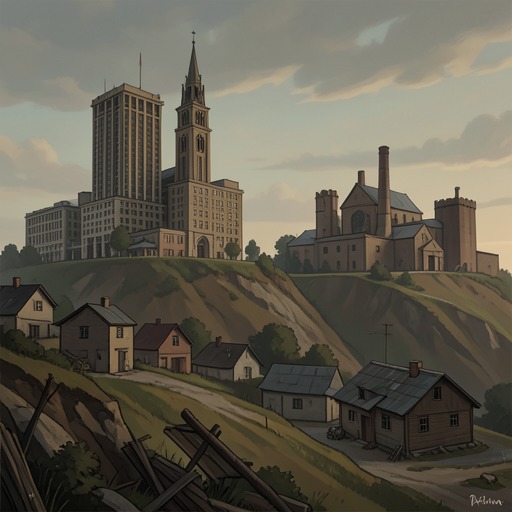
L’Houmeau grew at the foot of Angoulême’s steep rock, along the Charente River and the main road between Paris and Bordeaux. The old city’s walls and difficult approaches had once made it a defensible strategic point; the same terrain later restricted its growth toward the river. Commerce developed on the more accessible ground below. By the time of the story, L’Houmeau had expanded into a substantial industrial settlement, effectively a second town beside the historic one.
The river and road concentrated different kinds of work there. Papermaking had been established along the Charente and its tributaries for centuries, where the waterways supplied power. Transport businesses, coach services, inns, wheelwrights, tanneries, laundries, warehouses for brandy, and depots for goods arriving by river gathered nearby. The quarter’s identity rests on this practical geography: industries that needed water, transit, and access to the main route belonged below the rock, not within the walls of the old town.
That economic activity did not translate into equal social standing. The upper city retained government offices, the bishopric, the courts, and the aristocracy; below, L’Houmeau represented commerce and money. The narrative presents the two districts as mutually resentful, despite the lower quarter’s growing wealth. A merchant of the upper town could dismiss a tradesman from the faubourg simply as a man of L’Houmeau, making the place-name a marker of class as much as residence.
A boundary between social worlds
The division between L’Houmeau and upper Angoulême is reinforced by custom. The old families above the rock preserve an unusually closed social circle, marrying among themselves and resisting the admission of newcomers even when those families have lived locally for generations. Their caution extends to education and travel: sending a child to Paris is treated as a risk of social and moral loss. Meanwhile, the commercial quarter’s prosperity is met with disdain from above, and its residents answer with their own contempt for the poorer nobility.
The political climate of the Restoration intensified this antagonism. As provincial nobles became more closely aligned with government and more exclusive, the people of L’Houmeau experienced the social distance as a form of exclusion. The broader account connects such accumulated resentments to the force of the 1830 uprising, suggesting that the sharp opposition between upper and lower town was part of a wider instability in French society.
Against this background, a young man from L’Houmeau entering the salon of Madame de Bargeton is described as a small revolution. Lucien’s literary ambition offers a bridge across the divide, but the bridge is fragile: artistic distinction may attract attention without erasing the stigma of his origins. The quarter therefore helps explain why his social ascent appears both possible and precarious.
Home, work, and family
The Chardon household’s circumstances give L’Houmeau a more intimate dimension. After the death of Lucien’s father, the family’s pharmacy was sold. His mother, Madame Chardon, concealed her identity under the name Madame Charlotte while earning a living caring for women in childbirth; his sister, Ève Séchard, worked for a fine laundress nearby. Their combined income, including a small annuity, had to support three people, and nearly all of it was consumed by Lucien’s needs. They lived in a modest room above the successor pharmacist’s laboratory, at the back of an inner courtyard. Lucien occupied a cramped attic room there.
The quarter is also where David’s friendship with Lucien begins to take on material weight. Former schoolmates in Angoulême, the two young men meet again when Lucien is close to despair. David offers him forty francs a month and proposes to teach him the printer’s trade, although he has little practical need for another foreman. Their friendship deepens through their contrasting temperaments and ambitions: Lucien turns toward literary fame, while David, despite his poetic nature, is drawn toward exact sciences and their industrial applications. Their shared sense of being intellectually capable yet socially disadvantaged binds them together.
Work and affection bring the families into one another’s lives. When David refuses to accompany Lucien into Madame de Bargeton’s social world, he uses a walk beside the Charente to voice his concern that Lucien’s ambition may outrun his resources. He fears that the young poet will spend time and money on society, lose the habits of work, and depend on a woman whose attachment may not last. Later, after David and Ève become engaged, the family shares a night of joyful plans: David promises that Ève’s mother will no longer need to work as a caregiver and will live with the couple and Lucien. Their hopes are generous, but the household’s dependence on Lucien’s prospects also exposes it to risk.
Ambition, return, and local conflict
For a time, Lucien’s rise seems to carry him away from L’Houmeau. He changes from the poor young man in the attic to Monsieur de Rubempré, lives in greater comfort in upper Angoulême, and is received in the social circles of Madame de Bargeton and the bishopric. His mother and sister continue to subsidize his ambitions, while he expects his historical novel, The Archer of Charles IX, and his poems to repay their sacrifices. The contrast between this new standing and the family’s modest means makes his ascent dependent on hopes not yet secured.
His later return reverses the direction of that journey. After walking back from Paris in worn clothes, Lucien passes through L’Houmeau and sees that the old family name has been removed from the pharmacy, which has been repainted and relabeled. At the Séchard home in Angoulême, his mother and sister greet him with an embrace, but the changed expression on Ève’s face and the absence of David make the reunion painful as well as joyful. L’Houmeau is not simply the place he left behind: its familiar streets bring his changed circumstances into view, while the family’s hardship gives his return a cost beyond wounded pride.
The quarter’s commercial networks also enter the conflict over David’s printing and papermaking work. Cérizet, once employed by David, becomes friendly with workers at the competing Cointet establishment. He defends David’s old wooden presses in workplace banter, boasting that David is pursuing a secret capable of outstripping other printing houses. Information about Ève’s commercial venture reaches the rival firm, whose owners view her possible success as a threat and seek to discourage her. The episode links ordinary workshop loyalties and rivalries to a larger contest over who will control printing and paper production in the district.
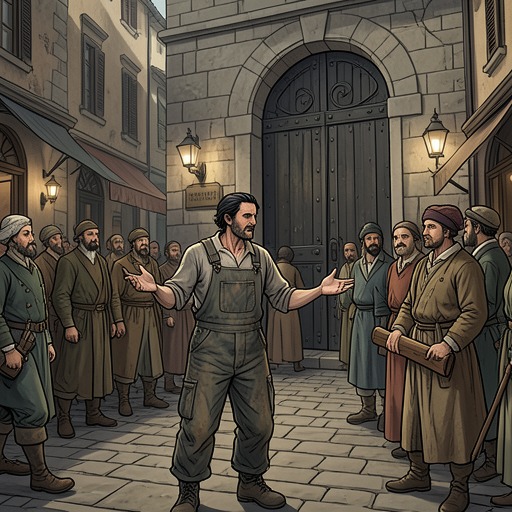
Political ambitions complicate that contest. Petit-Claud, a lawyer born to a tailor in L’Houmeau, helps organize the lower town’s liberal opposition and argues that it should not leave the department’s press under the control of a single competing concern. He proposes raising money to acquire the Séchard printing establishment, using a loan to secure influence over its owner, and draws Cérizet into the plan. In the novel’s later scenes, local crowds and workers become part of the public spectacle surrounding David’s arrest. The district’s commercial life, political organization, and class divisions thus converge in the family’s crisis.
Narrative significance
L’Houmeau gives social geography an active role in the story. The slope between it and upper Angoulême measures the distance between labor and inherited status, but the people who cross that boundary do not leave its meanings behind. Lucien’s entry into an aristocratic salon can briefly make his origins seem surmountable; his return through the quarter, after failure in Paris, restores the material circumstances his earlier ambitions had obscured. For David and Ève, meanwhile, L’Houmeau is tied to work, family obligation, and the struggle to make a livelihood from printing.
The quarter’s prosperity is also inseparable from its vulnerability. River commerce and industry make L’Houmeau a source of wealth, yet its social subordination and its competition over presses and paper leave its residents exposed to unequal power. By bringing household poverty, literary aspiration, business rivalry, and political organizing into the same setting, the novel makes L’Houmeau more than a backdrop: it is the place where the ambitions of the family meet the economic and social structures that can sustain them, exploit them, or force them back into view.