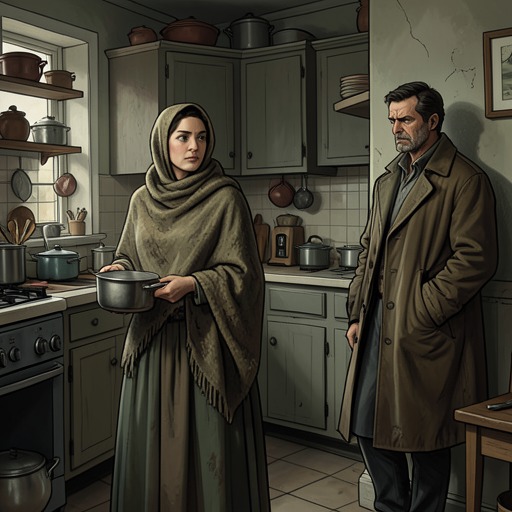
Madame Chardon
Illusions perduesMadame Chardon is the widowed mother of Lucien de Rubempré and Ève Séchard, a woman whose steadfast care holds together a household repeatedly exposed to poverty and disappointment. Once connected by marriage to the aristocratic Rubempré family, she lives in L’Houmeau on the earnings of difficult, low-paid work. Her story traces the cost of protecting a son’s ambitions: she conceals her occupation to spare him embarrassment, welcomes the future husband who joins the family’s fortunes to theirs, and later faces the consequences of Lucien’s actions without ceasing to love him.
Identity and family background
Madame Chardon was the last surviving member of the Rubempré family when Monsieur Chardon, a former surgeon in the republican armies, married her. He had left military service after an injury and later worked as a pharmacist in Angoulême. His scientific ambition centered on a treatment for gout, and he spent years studying the disease and developing a remedy adapted to different temperaments. He died in Paris while seeking approval for his work from the Académie des sciences; the discovery that he had hoped would secure the family’s future brought them no fortune.
Monsieur Chardon had spent the proceeds of his pharmacy on educating his children, Lucien and Ève, while nurturing expectations of distinction that his death abruptly ended. The family’s inheritance was therefore not wealth but the burden of supporting those aspirations with very limited means. Madame Chardon’s circumstances had also changed her appearance and habits, but she and her children met their hardship with courage. The contrast between her aristocratic descent and the household’s precarious existence would later make her paid work a source of social gossip.
Work, poverty, and a concealed name
After her husband’s death, Madame Chardon sold the pharmacy on the Grand Rue in L’Houmeau. The sale provided an annuity of three hundred francs, insufficient for her own maintenance. She took paid work caring for women in childbirth, earning twenty sous a day; her considerate manner made her welcome in wealthy households. To spare Lucien the discomfort of seeing his mother in what the narrative describes as a lowered social position, she worked under the name Madame Charlotte. Clients arranged her services through Postel, the pharmacist who had succeeded Monsieur Chardon.
Ève also contributed to the household, working for a fine-laundry business and earning about fifteen sous a day. Her position in the workshop gave her a degree of authority among the workers, but the family’s combined income remained meagre. Together with Madame Chardon’s annuity, their earnings amounted to about eight hundred francs a year for three people’s food, clothing, and lodging. They rented a very inexpensive home in L’Houmeau from Postel’s successor, above the laboratory and at the back of an interior courtyard. Lucien occupied a cramped attic room, while most of the household’s limited resources went toward him.
The concealment could not protect the family from public scrutiny indefinitely. When Lucien’s connection with Madame de Bargeton became a subject of scandal in Angoulême, Sixte du Châtelet disclosed that Madame Charlotte was Lucien’s mother and had worked as a birth attendant. The news circulated as a social joke and was repeated to Madame de Bargeton by Amélie de Chandour. Madame Chardon is not shown responding to the gossip, but the episode makes her hidden labor part of the public judgment directed at her son: the family’s economic necessity becomes an instrument for measuring his social standing.
A mother’s faith in Lucien
Madame Chardon and Ève place extraordinary trust in Lucien’s future. The narrative presents their devotion as unreserved, even though the household’s meagre income is largely absorbed by his needs. Their faith sustains the young man through hardship, but it also makes his ambitions a family undertaking: the money and labor that keep him afloat are drawn from the same household that has little to spare.
Lucien, for his part, remembers his mother as a woman of dignity despite her poverty, and as someone who believes him better than his cleverness alone would suggest. That recollection gives his ambition a moral counterweight. When he considers abandoning the family’s simple life for advancement through social connections, he also remembers Madame Chardon’s trust, Ève’s resignation, and the assistance he owes David Séchard. His return to those memories does not settle his character; he continues to move between gratitude and self-interest. Madame Chardon’s belief in him therefore stands both as a source of emotional support and as a measure of what his choices risk betraying.
Ève’s betrothal and the family’s precarious hopes
When David Séchard asks for Ève’s hand, Madame Chardon takes her daughter’s hand and places it in his, welcoming the match with joy. The moment is intimate but unsentimental about the family’s position: she warns David that they are in misfortune and fears it might be contagious. David answers that they will become rich and happy, and says that she will no longer need to work as a birth attendant but can live with Ève and Lucien in Angoulême. The family then talks through its hopes together, imagining future happiness before those plans have been secured.
That welcome reflects Madame Chardon’s willingness to receive David not merely as a prospective son-in-law but as someone entering the family’s shared struggle. Later, when Lucien is about to leave for Paris with Madame de Bargeton, the household’s financial dependence becomes painfully explicit. Madame Chardon reports that Postel is willing to lend one thousand francs for only six months and requires a bill accepted by David, since Lucien offers no security. David is present as the terms are delivered. The family falls silent, ashamed of how much it has already taken from him; David’s tears and the small bridal jewels he had bought for Ève give the debt a personal as well as financial cost.
The arrest and Madame Chardon’s final judgment
The consequences of Lucien’s later actions reach the family in a more devastating form when a forged letter leads to David’s arrest. After Ève collapses, Lucien is forced to tell his mother that he caused the arrest. Madame Chardon answers him with a look the narrative describes as carrying her curse; he withdraws and locks himself in his room. Her response is brief, but it marks the collapse of the trust on which his place in the family had depended. The injury to the household is not presented as an abstract misfortune: David has been taken away, Ève is overcome, and Lucien must confront the immediate consequence of his own act.
Later, as the family’s financial affairs are being settled and money is assembled, Madame Chardon remarks that her son seems fated to bring disaster even when he is trying to do good. The comment echoes Lucien’s own description of himself in a letter to Ève as the family’s fatal member, whose affection has repeatedly produced harm. Her words do not erase his responsibility or turn his attempted good into a successful repair. Instead, they register the family’s painful pattern: Lucien can love those closest to him and still endanger them. Madame Chardon’s role is consequently not only that of the devoted mother who sustains his early hopes, but also the witness who names the cost when those hopes and his conduct collide.