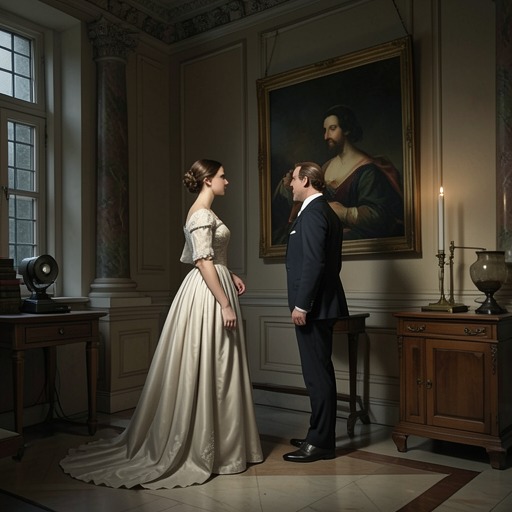
Madame d'Espard
Illusions perduesMadame d'Espard is a powerful Parisian aristocrat and cousin of Louise de Bargeton, whose brief support for Louise's circle becomes a test of who may pass as a member of high society. At the Opéra, she initially welcomes Lucien de Rubempré and gives him a conspicuous place in her box; once his parentage is disclosed, she withdraws that welcome and condemns his claim to the name Rubempré. Her reversal turns a social introduction into a lesson in the force of inherited status.
Identity and Social Position
Madame d'Espard belongs to the aristocratic world whose influence depends not only on personal connections but on strict boundaries of name, wealth, and birth. She is related to Louise through her husband's family, and her position makes her patronage valuable: she can receive Louise into Parisian society and present her to the people whose approval matters there.
That power reflects a broader social order already visible in Angoulême, where the upper town's noble families guard their exclusivity and look down on the commercially prosperous inhabitants of L'Houmeau. The divide is not merely geographic. Social acceptance depends on belonging to the right circle, and even a family connection can be conditional when reputation or rank is at stake. Madame d'Espard acts as an arbiter of those boundaries in Paris.
Patronage and Family Circumstances
Madame d'Espard's support for Louise is shaped by her own household circumstances. Her husband has withdrawn from society and takes no part in his affairs, political life, family, or marriage. Left to manage her position herself, Madame d'Espard seeks the world's approval and is glad to take her husband's place as the family's representative. She intends to make her patronage visible, in part so that his failings will appear more plainly by contrast.
Her welcome is therefore both family assistance and a public act. For Louise, a relative's protection offers an entry into the Parisian world; for Madame d'Espard, the gesture displays her own standing and authority. The protection is not unconditional, however. Once Louise's association with Lucien threatens her social credibility, Madame d'Espard urges her to distance herself from him.
The Opéra and Lucien's Exclusion
At the Opéra, Madame d'Espard first appears to accept Lucien as Louise's protégé. She addresses him courteously as Monsieur de Rubempré, invites him to sit at the front of the box, and presents him to her cousin. The place matters: Lucien had been sitting behind the women, in the shadow, and the invitation makes him visible in one of the theater's most conspicuous social settings.
That welcome collapses when the people around the box disclose that Lucien is the son of an apothecary named Chardon, not an established aristocrat. Madame d'Espard quietly asks Louise whether he truly bears the name Rubempré and then presses her for his father's name. She explains that the king alone can grant the family name by ordinance to the son of a woman from the Rubempré family, and that such a favor requires great wealth, services, and powerful protection. In her assessment, Lucien's conspicuously fashionable but ill-judged clothes signal that he is neither rich nor a gentleman; she also judges his bearing, speech, and education inadequate to his claimed position.
Madame d'Espard then takes Louise away from the box. In the carriage, she admonishes her cousin not to concern herself with the son of an apothecary until he has actually become famous, and asks whether he is either Louise's son or her lover. Louise, relieved that she has not yet compromised herself further, disavows him. Lucien is left behind without understanding why the women have abruptly abandoned him. The scene exposes the gap between adopting an aristocratic surname and possessing the social credentials that make it credible.
Influence and Narrative Role
Madame d'Espard's judgment is not simply a private opinion about Lucien's clothes or manners. It enforces a system in which royal recognition, family lineage, wealth, education, and social polish determine who may claim aristocratic standing. Her welcome can make Lucien briefly visible; her withdrawal shows how quickly that visibility can be revoked when his background is known.
Later, the society associated with Madame d'Espard is described as alarmed by reports of Lucien's wit. The Duc de Rhétoré, acting at Louise's request to sound out the journalist, helps bring that concern into the political and journalistic world Lucien is entering. The contrast is telling: the young man dismissed at the Opéra as an uneducated impostor becomes someone whose influence society watches. Madame d'Espard's place in the story thus marks both the rigidity of inherited social barriers and the changing power of reputation.