Manuscript of The Archer of Charles IX
Illusions perduesThe Manuscript of The Archer of Charles IX is Lucien de Rubempré’s first major work of fiction and the material focus of his early efforts to enter Parisian literary life. Conceived as a historical novel in the manner of Walter Scott, it begins as an ambitious but imitative book, encounters cautious and calculating booksellers, and is then reshaped through Daniel d’Arthez’s sustained editorial work. Its changing prospects reveal how literary aspiration depended not only on talent, but also on revision, money, and access to publishers.
A Historical Novel Seeking a Form
Lucien presents the manuscript to Vidal and Porchon as a historical work modeled on Walter Scott. Its subject is the conflict between Protestants and Catholics, which he frames as a struggle between two systems of government in a period when the throne was seriously threatened. He has taken the Catholic side. The pitch gives the novel a political and religious design, while its declared model places Lucien within a popular historical-fiction tradition.
At first, the book’s title impresses Doguereau, an older bookseller, who asks Lucien to summarize the subject. He sees promise in the novel’s style, its exaggerated characters, and the force of its imaginative first conception. But the manuscript’s initial form does not yet distinguish Lucien from his model. Daniel d’Arthez later identifies its structural dependence on Walter Scott: it begins with extended conversations to establish the characters, then adds description and action, delaying the dramatic antagonism until late in the process.
D’Arthez’s advice is practical as well as aesthetic. He urges Lucien to reverse that sequence, enter the action earlier, replace diffuse preliminary conversations with description, and make dialogue the culmination of the preparations. Rather than copy Scott’s arrangements, Lucien should vary his plans and find a distinct manner for French history. D’Arthez also points him toward the novel’s potential subject matter: historical settings could bring into view costumes, furniture, houses, interiors, and private life, while the story could revive disputed reputations and portray passions with greater variety. The manuscript thus becomes a test of whether Lucien can turn imitation into an original historical form.
First Encounters with the Book Trade
Lucien first offers the book to Vidal and Porchon. Their response makes clear that their business is not straightforwardly that of literary publishers: they describe themselves as commission booksellers and say that books undertaken on their own account are reserved for established names. Their interest, as they present it, lies in serious works such as histories and summaries. Lucien’s youthful authorship and fictional manuscript do not fit that commercial category, and the encounter offers no immediate path to publication.
Doguereau, by contrast, comes to Lucien’s room after being impressed by the work. He initially intends to pay one thousand francs for the full property of the novel and to bind Lucien to a series of books. On seeing that Lucien lives on the fourth floor, he revises his estimate: first to eight hundred francs, then to six hundred, reasoning that a handsome young writer with too much money might become dissipated and stop working. When he makes his offer, he names four hundred francs for the novel, paid in cash, and proposes a six-year agreement requiring two novels a year. If the first sells out within six months, the following books would bring six hundred francs apiece. The seemingly secure livelihood is therefore tied to a long commitment and terms set by the bookseller.
Lucien’s hopes outrun the offer. After his earlier visit to the booksellers, he imagines himself earning at least twelve hundred francs, enough to remain in Paris for a year and prepare more books. Doguereau’s visit instead reveals how quickly an interested buyer can translate literary promise into a lower price and a continuing claim on the author’s work. The manuscript attracts attention, but attention is not the same as an advantageous publication agreement.
Revision in Le Cénacle
The manuscript remains in circulation as a work in progress. By the beginning of October, Lucien has spent the rest of his money on a little firewood and is still absorbed in revising it. He is reluctant to tell his new companions in Le Cénacle that he is destitute. When he goes to the Rue du Coq hoping to sell the novel to Doguereau, he fails to find him. The episode leaves the manuscript suspended between artistic labor and the urgent need for money: it is being rewritten even as its author searches for a buyer.
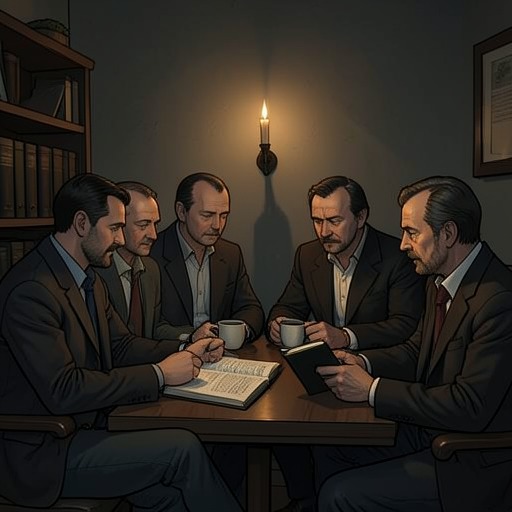
D’Arthez’s involvement extends beyond general advice. At Flicoteaux, where the two men have taken to sitting together and discussing literary subjects, methods of presentation, and the construction of beginnings and endings, D’Arthez holds the manuscript and continues correcting it. He rewrites chapters, contributes passages described as beautiful, and works on a preface. The novel’s authorship is therefore represented as collaborative in its making, even though it remains Lucien’s work: the manuscript carries the intervention of a friend whose judgment and labor help give it a stronger shape.
This revision takes place amid shared poverty rather than in comfortable study. When Lucien runs out of resources, D’Arthez burns fuel for him and bears hardship without complaint. The practical support surrounding the manuscript is inseparable from its literary development. The work advances through close reading and correction, but the conditions for that labor include scarce money, fuel, and the generosity of a small circle of writers.
The Manuscript and Its Material World
The book’s search for a reader belongs to a publishing world shaped by specific places and channels. Flicoteaux, where Lucien and D’Arthez discuss literature, was a modest Latin Quarter restaurant that served students three dishes for eighteen sous, with wine or beer costing extra. Its two narrow, low rooms and plain meals place the manuscript’s intellectual life far from the luxurious image of literary success. Meanwhile, the Galeries de Bois contained a dense, shabby book bazaar: some tiny shops, only six feet wide and eight to ten feet long, rented for one thousand écus. The contrast between the manuscript’s uncertain value and the high cost of commercial space gives the book trade a visible material scale.
Publication also depended on publicity and access to the press. In the period described, booksellers used posters to attract attention, and newspaper advertisements became an important means of promoting new works; under fiscal restrictions, newspapers could wield considerable influence over both literary ideas and bookselling ventures. These conditions help explain why an author’s manuscript needed more than a text and a willing reader: it needed a route into a crowded marketplace. The novel’s fate is not shown as a simple passage from composition to print. Instead, its changing state—from sales proposal, to undervalued commodity, to heavily revised manuscript—makes visible the labor and commercial uncertainty that stand between a writer’s ambition and a published book.