Michel Chrestien
Illusions perduesMichel Chrestien is a republican thinker, gifted singer, and impoverished member of the Cénacle whose ideals reach beyond national politics to a federation of Europe. Gentle in manner but uncompromising about deliberate moral betrayal, he becomes one of Lucien de Rubempré’s sternest friends and critics. His story joins intellectual fellowship to political violence: the man who gives his time and money to others is eventually killed at Cloître Saint-Merry for doctrines other than his own.
Identity and Political Vision
Chrestien is presented as a major but obscure political mind, comparable in force to Saint-Just and Danton, yet marked by a simplicity and gentleness that sharply contrast with that comparison. He dreams of a European federation, an alternative to both aristocratic dominance and the unbounded liberty proclaimed by young inheritors of the Convention. The narrative treats his proposal as more rational and, from the aristocracy’s perspective, more threatening than republican agitation: its challenge lies in imagining a durable political union rather than merely demanding freedom without limit.
His politics are inseparable from a religious conviction. Chrestien believes in Christ as the divine legislator of Equality and defends the immortality of the soul against Bianchon’s analytical materialism. These commitments do not make him doctrinaire in the company of his friends. He stands for a definite political and spiritual vision while living among people whose principles differ profoundly from his own.
The account also places him within the moral movement of the Saint-Simonians in 1830. Chrestien contributed substantially to that movement, though the Cénacle’s portrait emphasizes the breadth of his political imagination rather than reducing him to a party role. His European federation gives his idealism a scale that exceeds the immediate contests around him.
Life Among the Cénacle
Chrestien is poor, like Lucien and Daniel d'Arthez, and makes his living through modest intellectual work. He prepares tables of contents for substantial books and writes prospectuses for booksellers, while keeping his political doctrines as guarded as secrets in a tomb. This practical anonymity sits beside an extraordinary capacity: he has a melodious voice that could have delighted Mozart, Weber, or Rossini, and his performances of songs by Béranger can fill listeners with poetry, love, and hope.
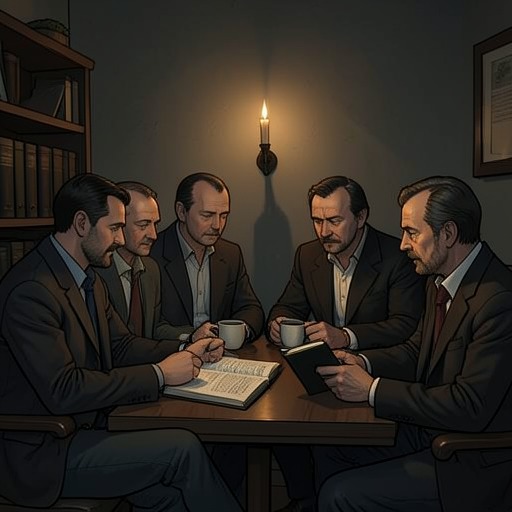
The nine members of the Cénacle find peace across differences that might elsewhere produce rivalry. Daniel d'Arthez is a convinced supporter of monarchy; Chrestien holds to European federation; Léon Giraud predicts the end of Christianity and the family; and Chrestien, in turn, defends the soul against Bianchon’s analysis. Their discussions do not become quarrels. They share work, offer advice in good faith, and, when a friend needs help, can enter the other person’s ideas without surrendering their own convictions. The group’s intellectual seriousness is matched by a lack of envy: each can give assistance or accept it without treating dependence as humiliation.
That ethic becomes visible when Lucien, too ashamed of his poverty to appear at dinner, is confronted by his friends. Chrestien tells him that the group will mark a cross on the chimney for each absent friend, and that they will do so again when the number reaches ten. The gesture turns an admission of distress into a sign of fellowship rather than a charge of disgrace. The friends have found work by different means: Chrestien himself had considered singing outdoors in the Champs-Élysées with a handkerchief and four candles, but instead accepted a six-hundred-franc commission to prepare a political brochure. Together their efforts provide Lucien with two hundred francs, which Daniel asks him to accept without repeating his concealment.
Friendship and Moral Judgment
Chrestien’s loyalty is generous, but it is not unconditional. When Lucien argues that friendship should not retreat from complicity, Chrestien distinguishes an impulsive crime of passion from a settled decision to sell one’s soul, intelligence, and thought. He says that he could help a friend conceal even a murder committed in passion, yet would shun him for becoming a spy. In Chrestien’s judgment, journalism can become just such a systematic traffic in the self. Friendship may forgive error; it must oppose a chosen, continuing corruption.
The distinction helps explain why Chrestien’s concern for Lucien can coexist with severe rebuke. When Lucien joins the royalist press after writing for liberal newspapers, d'Arthez and other friends urge him not to reverse his positions for advantage. Chrestien’s moral standard is not simple loyalty to one political camp: his own republicanism differs from d'Arthez’s monarchism, yet he respects the integrity of conviction. What he condemns is the deliberate conversion of thought into a tool of opportunism.
He also challenges Lucien’s understanding of love and Coralie’s place in it. Chrestien cannot imagine loving a woman who is publicly kissed by actors, addressed familiarly backstage, smiles for an audience, and displays herself onstage. If he loved such a woman, he says, she would have to leave the theatre; he would try to purify her through his love. If she could not leave, he believes jealousy and grief would destroy him. This is his own idealized and possessive standard, not a neutral account of Coralie. Its force in the scene comes from the contrast between Chrestien’s imagined conditions for love and Lucien’s actual attachment to a performer who cannot simply step outside her work. Lucien grows sombre, thinking that his friends will despise him for accepting Camusot’s support; Chrestien answers that he may become a great writer but will remain a small-time joker. The rebuke exposes the distance between literary promise and the compromises Lucien is making to sustain himself.
The Rupture with Lucien
That distance becomes a public break when Chrestien confronts Lucien over articles attacking d'Arthez. He spits in Lucien’s face and calls the act the fee for those articles. In Chrestien’s view, if writers answered attacks on themselves or their friends in the same way, the press might remain a respected vocation rather than a marketplace for personal and political service. His action makes the principle physical: the insult is both punishment and refusal to treat paid words as harmless.
Lucien demands witnesses and a duel. At dawn, he and Chrestien meet on the road to Clignancourt, under rules agreed by their seconds: pistols, a starting distance of twenty-five paces, movement toward one another to within fifteen, and three shots each. The account notes that the seconds have helped chance by choosing cavalry pistols. Lucien feels indifferent to living or dying and stays in place, a passivity mistaken by onlookers for calculated composure. Chrestien advances to the limit. Their first shots are simultaneous: Chrestien’s bullet grazes Lucien’s chin, while Lucien’s passes well over Chrestien’s head. In the second exchange, Chrestien’s bullet lodges in the collar of Lucien’s coat, where padding protects him. On the third shot, Lucien is hit in the chest and falls. The surgeon says he will recover. The duel does not kill Chrestien; it makes the cost of their moral conflict visible in Lucien’s wounded body.
Death and Narrative Significance
Chrestien’s eventual death is recorded as a different kind of violence. He is killed at Cloître Saint-Merry by a bullet fired by a merchant, dying like an ordinary soldier amid political upheaval. The narrative stresses the injustice that he perishes for doctrines other than his own. His European federation threatens the aristocracy more deeply than the republican propaganda of the young radicals, while his personal character—gentle, loving, and full of illusions—makes the abruptness of his end especially stark. Those who knew him grieve him; the remembrance of the unknown statesman persists among his friends even though he remains obscure to the wider world.
The later account of Coralie’s funeral notes that Chrestien is absent, though he has by then been disabused of Lucien’s guilt. The detail preserves a distinction between their earlier rupture and the facts surrounding Coralie’s death: Chrestien’s condemnation of Lucien’s paid attacks does not mean that he remains fixed in a false accusation. Across these episodes, he serves as the Cénacle’s demanding measure of friendship. He can give help without condescension, tolerate opposed beliefs, and forgive passion, but he refuses to call systematic self-betrayal a private mistake. His political idealism and his judgment of Lucien arise from the same conviction: thought and loyalty matter precisely because they should not be sold for advantage.