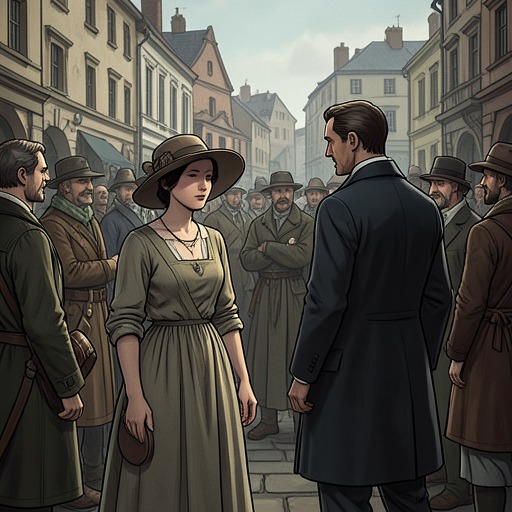
Monsieur de Bargeton
Illusions perduesMonsieur de Bargeton is a provincial gentleman whose hereditary title and polished social standing conceal a diminished fortune and a strikingly passive character. In his marriage to Madame de Bargeton, he is at once the obedient beneficiary of her management and, when her reputation is challenged, the man she sends to defend it. His transformation from smiling salon fixture to duelist gives his small role in Lucien de Rubempré’s story its decisive turn.
Family and Fortune
The Bargeton name came from a family whose fortunes rose and fell through marriage, office, and expenditure. Monsieur de Bargeton was descended from Mirault, a jurat of Bordeaux ennobled under Louis XIII after long service in that office. Mirault’s son became Mirault de Bargeton and served among the Guards of the Gate; a financially advantageous marriage helped his own son shed the Mirault portion of the name and be known simply as Monsieur de Bargeton. That later gentleman spent the family’s wealth in his determination to behave as a perfect nobleman, checking its further rise.
The present Monsieur de Bargeton inherited the family’s estate in Angoumois and its house in Angoulême, Hôtel de Bargeton. The estate, held under the fief of La Rochefoucauld, had lost its useful rights in 1789 and yielded about six thousand livres a year. The narrator imagines the more illustrious rank his ancestors might have secured had they managed their inheritance differently: the family’s history made a marquisate, and even a ducal title, seem like possibilities that expenditure had foreclosed. The surviving name therefore carries the trace of both aristocratic ambition and its failure.
Marriage and Life in Angoulême
In 1805, Monsieur de Bargeton was pleased to marry Marie-Louise-Anaïs de Nègrepelisse, the daughter of a country gentleman from an old southern family. The marriage connected him to an ancient lineage, but not to immediate wealth. Madame de Bargeton’s father lived from the small estate he farmed himself, selling grain at market and making his own wine, while steadily adding to his holdings. Her husband and she remained in Angoulême partly because she awaited that father’s inheritance and hoped eventually to go to Paris; he died before his father-in-law did.
At the time of Lucien’s first visits, Monsieur de Bargeton is fifty-eight and his wife thirty-six, though he seems nearly seventy. Their income, about twelve thousand livres a year, places them among the six largest fortunes in the old city, excluding merchants and administrators. The disparity between them is not merely numerical. Madame de Bargeton has beauty, intelligence, and literary aspirations, while the account presents her husband as possessing just enough sense to manage his fortune and enough manners to remain acceptable in Angoulême. His social position gives his wife a respectable household and a name; her abilities, in turn, animate the salon in which he is most at ease.
The Smiling Host and Lucien’s Misreading
Monsieur de Bargeton’s habitual response to almost everything is a smile. He smiles at bad news as readily as good, and adds an obliging laugh when someone requires a more explicit sign of agreement. Conversation alone unsettles him: when left to sustain a tête-à-tête, he fills the silence with intimate details of his meals, discomforts, errands, or plans, then leaves his visitor little to answer. In company, however, his attentive listening makes him useful to talkative guests, who mistake his courtesy for hidden intelligence.
He knows the practical rhythms of his wife’s salon. He watches arrivals, greets visitors, conducts them to Madame de Bargeton, and accompanies departing guests to the door. When the room is lively, he stands listening, studies card games he cannot play, or strolls while smoking and digesting. He admires his wife as she speaks for him and obeys her requests with the unquestioning regularity of a soldier receiving an order. She tends to him with protective care, and he returns an almost canine devotion. The account presents this arrangement as affectionate as well as unequal: she manages a husband content to be governed, and he finds happiness in the care and attention she gives him.
Lucien, still inexperienced in the household, does not understand this apparent emptiness. Arriving before Madame de Bargeton, he finds her husband alone and treats him with more respect than the older man’s ordinary standing might command. When Monsieur de Bargeton explains that people who live far away arrive earlier than those who live nearby, Lucien takes the remark for a jealous husband’s pointed insinuation. He blushes and searches for composure. The exchange exposes less a hidden design in Monsieur de Bargeton than Lucien’s tendency to magnify what he cannot read: he mistakes a literal, socially awkward observation for evidence of a formidable rival.
The Duel and Its Consequences
That misreading becomes consequential after Lucien declares his love to Madame de Bargeton and Stanislas de Chandour enters while she is helping him up. Madame de Bargeton tells her husband that Chandour has accused her of compromising conduct with Lucien. She insists that the young man must not become her defender, since his challenge would publicly confirm the very attachment she seeks to contain. Instead, she directs Monsieur de Bargeton to demand satisfaction himself, requiring a retraction before witnesses and naming his father-in-law, Monsieur de Nègrepelisse, as a prospective second.
Monsieur de Bargeton follows her instructions. He confronts Chandour, asks whether he claims to have found Madame de Bargeton in an equivocal situation with Lucien, and stipulates that, without a public retraction, Chandour must appoint a witness. He names pistols as his chosen weapons and insists that he is the offended party. Sixte du Châtelet, meanwhile, urges Chandour and his wife to keep the affair quiet and to maintain a show of cold politeness. The contrast is pointed: the husband whom Lucien has mistaken for a jealous sphinx acts not from a display of personal passion but in accordance with the role his wife has assigned him.
According to the report Madame Chardon brings the next morning, the duel took place at five o’clock in a field belonging to Monsieur Tulloye. Monsieur de Nègrepelisse had arrived by three and had tested the pistols; an officer of cavalry lent the weapons and served as arbiter. The two men were placed twenty-five paces apart. Monsieur de Bargeton, who appeared as unhurried as if taking a walk, fired first and struck Chandour in the neck; Chandour fell without returning the shot. The episode overturns Lucien’s mistaken picture of an imposing, secretly jealous husband, but it also confirms the real power of Madame de Bargeton’s direction over her household: the mild salon host becomes the instrument through which her public reputation is defended.