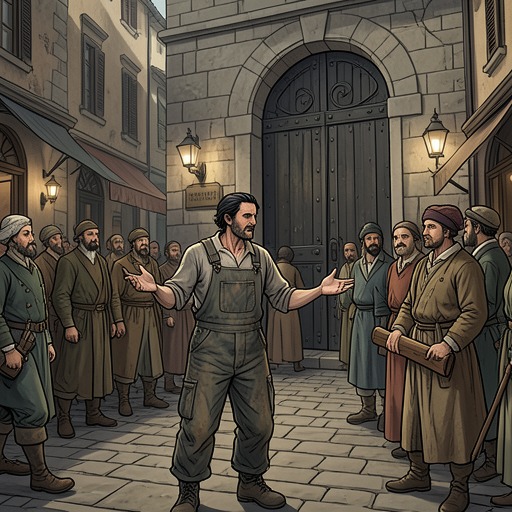
Pierre Petit-Claud
Illusions perduesPierre Petit-Claud is a young legal officer whose ambition turns David Séchard’s trust into a weapon against him. A tailor’s son from l’Houmeau and once a despised schoolmate, Petit-Claud rises by purchasing a legal practice he cannot yet afford. Boniface Cointet recognizes how resentment and financial pressure may be put to use: he recruits Petit-Claud to advance the Cointets’ interests against David while appearing to act as David’s advocate.
Identity and Ambition
When Boniface Cointet waits for him beside the water intake serving his paper mill, Petit-Claud has been an avoué at the Angoulême court of first instance for only six weeks. He is twenty-nine and has bought his former employer’s practice for thirty thousand francs, counting on a marriage to pay the debt. The purchase leaves him dependent on the same network that arranged the sale: a retiring practitioner has an interest in finding a wife for his successor, since the successor’s marriage may help secure payment.
The novel presents Petit-Claud’s appearance in language that connects physical signs with moral character. He is thin, pockmarked, and sparsely haired, with a cracked voice, a sharp manner, and a magpie-like eye; the narrator associates his face with deprivation and hostile feeling. More consequential than these outward descriptions is the history behind them: his schoolmates’ disdain has fed a corrosive envy and an intense desire to rise. Cointet judges that this grievance can be recruited, and that Petit-Claud’s provincial practice gives him both a livelihood to protect and a way to profit from procedural maneuvering.
Cointet’s Offer
Cointet offers Petit-Claud more than a client or a fee. He discloses the concealed family history of Françoise de La Haye, the daughter born to Francis du Hautoy and Zéphirine de Sénonches before her marriage to Monsieur de Sénonches. Raised in the country and cared for by her godmother, Madame de Sénonches, Françoise is presented as a desirable match with connections to Angoulême’s aristocracy. Cointet says he can secure the marriage; it would bring Petit-Claud a trousseau and household goods, enlarge his clientele, and open a more promising future.
The bargain has a direct condition. Cointet tells Petit-Claud that once David is in prison, Petit-Claud will be presented at Madame de Sénonches’s. The proposed reward makes the assault on David’s position part of Petit-Claud’s own social and financial advancement. At first, he objects that the plan cannot be carried out. Cointet answers that David has never been involved in a lawsuit and has no avoué, making the maneuver possible. Petit-Claud accepts the logic of the opportunity, even though it means betraying a former schoolmate who will later rely on him for a defense.
A Defense That Serves the Opponent
Petit-Claud’s duplicity depends on keeping two roles in play. He tells David that, as a schoolmate, he will defend him, but warns that the defense will cost five or six thousand francs. He urges David not to endanger his fortune and argues that protecting the paper invention will itself require time and money: David may have to share profits with a manufacturer, build or buy a paper mill, and obtain a patent. David, absorbed in his invention and confident that its secret is safe, does not understand the conflict of interest behind this advice.
A brief impulse of generosity complicates, but does not undo, Petit-Claud’s conduct. At one point he tries to reconcile his own advantage, the Cointets’ interests, and David’s welfare. The attempt is quickly overtaken by the scheme he has accepted. On Boniface Cointet’s instructions, he works to widen the breach between David and Jérôme-Nicolas Séchard, so that David’s father will not help him escape his desperate position. Ève Séchard recognizes that the hostility being stirred up is calculated, but David does not know that his defender has ties to the Cointets or that the Cointets are acting through Maison Métivier.
The legal and financial pressure around David makes this betrayal practical as well as personal. The returned-bill account, discussed in the narrative, shows how protest charges, taxes, an usher’s fees, and banking commissions can swell the cost of a default. Its itemized example explains the machinery of debt enforcement bearing on David; it does not establish that Petit-Claud personally devised every charge. His part is to exploit David’s vulnerability within that machinery while presenting the cost of resistance as another reason to yield.
Settlement and Consequences
Petit-Claud’s promised social reward depends on David’s imprisonment, but the conflict eventually moves toward a settlement. When Ève reports the terms he claims to have obtained from the Cointets, David accepts them with visible relief. He is willing to live quietly in a village near the Cointets’ factory, surrender the commercial advantage of his discovery, and cease struggling for a life as a businessman. He reasons that the invention may benefit his country even if the Cointets profit from it; he and Ève, he says, are not made for commerce.
Ève sends word to Petit-Claud that they consent to the proposed arrangement and asks him to secure David’s release. Petit-Claud enters the prison room and addresses David as a friend, remarking on his having allowed himself to be caught. The moment brings his double role into sharp relief: he is the man whose maneuvering helped put David there, yet also the intermediary through whom the family’s acceptance of the settlement can reach the Cointets. The arrangement offers David and Ève a return to domestic peace, but it does not restore the invention to them on their own terms.
Narrative Role
Petit-Claud embodies the way private ambition can make legal procedure serve commercial power. His poverty and resentment help explain why Cointet’s offer appeals to him, but they do not erase the choice involved: he accepts advancement through a plan that requires misleading David and worsening the family’s crisis. His brief effort to balance competing interests suggests a possible alternative, then underscores how readily that impulse gives way to the rewards held out by the Cointets.
His role is therefore not simply that of an openly hostile lawyer. The danger lies in the disguise of service: David entrusts his defense to a former schoolmate, while Petit-Claud’s marriage prospects and professional prospects are being made conditional on David’s defeat. Through that contradiction, the character links the intimate breach of trust between old companions to the larger contest over David’s invention, property, and freedom.