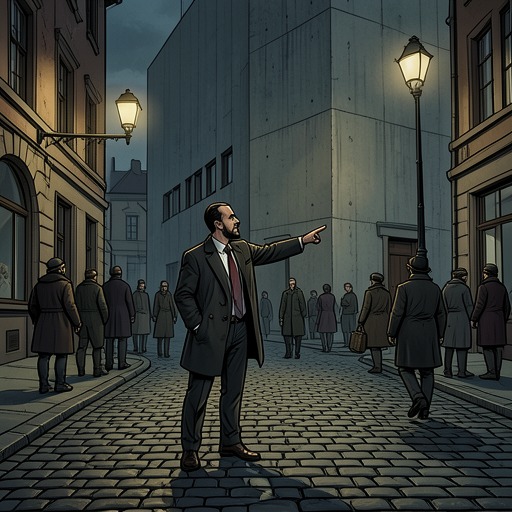
Place du Mûrier
Illusions perduesPlace du Mûrier is a public square in Angoulême where private crises repeatedly become public events. The square gathers merchants, neighbors, and political actors around the Séchard family’s troubles, making it both a practical center of commercial life and a stage on which reputation and influence are contested.
Commercial Exposure and Public Judgment
At two o’clock, when the square was full, Victor-Ange-Herménégilde Doublon, the Cointets’ bailiff, formally protested the unpaid bill. He spoke with Marion and Kolb by the entrance to the alley, apparently taking care not to make the matter conspicuous; nevertheless, the protest became known throughout Angoulême’s commercial community by evening. The scene gives the square an important function: it is a place where an official act, even one handled with outward discretion, can quickly become public knowledge.
The episode also connects the square to the machinery behind David Séchard’s debt. The bills had passed through banking intermediaries between Paris and Angoulême, and the unpaid effects brought further commercial procedures into play. At Place du Mûrier, those abstract dealings acquire a visible consequence: the protest attaches a public mark of financial failure to the Séchard household. The square thus stands at the point where private obligation becomes collective judgment.
Negotiation in Full View
The square is also a meeting place for men whose interests shape David’s immediate future. When Abbé Marron arrived there at about five o’clock, Père Séchard, Boniface Cointet, and Petit-Claud were together. People returning home to dinner stopped to watch them, wondering what the older Séchard and Boniface Cointet had to discuss. Their curiosity soon turned into speculation about David, whom they imagined as a man leaving his wife, mother-in-law, and child without support.
The narrator sets this public speculation against the concealed bargaining among the three men. Each is described as pursuing a different kind of self-interest: Père Séchard is prepared to trade on his son, Petit-Claud on his client, and Boniface Cointet seeks to obtain the advantage without paying its full price. The square makes their negotiation visible, but not transparent. Bystanders can see the powerful men together and invent an explanation; they cannot see the full calculation taking place between them.
David himself is close by but unseen: he has been hidden for eleven days only two doors from the place Abbé Marron has just left. The proximity sharpens the contrast between the square’s open circulation and the concealment imposed by the debt crisis. News, rumor, and negotiation move through public space, while the person at the center of them remains in hiding.
Public Acclaim and Private Alliance
At eleven at night, music from the town, joined by the garrison band, woke Lucien Chardon de Rubempré and his family. The square filled with people gathered for a serenade organized by Angoulême’s young men. Lucien appeared at his sister’s window and thanked his compatriots, saying that his emotion prevented him from speaking at length. The crowd answered with cheers for the author of The Archer of Charles IX, the author of The Daisies, and Lucien de Rubempré. Three wreaths and bouquets were thrown through the window; ten minutes later the square was empty again.
This brief ceremony turns the square into a public theater of literary recognition. The titles of Lucien’s works and his aristocratic name are voiced together, while the wreaths carry the crowd’s approval across the threshold into the family’s room. Yet the acclaim matters to the plot for more than its ceremonial force. Lucien has told his sister Ève Séchard that his influence as a journalist, and the continuing presence of Louise de Nègrepelisse within the Countess of Châtelet, might help secure money for David. Public standing is presented as a resource he hopes to convert into practical assistance.
At midnight, Petit-Claud walked Lucien back to the square. Lucien declared their bond one of life and death; Petit-Claud invited him to attend the signing of his marriage contract the following day at the home of Madame de Sénonches, where the prefect’s wife would also be present. The exchange places Lucien’s public triumph beside a more calculated alliance, linking the square’s celebrations to the social arrangements through which influence may be pursued.
Concealment, Surveillance, and Political Stakes
The square’s public openness also provides cover for surveillance. Near the wooden enclosure around the site where the courthouse now stands, Petit-Claud heard someone tapping behind a plank. Cérizet spoke through a gap, reporting that he had seen David leaving L’Houmeau and now knew where to find him. To set a trap, Cérizet wanted to learn Lucien’s plans and hear the brothers’ farewell; he asked Petit-Claud to keep them nearby while he listened unseen. Petit-Claud’s position on the square therefore becomes part of an attempted interception, with its windows and enclosure offering points from which people can watch or listen without being noticed.
Petit-Claud then walked along the square, looking toward the windows of the room where the family had gathered and considering his own future. His maneuvering is connected to wider political ambitions in L’Houmeau. He had become an organizer of the liberal opposition there and argued that it needed an independent press in Charente rather than leaving control to the Cointets. He proposed raising money to buy the Séchard printing works, with David kept dependent through a loan. Place du Mûrier consequently links the immediate plot against David to the larger struggle over who will control printing and political expression in the region. Across its recurring scenes, the square is at once a marketplace of reputation, a gathering ground for negotiation, and a vantage point from which power watches for opportunity.