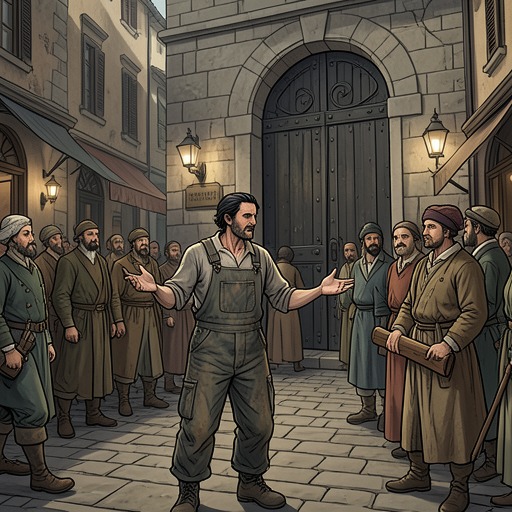
Victor-Ange-Herménégilde Doublon
Illusions perduesVictor-Ange-Herménégilde Doublon is a bailiff in Angoulême whose work for the Cointet brothers carries a debt dispute from stamped paper into the streets. He protests David Séchard’s bills, helps convert their nonpayment into an accumulating legal claim, and later joins the effort to track David’s movements. His importance lies in the way he makes enforcement both bureaucratic and personal: a formal act can become public humiliation, while a network of observers can turn the search for a debtor into surveillance.
Position and Commercial Connections
Doublon acts as the Cointet brothers’ huissier, or bailiff, in their dealings with David Séchard. The relationship is not merely a sequence of instructions delivered through the courts. Doublon is financially connected to the Cointets: he extends them six months’ credit, which the elder Cointet in practice stretches to a year by paying slowly. The Cointet asks him from month to month whether he needs money, a recurring accommodation that places the bailiff within the commercial network he serves.
That connection also shapes the costs of enforcement. Doublon gives the Cointets a discount on his acts, allowing the powerful firm to save a small sum on each one—one franc and fifty centimes on a protest. The amount is modest, but the arrangement makes the relationship concrete: routine legal paperwork brings the firm repeated savings, while Doublon gains a continuing account with an influential client. His role thus sits at the junction of legal procedure and local business, where even the fees attached to an official act reflect private ties.
The Protest and Its Public Consequences
When David’s bill is protested, Doublon performs the act at two o’clock, when Place du Mûrier is crowded. Though he takes care to talk with Marion and Kolb at the entrance to the alley, the protest is widely known among Angoulême’s merchants by that evening. The scene makes the notice more than a technical step: its timing and visibility expose the family to the commercial disgrace associated with suspension of payment. The narrator notes that even Doublon’s outwardly considerate manner, encouraged by the elder Cointet, cannot shield David and Ève Séchard from that humiliation.
Doublon also personally carries the protested document to the Cointet brothers. There, while he speaks with the elder Cointet, information about other local merchants becomes part of their conversation. The Cointet uses the exchange to learn about the condition of businesses in town, illustrating how Doublon’s work brings him into a flow of commercial intelligence as well as legal business. The document itself is drawn up on a small, stamped square of paper; the formal instrument is slight, but it sets in motion a much larger chain of charges and proceedings.
Escalation Through Legal Process
The debt grows through the mechanics of banking and recourse. The three bills pass from Lucien de Rubempré to Métivier and then to the Cointet brothers, who act as Métivier’s correspondents in Angoulême. Once the bills are unpaid, the protest allows the claim to acquire additional charges: the account includes fees, commissions, interest, postage, and the cost of exchanging bills between places. In the detailed account presented in the narrative, a bill with a principal of one thousand francs has risen to 1,037 francs and 45 centimes. Doublon is not the author of every element in that calculation, but he supplies a crucial procedural link by protesting the bill and bringing the document to the Cointets.
The action then reaches the commercial court. On July 3, Doublon summons David on behalf of Métivier for 4,018 francs and 85 centimes, the total claimed on the three bills and expenses already incurred. The sum places the legal demand in stark contrast with Ève’s initial hope that the return of the bill to Métivier meant the family could be at ease. A formal summons turns that mistaken relief into an urgent threat. Through Doublon, the claim is not simply entered in an account: it arrives at the household as a command to pay, backed by the prospect of further proceedings.
Surveillance and the Pursuit of David
Doublon’s part in the affair extends beyond service of documents. When Kolb runs to the bailiff’s office, David’s enemies are gathered there considering how to seize him. In their presence, Doublon lays out a plan to follow David without alerting him. Men are to be stationed at intervals from Beaulieu to Place du Mûrier and in several directions, keeping track of David until he enters the house where he believes himself hidden. They are then to leave him a few days’ sense of security and find him there at a time shortly before sunrise or sunset.
The plan depends on observation distributed across the town. Doublon says that one of his clerks is watching Place du Mûrier, another the corner of the Palais, and a third a short distance from his own house. If David leaves, they are to signal by whistling; the information will reach Doublon almost at once. When the elder Cointet asks where David is, Doublon reports that he is at home and says that he would know if he went out. In this final glimpse, the bailiff’s procedures have become a human surveillance system: scattered watchers, signals, and rapid communication serve the effort to locate a debtor. The evidence shows the plan and the watch in operation, but does not establish here what ultimately happens when the pursuers reach David.