“Gypsy blood” and restlessness
In Cold BloodPerry Smith’s idea of gypsy blood and restlessness turns a life of repeated departures into a personal explanation for why he could not remain in one place. The poem he gave a nurse he had cared for presents restless travel as a curse shared by people who break ties and seek what is strange and new. His history gives that image concrete form: years on the road with his father, a break that left him walking away with his guitar, and later journeys marked by temporary work and crime. The motif is not evidence of an inherited nature; it is a story Perry used to describe movement, attachment, and loss.
The Poem and the Idea of Restlessness
While recovering from a motorcycle accident, Perry met Cookie, a nurse who treated him kindly and encouraged his interest in reading. Their relationship included talk of love and marriage, but after his injuries had healed, Perry said goodbye and gave her a poem he claimed to have written. The poem describes people who cannot stay still, who leave those close to them, and who roam in pursuit of novelty. It casts this pattern as a curse rather than a freely chosen adventure, making departure at once an assertion of independence and a source of hurt.
The poem’s significance extends beyond that parting. Several years later, Perry had Cookie’s name tattooed on his arm, although he had not seen or heard from her again. When Dick asked who she was, Perry minimized the relationship while acknowledging that he had nearly married her. The discrepancy between the lasting mark and the dismissive explanation makes the poem’s theme personal: movement does not erase attachment, and an abandoned relationship can remain present after the traveler has gone.
A Childhood of Moving On
Perry’s childhood with his father, Tex John Smith, gave mobility a different setting. After periods of separation and institutional care, Perry lived with his father near Reno for almost a year and attended school, completing the third grade. They then built a small house car with two bunks and a cooking galley and spent the next six years moving from place to place. Their route included Wyoming, Idaho, Oregon, and eventually Alaska. Perry remembered the practical routines of that life: making bread and preserves, preparing meals, and helping his father earn a living.
At first, moving on could protect Perry from the scrutiny that made him feel exposed. He recalled that when they stayed too long, people began to regard his father as a character, an attention that hurt him because he loved his father. Their departures therefore served as relief from an unwanted social gaze as well as a way of life. In Alaska, Tex taught Perry to search for gold, use a gun, and track and hunt animals. The shared labor and close life in cold conditions belonged to a period Perry remembered with affection, even though he also described his father as bossy and rough with him.
As Perry grew older, the bond became more difficult. He felt that his father did not recognize or encourage his abilities in music, reading, songwriting, and drawing. The difference between them widened: Perry still loved Tex, but increasingly felt that his father did not understand important parts of him. In Perry’s account, mobility could postpone that conflict, but it could not resolve it. The family’s later attempt to establish a settled livelihood at Trapper’s Den Lodge ended in hardship and a final break.
The Break at Trapper’s Den Lodge
When the lodge failed to attract the expected visitors, Tex tried to improve its prospects with a Garden of Memories, a wishing well, and signs along the highway. The effort brought no financial relief. As money and food grew scarce, the strain intensified, and father and son argued over a biscuit. Perry described losing control of his hands and grabbing his father by the throat; Tex pulled free and returned with a gun, which proved unloaded. The confrontation ended not in reconciliation but in exhaustion and sorrow on both sides.
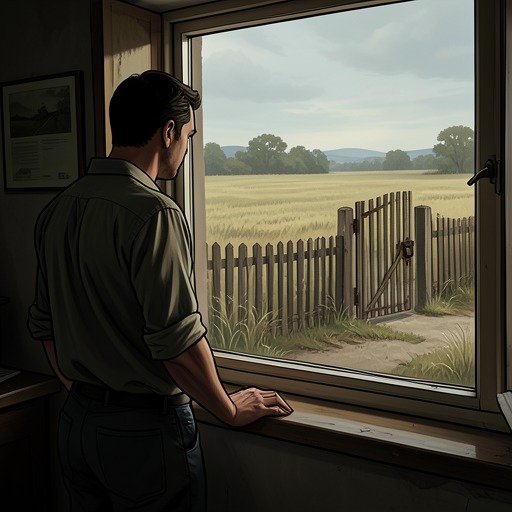
Perry’s departure made the idea of restlessness literal. After walking in the snowy woods, he returned to find the lodge dark and locked and his belongings left outside. He picked up his guitar, left the rest, and started down the highway without money. Around midnight, a truck driver offered him a ride; Perry left the destination open, agreeing to go wherever the driver was headed. The guitar was the one possession he chose to carry, linking the departure to the creative abilities he felt his father had overlooked. Here, movement is less an exhilarating escape than what remains after a home and a relationship have broken down.
The Road as a Series of Episodes
After sheltering again with the James family, Perry chose Worcester as a destination, hoping an Army acquaintance there could welcome him and help him find a well-paying job. The journey did not proceed directly. He washed dishes in an Omaha restaurant, pumped gas at a garage in Oklahoma, and worked for a month on a ranch in Texas. These successive jobs echo the poem’s roaming figure, but they also show the material limits of travel: Perry depended on temporary work and on the possibility of help from people he knew.
In July 1955, while passing through Phillipsburg, Perry agreed to a companion’s suggestion that they break into Chandler Sales Company. They took office equipment, including typewriters and adding machines. After police stopped them in Saint Joseph because they had ignored a traffic signal, the stolen goods led authorities back to Phillipsburg, where Perry and his companion were jailed. Within forty-eight hours they escaped through an open window, stole a car, and drove northwest to McCook, Nebraska. They later separated; Perry said he did not know what became of the other man. Both were placed on the Federal Bureau of Investigation’s wanted list, though Perry believed the authorities never caught up with his former companion.
Meaning and Limits of the Motif
Across these episodes, restlessness connects affection and estrangement without reducing either to a simple preference for freedom. Perry’s poem treats departure as a curse that injures close relationships; his tattoo suggests that separation did not make Cookie insignificant to him. His early travels with Tex include work, shared skills, and remembered love, while their later conflict leaves Perry alone on the highway. Subsequent journeys bring work and new destinations, but also a burglary, imprisonment, escape, and another separation.
The motif also gives Perry’s life a succession of loosely connected stages: a household on wheels, a lodge, a walk away from home, short-term jobs, and another flight. The pattern makes each new place seem like a possible beginning, yet the evidence repeatedly shows attachments or circumstances left unresolved. Gypsy blood, in this account, is Perry’s own poetic language for that recurring motion, not a settled explanation of why he traveled or a guarantee that movement could deliver the life he wanted.