“No witnesses”
In Cold Blood“No witnesses” is the compact rule Dick uses to make a robbery plan sound manageable: anyone who might identify the intruders, he insists, must be silenced. Repeated before the crime and recalled afterward by Perry Smith, the phrase reveals more than a shared intention. It records Dick’s confidence in a plan he calls flawless, Perry’s unease about what cannot be accounted for, and the moment that logic makes Dick a possible target too.
A Rule Built Into the Plan
Before the break-in, Dick dismisses Perry’s concern that his eyes could identify him. Stockings of any shade, Dick argues, would be unnecessary expense and an encumbrance; no one encountered would live to bear witness. He repeats the phrase as if it settles the question. Perry is irritated by the certainty behind it. A witness might remain unseen, he argues, and events might take an unforeseen turn. Dick answers with boastful assurance that nothing can go wrong. Their disagreement is already contained in the slogan: Dick treats the elimination of witnesses as a solution, while Perry sees that the plan cannot guarantee who might witness them.
Their preparations make the rule’s reach concrete. Perry, drawing on his experience with rope in the United States Merchant Marine, tests the stock and chooses a thin, strong white nylon cord. Dick cannot confidently calculate how much they need. When he counts the people they might encounter, he includes the household’s four members and allows for additional occupants or guests, arriving at a possible total of eight or even twelve. Whatever the number, he says, all of them must be dealt with. The phrase is therefore not an incidental boast: it governs how they estimate risk and prepare for a household whose size they do not know.
The Phrase Against Perry’s Doubts
The expression also marks the difference between Dick’s confidence and Perry’s recurring suspicion. In a later passage, Perry reads a November 17 report in the Kansas City Star describing investigators’ limited clues. The article presents the perpetrators as careful and the motive as unclear; Perry disputes its account and presses Dick to admit that he does not believe the investigation is truly without leads. Dick is bored by Perry’s return to the subject and had already brushed aside the possibility that investigators could connect them to the crime.
Perry’s doubts are not simply a practical objection to the disguise or the quantity of cord. He describes himself as someone who trusts hunches, recalls earlier instances in which he believed he had foreseen danger, and says that the newspaper account feels like a trap. The narrative places this suspicion beside the pre-crime refrain: Dick had treated the absence of witnesses as certain, while Perry keeps imagining what certainty leaves out. His unease does not stop the plan, but it prevents the phrase from functioning as a shared assurance. It belongs most fully to Dick, even as Perry repeats and tests its implications.
What Perry Recalls to Dewey
When Perry explains the plan to Alvin Adams Dewey, he traces it to information Dick said he had received from a former cellmate who had worked for a wealthy wheat grower in western Kansas, Mr. Clutter. Dick had described the layout of the Clutter family home and claimed that a wall safe held at least ten thousand dollars. The plan was to rob it; if anyone saw them, that person would have to be eliminated. Perry remembers Dick repeating the phrase again and again.
Once inside, Perry says, the family’s denials that a safe existed appeared truthful to him. Outside the room, he told Dick that Floyd Wells, rather than the Clutters, had lied, and urged him to leave. Dick refused to accept this without searching the house. Perry’s account connects the slogan to the plan’s failure at its supposed center: the expected safe was not there, but Dick’s rule about witnesses remained in force. The phrase had been framed as a contingency for a robbery; it continued to shape events after the premise that had brought them to the house had collapsed.
The Rule Turns Back on Dick
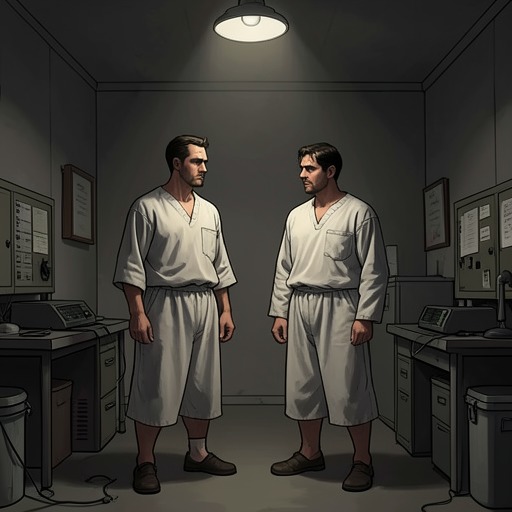
In Perry’s recollection of the departure, the pair wait in the office and look through the blinds to see whether anyone has approached. Then, he says, he decides he should shoot Dick. The reason is not a new discovery about the house: Dick, too, is a witness, and Dick had made the rule absolute by repeating it. Perry says he does not know what stopped him. He considers killing his partner and continuing toward Mexico, but the account does not say that he acts on that thought.
After Perry finishes, the three men ride for more than ten miles without speaking. Dewey’s silence follows the repeated accounts of what happened in the house; the confessions answer questions about how the crimes were carried out but do not make the suffering meaningful to him. In that aftermath, the phrase’s final force is its reversal. Dick had used it to imagine control over every possible witness. Perry’s recollection shows the rule consuming the partnership that produced it: when the robbery is over, the person beside him fits its definition as surely as anyone else.
Narrative Function
Across the planning, the newspaper discussion, and Perry’s account to Dewey, “No witnesses” works as a refrain whose meaning changes with its context. At first it sounds to Dick like a complete answer to the danger of recognition. Against Perry’s warnings and the uncertain count of possible occupants, it instead exposes the gap between confidence and control. In the retrospective account, it becomes evidence of the plan’s governing logic and then a threat that reaches into the pair’s escape.
The book does not present the phrase as proof that the plan was flawless; its recurrence lets the reader measure Dick’s assurance against Perry’s doubts, the false safe premise, and Perry’s later thought of turning the rule on Dick. Its bluntness is part of its significance. A contingency reduced to two words can be repeated as though it settled every question, yet each return reveals another consequence the speakers could not contain.