Alvin Adams Dewey
In Cold BloodAlvin Adams Dewey, a Kansas Bureau of Investigation agent and former sheriff of Finney County, leads the investigation into the Clutter family murders. His professional experience makes him a natural choice for a case that appears nearly without clues, but his friendship with Herbert William Clutter and Bonnie Clutter makes the work personal as well as official. He approaches the crime as a puzzle to be solved through careful examination, even when the available evidence cannot yet explain who committed it or why.
Identity and Professional Background
A fourth-generation Kansan, Alvin Adams Dewey is forty-seven and serves as the Kansas Bureau of Investigation’s Garden City representative, responsible for a substantial part of western Kansas. The statewide agency is headquartered in Topeka, Kansas, and its detectives assist when a case exceeds the capabilities of local authorities. Alvin Adams Dewey is professionally suited to lead the inquiry: he had served as Finney County sheriff from 1947 to 1955 and, before that, as a Federal Bureau of Investigation special agent from 1940 to 1945, working in New Orleans, San Antonio, Denver, Miami, and San Francisco.
The sheriff of Finney County, Earl Robinson, asks Alvin Adams Dewey to take charge. As the investigation grows, eighteen men are assigned to it full time. Three of the Kansas Bureau of Investigation’s most capable investigators—Harold Nye, Roy Church, and Clarence Duntz—join the team, which Alvin Adams Dewey regards as a strong investigative unit. Their arrival also changes the ordinary rhythm of Garden City: the case draws substantial press attention, and the sheriff’s usually quiet office fills with visiting reporters and investigators.
Personal Connection and Investigative Commitment
Alvin Adams Dewey knew the murdered couple beyond the requirements of his job. He and his wife were fond of Herbert William Clutter and Bonnie Clutter, saw them at church every Sunday, and visited them often. That closeness makes the murders, in his view, a personal matter. He says that even without knowing the family, the crime’s viciousness would have compelled him to pursue it; he is determined to learn both who acted and why, however long the investigation takes.
The narrative sets that resolve against the limits of what investigators can establish. Alvin Adams Dewey questions whether one person could have subdued Herbert William Clutter and his son Kenyon Clutter, both described as strong, and notes that the same half-hitch knot was used to bind all four victims. He and most of his colleagues therefore favor the possibility of an accomplice. Yet that explanation creates another difficulty: he cannot readily understand how two people could share the extreme rage the crime seemed to require, or how a person with a private grievance could find a partner willing to participate. The evidence constrains the theories without settling them.
Evidence and Method
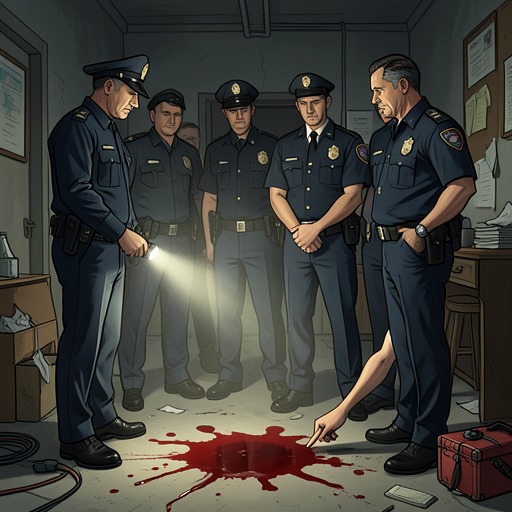
After a news conference, Alvin Adams Dewey returns to the temporary office lent to him by the sheriff. On his desk are the cord and adhesive tape removed from the victims, sealed in plastic sacks, and twenty enlarged crime-scene photographs. The materials seem unpromising at first: the binding products are common and widely available. Still, Alvin Adams Dewey studies the photographs repeatedly, hoping that a detail not apparent at the scene will emerge under closer examination.
One photograph has already disclosed an important clue. A close-up of Herbert William Clutter and the mattress box on which he lay records dusty shoe tracks with diamond-patterned soles that were not visible to the naked eye. A separate mark on the cardboard is a clear impression from a Cat’s Paw half sole. These prints are among the few serious clues the investigators have, and Alvin Adams Dewey’s team keeps their existence secret. The episode captures his investigative method: evidence that seems obscure or negligible may become meaningful through patient scrutiny, but its value depends partly on withholding it from public view.
Among the papers on his desk is Nancy Clutter’s diary. Alvin Adams Dewey begins with its final entry, written an hour or two before her death. Its account of an ordinary evening—making a pie, practicing, and watching television with Bobby Rupp—places familiar daily routine beside the violence the investigation is trying to reconstruct. He then settles into a careful reading of the entries, which cover several years of her life. The diary offers a record of Nancy Clutter’s interests and relationships, but the passage does not present it as an answer to the crime; its ordinary details sharpen the contrast between the victims’ lives and the investigators’ incomplete knowledge of their deaths.
Interrogation and Narrative Role
Later, while Perry Smith is being transported, Alvin Adams Dewey tells him that Dick has described him as a natural-born killer and has claimed that he once beat a man to death in Las Vegas. Perry Smith reacts with visible surprise, then denies killing the man and says he had expected Dick to make that accusation if they were caught. Clarence Duntz, who has reviewed unsolved Las Vegas homicide files, confirms that Perry Smith was not responsible for that particular killing. The exchange exposes a false story that had helped shape Dick’s view of Perry Smith and makes the distinction between a boast and a verified crime explicit.
Alvin Adams Dewey does not treat the reaction as a complete explanation. He offers Perry Smith a cigarette and asks him to tell what happened. Perry Smith pauses to gather his recollection, then begins with a letter from Dick urging him to return to Kansas for a supposed sure-fire opportunity. The scene presents Alvin Adams Dewey as an attentive questioner who gives the account room to unfold, rather than as someone who already possesses the whole story. Across the investigation, his work is defined by that tension: personal certainty that the crime must be explained, professional care in preserving and testing evidence, and the continuing need to distinguish what witnesses claim from what the facts support.