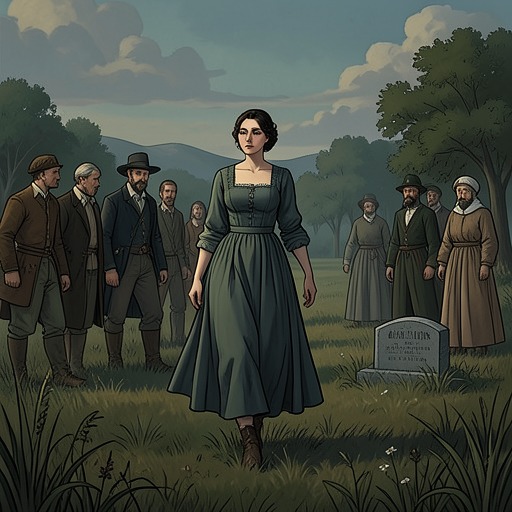
Bobby Rupp's grief
In Cold BloodBobby Rupp’s grief after Nancy Clutter’s death turns familiar places and rituals into measures of absence. Christmas, once marked by gifts and visits to River Valley Farm, finds him unable to eat or keep his usual routine; later, the river he remembers through Nancy’s stories and her old mare bring her presence close without restoring what he has lost. His mourning also reshapes his relationship with Susan Kidwell, whose company helps him endure the first shocks before shared remembrance becomes difficult for them both.
A courtship marked by Christmas
Nancy’s birthday came just after New Year’s, so Bobby Rupp faced the problem of finding two suitable gifts in quick succession. He had met it each year with money earned working summers on his father’s sugar-beet farm. On Christmas morning, he would hurry to the Clutter house with a package his sisters had helped wrap, hoping to surprise Nancy. The previous year he had given her a small heart-shaped gold locket; for this Christmas he had been considering imported perfume from Norris Drugs or riding boots. Nancy’s death made the choice—and the ritual around it—impossible.
The relationship had roots in childhood. When they were twelve, Bobby Rupp began carrying Nancy’s book satchel on the mile-long walk from the Holcomb schoolhouse to her father’s farm. On warm afternoons, they sometimes stopped by the Arkansas, then a slow, winding brown river across the Kansas plains. That shared route and the river became part of the history against which his bereavement would later register: Nancy was bound to ordinary journeys, seasonal weather, and the landscape they knew together.
Christmas after Nancy’s death
On Christmas morning, Bobby Rupp stayed home instead of going to River Valley Farm. Later he ate the holiday dinner his mother had spent a week preparing, while his parents and seven siblings treated him gently and repeatedly urged him to eat. Their care did not reach the central fact of his condition: he was ill with grief. The narrative describes his sorrow as a circle that others could neither enter nor remove, with Susan Kidwell perhaps the one exception.
His isolation followed a holiday formerly associated with welcome at the Clutter home. In an earlier Christmas memory, after walking three miles through deep snow to visit Nancy, Bobby had been warmed by her delight and by the hospitality of her mother. He sat by the fire with Kenyon Clutter and Mr. Clutter, cracking walnuts and pecans. The contrast is stark: a journey through winter had once ended in family warmth, while the Christmas after the murders kept Bobby at home, separated from the place and people around whom the season had gathered.
He also had to endure the crime’s aftermath and questioning by Mr. Dewey. For a time, Bobby Rupp was the principal suspect, adding a further shock to his bereavement. The combination left him struggling not only with Nancy’s absence but with the investigation’s attention and the distress of being suspected in the very crime that had taken her from him.
Susan Kidwell and the limits of shared mourning
Before Nancy’s death, Bobby Rupp had not fully appreciated Susan Kidwell. Her seriousness about paintings, poems, and piano music made him uncomfortable, and he was jealous of the place she held in Nancy’s esteem. He understood that place as different from his own but at least equal in importance. After the murder, however, Susan’s closeness gave him someone who could understand the loss in a way his family could not.
Her almost constant presence helped him withstand the successive shocks of the crime, the interviews, and his temporary status as the main suspect. But after about a month, their friendship began to wane. Bobby visited the Kidwells’ small, comfortable parlor less often, and when he did, Susan seemed less welcoming. They were compelling each other to remember what both wanted to forget. Their distance does not cancel the support they had given one another; it marks the limit of a companionship organized around a shared wound.
Running, memory, and River Valley Farm
Bobby Rupp sometimes found relief in activity: basketball, fast drives on country roads, and long runs across the flat yellow fields. He hoped to become a high-school gymnastics instructor, and after helping clear the Christmas dinner table, he put on a sweatshirt and went running. Yet the run carried him, without intention, to River Valley Farm. His movement away from grief ended at the place most saturated with Nancy’s memory.
The farm’s condition made the family’s absence visible. Spoiling apples scented the orchard of fruit trees Mr. Clutter had planted and cherished. The house still stood white, solid, and spacious, but without its owner’s attention decay had begun: a gravel rake rusted in the driveway, the lawn looked parched, and the ambulance tire tracks from the day the murdered family was removed remained on the grass. The hired man’s house was empty too; he had moved his family nearer Holcomb. Though the weather was bright, the property seemed hushed and motionless.
Bobby Rupp had not meant to come there. He turned as if to leave, then wandered toward the house before passing the barn and corral. Hearing a horse, he found Nancy’s Babe, an obedient old dappled mare with a flaxen mane. He clutched the mane and rubbed his cheek against the mare’s neck, repeating a gesture Nancy used to make. Babe’s response offered a moment of contact with a familiar presence, but the gesture belonged to Nancy’s vanished life as much as to Bobby’s continuing grief.
The Arkansas provides a different form of return. Nancy had told Bobby about seeing the river’s source in Colorado, where it was clear, fast, and full of rocks, unlike the muddy stream they knew on the Kansas plains. Since her death, looking at the local river could briefly transform it in his mind into the mountain torrent she had described. The remembered contrast makes the river a vessel for Nancy’s way of seeing: Bobby does not simply recall a story but perceives the familiar landscape through her account. The narrative likens Nancy herself to young water, energetic and joyful, leaving the image to hold both the vitality he remembers and the irretrievable distance of her death.