Bonnie Clutter
In Cold BloodBonnie Clutter’s life in In Cold Blood is shaped by a sharp contrast: she is cherished within her family, yet for years illness has kept her at a distance from the life she longs to share. The news that her suffering might have a physical cause briefly opens the prospect of recovery. Her death then turns that promise into a devastating reversal, while the tenderness and fear surrounding her final hours complicate the account of the crime.
Identity and Background
Bonnie Clutter was born Bonnie Fox, the only daughter of a prosperous wheat grower and the adored younger sister of three brothers. Her childhood, as she remembered it to Jolene, was a protected sequence of Kansas autumns, California summers, and small, beautiful keepsakes. She particularly valued miniature objects collected during family trips to the California coast. The little teacups and paper fan she showed Jolene were not merely ornaments: they carried memories of a childhood in which she had felt cared for and secure.
At eighteen, inspired by a biography of Florence Nightingale, she entered nurse training at St. Rose’s Hospital in Great Bend. After two years she acknowledged that hospital work overwhelmed her, and left without completing the course. She continued to regret not earning the diploma, which she had hoped would prove she had once succeeded at something. She later married Herbert William Clutter, a college classmate of her oldest brother. Though the Foxes and Clutters moved in different social circles, Bonnie loved Herbert, and he wanted to marry her. Their marriage lasted about a quarter-century and was represented by the plain gold band Herbert wore on a hand once injured by farm machinery.
Bonnie and Herbert had four children: Eveanna Jarchow, Beverly Clutter, Nancy Clutter, and Kenyon Clutter. By the time of the family’s planned Thanksgiving reunion, the older daughters lived away from River Valley Farm: Eveanna Jarchow, married and a mother, visited frequently, while Beverly Clutter was studying nursing in Kansas City and preparing for a Christmas-week wedding. Nancy Clutter and Kenyon Clutter remained at home. Bonnie’s family was therefore both the center of her life and, increasingly, a source of grief over the time she felt illness was taking from her.
Illness and Domestic Life
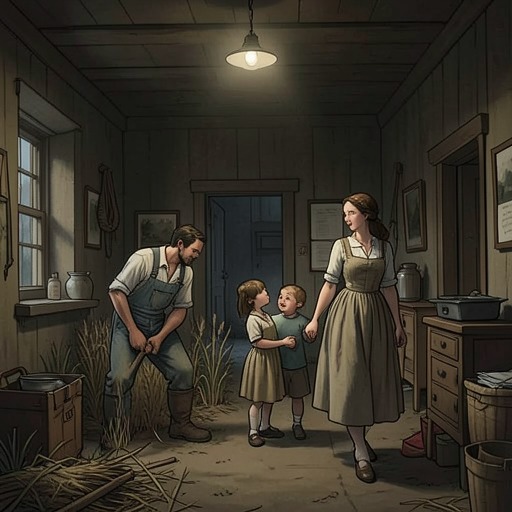
Those close to Bonnie softened descriptions of her condition as nervousness or spells, but her history of psychiatric treatment was known. For roughly six years she had been an intermittent patient, often retreating to Wichita for care. Her withdrawal affected the household: she could feel unable to make decisions about the farm in her husband’s absence and sometimes shut herself in her bedroom rather than risk displeasing him. The spare room, with its oak bed, walnut bureau, heating pad, white nightgowns, and closed window, reflected how much of her daily life had contracted around illness.
The room also became a place where Bonnie felt the cost of that separation. During a summer visit, Wilma Kidwell found her in distress after the others had gone to pick mulberries. Bonnie told her that hearing the guests laugh made her feel she was missing the best years of life, including her children’s growing up. She feared Kenyon Clutter would become a man while she remained, in her own image, a kind of ghost to him. The episode gives her isolation a particular shape: she was not indifferent to the family around her, but painfully aware of being unable to join them.
A change seemed possible shortly before her death. After two weeks of treatment at Wesley Medical Center in Wichita, Bonnie returned with the explanation that doctors believed her misery came from misplaced vertebrae rather than from her mind. An operation, she was told, might restore her former self. On the evening of Friday the thirteenth, she appeared to embody that hope: she dressed carefully, went with Herbert to a Holcomb School production of Tom Sawyer, and watched Nancy Clutter perform as Becky Thatcher. Herbert was pleased to see her out among people, smiling and talking despite her nervousness. Her pride in Nancy and the prospect of future treatment briefly brought recovery and family life into view together.
Relationships and Final Hours
Bonnie’s marriage joined her sheltered upbringing to Herbert’s practical, public life. He traveled frequently for business but remembered her fondness for tiny things, bringing her inexpensive keepsakes from his trips. She spoke of those gifts as evidence that he knew what delighted her. Their attachment also appears in the account of the farmhouse invasion: when Herbert brought the intruders to her room, he tried to reassure her and explained that they wanted money. Bonnie answered that she had none and defended her husband’s account when his captors challenged it. Her response remains grounded in the ordinary trust between them, even as the household’s safety was collapsing.
In Perry Smith’s later account, Bonnie was frail and crying, and asked about Dick’s intentions and whether the family would be harmed. Perry said she regarded him as more trustworthy and made him promise not to let Dick hurt anyone. He understood her concern to include her daughter. His account places Bonnie’s attention on the safety of her family even while she herself was frightened. It also records that she had been left bound in her bedroom. These details are mediated through Perry’s confession, not through an independent account of her thoughts, and should be read as his recollection of their encounter.
Death and Aftermath
Bonnie was murdered along with Herbert William Clutter, Nancy Clutter, and Kenyon Clutter at River Valley Farm. Investigators later examined details of the scene that seemed to them to resist a simple account of the killers as uniformly indifferent. In particular, Alvin Adams Dewey focused on the bedcovers drawn over Bonnie and Nancy after they had been restrained. He wondered whether this apparently considerate gesture reflected a distorted tenderness in one of the assailants. That was Dewey’s interpretation, not a settled explanation of the killers’ motives; its force lies in the unsettling coexistence of violence and small acts resembling care.
Bonnie’s absence continued to shape the people and place she left behind. Paul Helm remembered her at a bedroom window overlooking the garden, where she sometimes stood for long periods. On a later December afternoon, the sight of a scarecrow in a faded flowered dress recalled her to Alvin Adams Dewey. The image turned a familiar piece of farm clothing into an emblem of loss amid the winter fields. Marie Dewey, too, dreamed that Bonnie had entered her kitchen after the murders, but could not be comforted. In these later scenes Bonnie is no longer present to speak for herself; others encounter her through memory, an object, or a dream.
Narrative Significance
Bonnie is not defined only by illness or by her place among the victims. The narrative establishes her childhood pleasures, unfinished ambition, affection for Herbert, pride in Nancy, and sorrow over lost time before showing how narrowly illness has confined her. Her report of a potentially treatable physical cause arrives just before the family’s destruction, so the promise of restored health becomes one of the story’s sharpest reversals. Her life also unsettles any easy separation between vulnerability and agency: even in her final hours, she speaks for her husband’s honesty and seeks assurances for her children. The later memories of her room, garden, keepsakes, and hoped-for recovery preserve a person whose private longing for ordinary family life survives in the narrative after her death.