Boots from the Murder Scene
In Cold BloodThe Boots from the Murder Scene turned ordinary personal possessions into a physical link between Dick, Perry Smith, and the Clutter family home. Recovered shortly before the suspects’ arrest, the two pairs were compared with photographed footprints from the scene; their sole patterns gave investigators a specific basis for confronting the men during questioning.
Recovery and Identification
The boots came to investigators in a box of belongings that Dick and Perry Smith had picked up at a post office shortly before their arrest. The timing mattered: Harold Nye later recalled that the team had the boots and the corresponding sole patterns just as the opportunity to secure them was closing. The objects were not merely described as footwear associated with the suspects; investigators had obtained both pairs and compared their soles with life-size photographs of footprints found in the Clutter family home.
The comparison distinguished the two patterns. One pair bore a Cat’s Paw half-sole pattern, while the other had a diamond pattern. The Kansas Bureau of Investigation agents regarded both as matching the photographed impressions. Thus the evidentiary force lay in a concrete correspondence between sole designs and recorded tracks, rather than in a general resemblance between the boots and footwear that might have been common.
The Interrogation Evidence
When the four Kansas investigators—Harold Nye, Roy Church, Alvin Dewey, and Clarence Duntz—assembled for the first confrontation in Las Vegas, the boots were among the evidence they had brought with them. Nye and Church were assigned to press Dick, while Dewey and Duntz were to question Perry Smith. Nye recalled that the case still seemed vulnerable, but that the agents felt they were close to the truth. The boot matches supplied an unusually tangible point of pressure in that uncertain investigation.
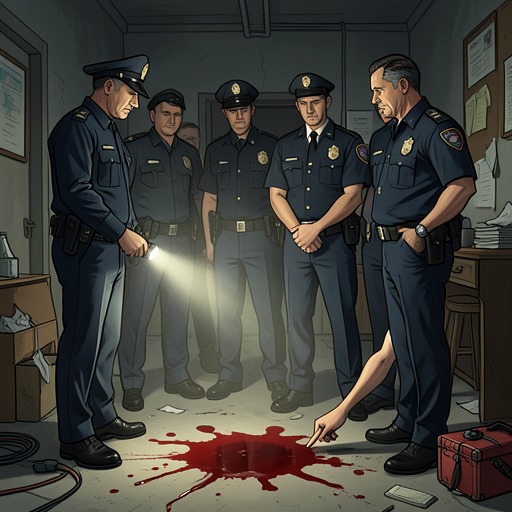
During the interview with Dick, Nye produced a one-to-one reproduction of footprints found near Mr. Clutter’s body, then opened a box containing the boots he identified as Dick’s. Dick looked at the photograph and boots, then lowered his head into his hands. Nye also told him that investigators had Perry Smith’s boots and that they matched another set of prints, including blood-marked impressions. The boots therefore became part of a direct confrontation: an assertion about the suspects’ connection to the scene made visible on the interview table.
Evidentiary Meaning and Limits
The matches helped investigators move from suspicion toward a specific physical link: the patterns on the recovered boots corresponded to footprints documented at the house. They also gave the detectives a way to challenge Dick with evidence rather than relying only on questioning. In the scene, the boots’ significance is heightened by their ordinary character. Once paired with the photographs, they cease to be incidental belongings and become readable traces of presence.
The evidence, as presented in these passages, establishes the footwear-to-footprint comparisons and the role those comparisons played in the interrogation. It does not, by itself, narrate the full sequence of events in the house or settle every question about what each man did. Its importance is narrower and concrete: the boots connected each suspect with a corresponding set of prints, giving the investigators a material basis for pressing their case.