Discovery of the slain Clutter family
In Cold BloodThe discovery of the slain Clutter family transformed an unexplained absence from Sunday church into a four-victim murder investigation. When Susan Kidwell and Nancy Ewalt entered the Clutter home at River Valley Farm, they found the family dead and the household’s ordinary routines abruptly interrupted. The scene provided clues, but not an immediate explanation: investigators could establish that four people had been killed without knowing who had been targeted, in what order the family died, or why.
The family’s absence
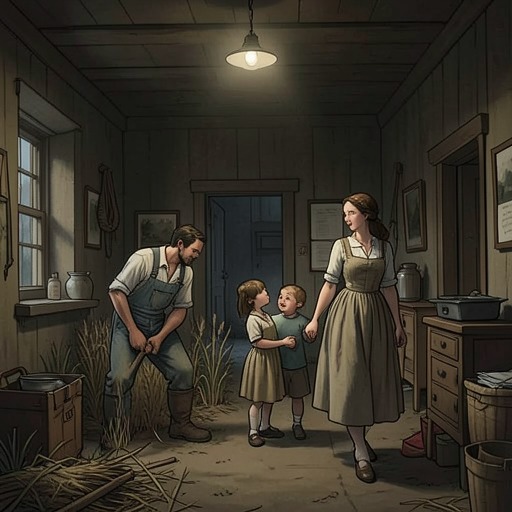
On Sunday morning, Nancy Ewalt’s father, Clarence Ewalt, drove her to River Valley Farm, as he customarily did so she could accompany the Clutter family to Methodist services in Garden City. The arrangement depended on the family being home and ready to go. Earlier that morning, boys completing chores on the property had noticed nothing amiss. By the time Nancy Ewalt arrived, the sun was up, but no one answered the front door.
Nancy Ewalt tried the house’s entrances in turn. The office door stood partly open, but she did not enter; the cars in the garage suggested the family was home. After the kitchen door also brought no response, she returned to her father. The apparent contradiction—that the Clutters were present but not answering—made their absence harder to explain. Clarence Ewalt and his daughter then went to tell Susan Kidwell, who was also expected to join the family for church.
Susan Kidwell could offer no explanation for the missed outing. After her mother suggested that the family might be asleep, Susan called the house and let the phone ring without receiving an answer. Clarence Ewalt proposed that they return and try to wake them. Susan later recalled that she was afraid to go inside, though she did not then know why. Her account emphasized the mismatch between the bright, quiet morning and the prospect of entering a house in which ordinary signs of breakfast and family activity were missing.
Entering the house
Susan Kidwell and Nancy Ewalt went to the kitchen door, which was unlocked, and entered. The absence of breakfast dishes and food on the stove suggested that the household had not begun its normal Sunday routine. They noticed Nancy Clutter’s purse on the floor, partly open, then moved through the dining room to the stairs. Susan called for Nancy Clutter and started upstairs, followed by Nancy Ewalt. Susan later remembered their footsteps sounding unusually loud in the otherwise silent house.
Nancy Clutter’s bedroom door was open, and sunlight filled the room. Susan saw Nancy Clutter and ran from the house; Nancy Ewalt also fled, telling her father that Nancy was dead. Susan initially rejected that conclusion and insisted to herself that what she had seen might be a nosebleed. Her response records the distance between recognizing a familiar person and accepting that the ordinary explanation no longer applied. Clarence Ewalt, who had been getting out of the car to follow the girls, heard their alarm and took them in as they ran back to him.
The girls’ account brought Clarence Ewalt to the telephone. He contacted the Garden City sheriff’s office to report that something was seriously wrong at the Clutter home. Susan accompanied him to meet the sheriff and later said she began paying attention to details because she anticipated she might be asked to testify. At 9:35, according to her recollection, the sheriff arrived and followed the Ewalts’ car back to the property. The sheriff initially described the situation as a possible accident; inside, the cut telephone wires in the kitchen and office made clear that the discovery involved more than a family’s unexplained failure to answer the door.
Four victims and an uncertain scene
The first room they examined was Nancy Clutter’s. The sheriff confirmed her identity with Susan Kidwell, who knew Nancy and had directed her in a school production. The investigators then searched for Herbert William Clutter and Kenyon Clutter. In Herbert William Clutter’s bedroom, they found his wallet with cards displaced, while his glasses remained on a bureau. Susan knew that he and Kenyon Clutter depended on their glasses to see clearly; their absence from the rooms where they were found suggested that the two had not simply gone about their ordinary business. The rooms otherwise showed little disturbance, and shotguns found in a closet did not appear to have been fired.
The search widened when undersheriff Wendle Meier arrived from the basement and reported another body. Kenyon Clutter was found in the basement playroom. In the furnace room, the sheriff and the others found Herbert William Clutter. Susan’s recollection also noted a bloodstained half-sole print on a cardboard box and a piece of cord knotted to an overhead pipe. Those details raised questions about how Herbert William Clutter had been restrained and moved, but the scene did not answer what had happened inside the house or what the killers intended.
The house soon filled with emergency personnel, investigators, a minister, a photographer, and members of the press. The arrival of so many people from the community, many called away from church, registered the rupture between the crime and Holcomb’s accustomed quiet. Outside, Alfred Stoecklein, the hired man who lived nearby, said he had heard nothing during the night. Even the proximity of another household had not produced a witness to the killings.
Investigation and competing explanations
At a press conference, Alvin Adams Dewey insisted on separating known facts from theories. There had been four murders, he said, but investigators did not know which family member, if any, had been the primary target. The coroner could place the deaths only within a window between 11 p.m. Saturday and 2 a.m. Sunday, and could not establish their order. Investigators also knew at that point that nothing appeared to have been stolen from the house. Herbert William Clutter’s recent purchase of a $40,000 life-insurance policy with double indemnity seemed striking, but Alvin Adams Dewey saw no connection: the surviving beneficiaries were his two elder daughters.
Alvin Adams Dewey had developed two competing reconstructions, one involving a single killer and another involving two. His single-killer possibility depended on an intruder having particular knowledge of the house: which doors were usually unlocked, where the family slept, and how its rooms were arranged. In that version, the intruder cut the telephone wires, forced Herbert William Clutter to help restrain the others, and then killed the family. It remained a working theory, not an established account; Alvin Adams Dewey had not decided between his two concepts when he addressed reporters.
The investigation eventually supplied evidence that the discovery scene alone could not. Agents traced a radio and binoculars taken from the home to a pawnshop in Mexico City. Perry Smith’s dictated statement also disclosed where he and Dick had buried discharged shells, cord, and adhesive tape after leaving the crime scene, and where they had burned clothing and gloves. At trial, the prosecution presented forensic evidence including blood samples, footprints, cartridge shells, rope, and tape, alongside accounts of the prisoners’ statements. Perry Smith’s refusal to sign a typed version of his seventy-eight-page statement prompted a later dispute over responsibility, while his account and other evidence helped investigators and the court reconstruct the crime. The discoveries at River Valley Farm thus began a chain from a family’s unanswered doors to physical evidence, confessions, and a prosecution, without making the first morning’s unanswered questions disappear at once.