Execution of Lowell Lee Andrews
In Cold BloodThe execution of Lowell Lee Andrews, carried out on Friday, November 30, 1962, ended a long legal struggle and became, in Dick’s later recollection, a scene watched from inside the prison. Its significance lies both in the grimly prolonged mechanics of the hanging and in the farewell that preceded it: Andrews left a poem, spoke lightly of his burial, and met death with a composure that Dick remembered as inseparable from his intelligence and strangeness.
Appeals and the date of execution
The execution came after Andrews’s lawyers had fought to the final moment. The book places his fate beside that of Perry Smith and Dick, who had received a reprieve from a federal judge and evaded their execution date. Andrews did not. The contrast makes the outcome feel contingent as well as final: capital cases might move quickly or stretch for years, depending partly on luck and, above all, on litigation.
The account describes appeals as a legalistic wheel turning through state and federal courts toward the Supreme Court, then potentially beginning again when counsel found new grounds to raise. That process could delay execution without guaranteeing escape from it. Andrews’s lawyers pursued it to the end, but the wheel stopped for him at the gallows. His execution therefore stands not simply as the conclusion of a sentence, but as the moment when further legal postponement no longer altered the outcome.
The prison’s view
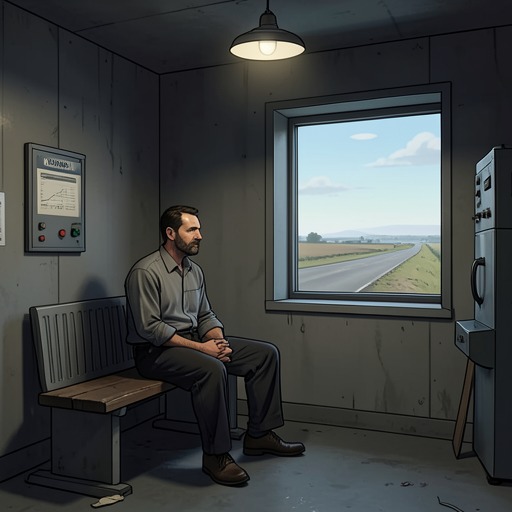
Dick later described the execution to a journalist with whom he corresponded and who was periodically permitted to visit him. His account begins with the weather and the route: a cold, wet night, rain, and a baseball field so muddy that Andrews had to be led along a path to the warehouse. From their windows, Dick, Perry Smith, George Ronald York, and James Douglas Latham watched. The warehouse doors stood open and its interior was brightly lit, but the gallows itself was hidden from their angle. They could see its shadow on a wall, which Dick likened to the shadow of a boxing ring.
A chaplain and four guards accompanied Andrews. His arms were tied in front of him. At the warehouse entrance, the group paused briefly, and the chaplain removed Andrews’s glasses before leading him inside. Dick remembered the small, unsettling change in his appearance without them and wondered how he could see well enough to climb the steps. The prisoners could not see the gallows; they had to follow the execution through sounds and glimpses of those entering and leaving the warehouse.
The scene’s quiet was broken by a dog barking in the distance. After the trapdoor fell, silence returned except for the dog. Dick said Andrews’s body continued to move for a long time. Every few minutes, the doctor came outside with a stethoscope, then returned to listen for a heartbeat. Dick recalled that the doctor was gasping and crying, and that James Douglas Latham remarked on his distress. Andrews’s heart continued beating for nineteen minutes. The precise interval, relayed from a witness behind a prison window, gives the hanging its terrible duration: the trapdoor’s fall did not immediately end the event.
Farewell and burial
Dick’s recollection also turns to Andrews’s final hours and the exchange between the two men before the execution. Andrews had eaten two fried chickens shortly before he was hanged; during the last afternoon, he smoked cigars, drank Coke, and wrote poetry. When the prisoners said goodbye, Dick joked that they would meet again in the same place and asked Andrews to find them a cool, shady spot. Andrews laughed and said he believed in neither heaven nor hell, only in dust returning to dust.
Andrews told Dick that an aunt and uncle had visited and said they had a coffin waiting to take him to a small cemetery in north Missouri. They intended to bury him beside the three people he had killed. Dick answered by contrasting Andrews’s expected grave with the possibility that he and Perry Smith might be given to a vivisectionist. The exchange makes death tangible through arrangements for a coffin and a named burial place, even as the prisoners use dark humor to speak about their own expected deaths.
As he was led away, Andrews handed Dick a piece of paper bearing a poem. Dick could not be certain whether Andrews had written it himself or copied it from a book, though he suspected it was his own work. The farewell message proved to be the ninth stanza of Gray’s “Elegy Written in a Country Churchyard,” including the line “The paths of glory lead but to the grave.” In the context of the hanging, the borrowed or composed verse joins literary reflection to the immediate fact of Andrews’s death; the uncertainty about authorship remains part of Dick’s account rather than being resolved.
Dick’s portrait of Andrews
After recounting the execution, Dick remembered Andrews as someone he had genuinely liked: goofy, in his view, but not mentally ill in the sense other people insisted on. Andrews often talked about escaping and earning his living as a hired gun, imagining himself moving through Chicago or Los Angeles with a machine gun concealed in a violin case and charging a thousand dollars for each killing. Dick presented these plans as extravagant fantasies, made stranger by the contrast between their imagined violence and the intellectual discipline he associated with Andrews.
Dick called Andrews the smartest person he had ever encountered and described him as a human library: what he read stayed with him. Yet he also judged him ignorant of life. Dick set this book learning against his own claimed experience—mean streets, violence, childbirth, dangerous encounters, a near-fatal swim after falling from a ship, and work as an ambulance driver. The contrast is not a neutral measure of either man; it is Dick’s way of defining what each knew. Andrews possessed an exceptional memory for books, while Dick claimed knowledge earned through exposure to events and people. Their difference gives the execution recollection its final tension: the condemned man who could carry a library in his mind could not, in Dick’s estimation, understand the lived world beyond it.