Garden City, Kansas
In Cold BloodGarden City, Kansas, is both a working county seat and the principal civic stage of the Clutter case: a town whose quiet routines and frontier remnants are overtaken by investigation, press attention, trial, and the long memory of the dead. The crimes occur nearby in Holcomb, Kansas, but it is in Garden City, Kansas, that law enforcement organizes, the accused are brought back, the trial unfolds, and the case’s legal history is revisited. Its courthouse and cemetery make the town more than a backdrop; they give the story recurring public spaces in which grief, pursuit, judgment, and remembrance meet.
A Frontier Town in the Continental Middle
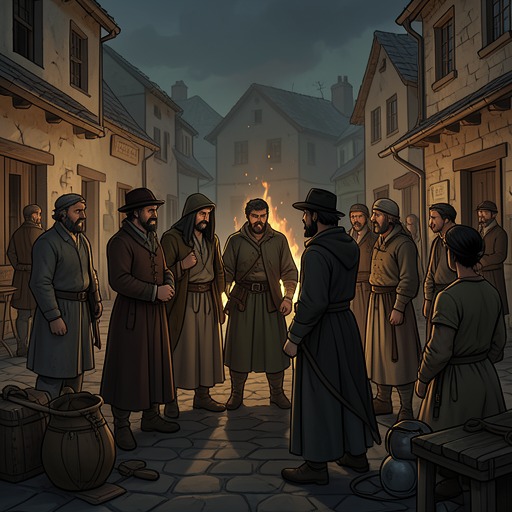
Garden City, Kansas, had grown from a settlement founded soon after the Civil War into a town of eleven thousand. Its origins were associated with an itinerant buffalo hunter whose influence helped transform huts and hitching posts into a ranching center with saloons, an opera house, and a hotel famed as the plushiest between Kansas City and Denver. The old frontier prosperity had faded by the time of the Clutter case. The Buffalo Block preserved a colorful row of commercial buildings, and the Windsor Hotel remained a Main Street landmark, with a high-ceilinged saloon and vast, echoing rooms. Yet travelers and residents had more modern alternatives: the Hotel Warren and the Wheat Lands Motel, whose amenities included individual televisions and a heated swimming pool.
The town’s position in the continental interior contributes to its uneasy double identity. Coast-to-coast travelers might pass through without remembering it, as though it were simply another fair-sized town near the middle of the country. Garden City residents, however, took pride in their schools, churches, air, water, and prospects for raising families. The novel places that civic self-confidence alongside the evidence of a town still tied to its frontier past, but increasingly shaped by ordinary institutions and modern commerce. Before the murders, the drama of exceptional events seemed to pass it by; afterward, that apparent distance from history could no longer hold.
Garden City, Kansas, is also the close-by county seat for Holcomb, Kansas, and the civic center of a surrounding agricultural region. Herbert William Clutter, owner of River Valley Farm, was prominent in both communities. He had studied agriculture at Kansas State University, chaired the Kansas Conference of Farm Organizations, and led the building committee for Garden City First Methodist Church, an eight-hundred-thousand-dollar building. His recognition extended beyond the town: he had also served on the Federal Farm Credit Board during the Eisenhower administration. These details establish the local standing of the family whose deaths would draw national attention to Garden City, Kansas.
The County Seat Becomes the Case's Center
The sheriff’s office occupied three sparsely furnished rooms on the third floor of the stone-and-cement Finney County Courthouse and Jail, Kansas, set in the middle of a tree-filled square. Before the murders, it was a quiet workplace where courthouse visitors might linger and the sheriff’s secretary had time for conversation. The Clutter investigation changed that routine. Alvin Adams Dewey, the Kansas Bureau of Investigation’s Garden City representative, was asked by Finney County Sheriff Earl Robinson to take charge. Dewey had previously served as the county sheriff and as a Federal Bureau of Investigation special agent; he also knew Herbert William Clutter and Bonnie Clutter through church and visits. The investigation was professionally demanding, but for Dewey it was personal as well as official.
As the inquiry expanded, eighteen men were eventually assigned to the case full time, including Kansas Bureau of Investigation agents Harold Nye, Roy Church, and Clarence Duntz. The courthouse office became a hub for investigators and journalists. The case brought reporters from across the country to Garden City, Kansas, and local staff felt the change in the building’s atmosphere as unfamiliar visitors and newspaper attention displaced its customary quiet. At a press conference, Dewey distinguished known facts from theories: four people had been murdered, the precise order of their deaths was unknown, and the coroner could only place the killings within a span from late Saturday night to early Sunday morning. The town’s civic offices thus became places where uncertainty was publicly acknowledged even as the investigation pressed toward answers.
The scale of local grief was visible at the Clutter funeral. A thousand people attended services at Garden City First Methodist Church, and about six hundred went on to graveside services at Valley View Cemetery, north of town. The crowd made the church and cemetery part of a communal response extending beyond the family’s immediate circle. Later, when Perry Smith read a newspaper account of the funeral in a hotel room, he registered the size of the congregation and wondered about the cost. The same public mourning that filled Garden City’s religious and burial spaces reached one of the men responsible for the deaths through the printed report.
Streets, Courthouse, and Trial
Garden City, Kansas, enters a different register when Alvin Adams Dewey sees Herbert William Clutter apparently sitting alive in the Trail Room, despite having attended his funeral. The vision turns into a dreamlike pursuit: Dewey and Clarence Duntz recognize Dick and Perry Smith, who flee through a plate-glass window and along Main Street, past local businesses and toward the depot and grain-storage towers. The chase then shifts into the town’s enormous public swimming pool and, in the dream, to Valley View Cemetery. There, the two fugitives stand laughing over the unmarked mass grave of Herbert William Clutter, Bonnie Clutter, Nancy Clutter, and Kenyon Clutter. Dewey fires repeatedly, but they do not fall; they fade from view as their laughter grows. The city’s streets and landmarks are rearranged by Dewey’s fear and exhaustion, turning the geography of investigation into a landscape of unresolved pursuit.
The actual return of Dick and Perry Smith to Garden City, Kansas, drew a crowd to Courthouse Square. News reporters and camera crews had gathered for days, and the Kansas Highway Patrol reserved space on the sidewalk before the courthouse steps so they could record the prisoners’ arrival. The sheriff’s office and jail were housed in the same courthouse complex, bringing the public spectacle of the return directly to the institution that would hold the accused. The crowd’s presence gave the transfer a charged atmosphere, though a patrol captain disputed a newspaper headline suggesting that a lynch mob awaited them.
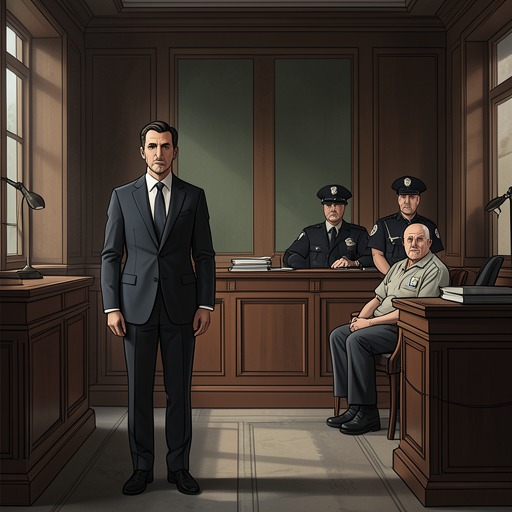
The trial began in the courthouse on March 22, 1960. Its courtroom, on the third floor, was an unpretentious chamber with white walls, dark wood, and seating for roughly 160 spectators. The jury was selected from the first forty-four candidates in four hours, much faster than expected. Fourteen men, including two alternates, were chosen; twenty candidates had been dismissed because they opposed capital punishment or had already formed a firm opinion about guilt. Four eventual jurors acknowledged some personal acquaintance with Herbert William Clutter, but said it would not prevent an impartial verdict. The proceedings brought the case’s public stakes into the ordinary physical limits of a county courtroom: local residents, lawyers, defendants, and observers gathered in a room whose scale was modest beside the crime’s notoriety.
The trial also revealed how unevenly the case’s fame was distributed. The Garden City Telegram noted before the proceedings that national attention had already moved among several multiple-murder cases. At the final session, local ranching elites sat alongside other residents and visiting lawyers to hear the state’s closing arguments. Logan Green, an experienced criminal lawyer retained to assist the prosecution, was among the prominent participants. The courtroom therefore held not simply a legal contest but a cross-section of local status and outside scrutiny, with Garden City, Kansas, serving as the place where the community’s knowledge of the dead and the state’s demand for punishment were brought together.
Cemetery and the Case's Afterlife
Valley View Cemetery gives Garden City, Kansas, a second, quieter center of gravity. Founded on a plateau above town, it was designed as a green refuge from the arid soil and dusty streets. Trees planted generations earlier shade its paths, while the surrounding wheat fields make the cemetery appear like a dark island amid open country. Its landscape repeatedly contrasts cultivated calm with the violence remembered there: the Clutter family’s graves lie together beneath one gray stone, at the cemetery’s far edge, beyond the trees and near the sunlit fields.
Almost two years after the trial, Garden City’s courtroom hosted a hearing on the defendants’ habeas corpus petition. The Kansas Supreme Court had appointed retired justice Walter G. Thiele to conduct the inquiry, and the hearing brought many of the case’s participants back to the city; it lasted six days and examined the claims in detail. The original defendants were absent from the Garden City courtroom itself, though the hearing was transferred to Lansing for their testimony. The return of lawyers, witnesses, and local figures made the courthouse a site not only of judgment but of retrospective scrutiny, where the fairness of the earlier proceedings was itself examined.
In the following May, Alvin Adams Dewey visited Valley View Cemetery to weed his father’s grave. He passed the graves of Judge Tate and a young woman killed in a car collision, and recalled changes in the lives of people connected to Garden City. Near the Clutter family’s graves, he encountered Susan Kidwell, whom he had not seen since the trial, when she had been a child. Their recognition of one another links the cemetery’s public memorial to a surviving personal relationship with the family and the case. Garden City, Kansas, does not resolve the losses through its institutions or landmarks; instead, its courthouse and cemetery preserve the continuing passage from investigation and punishment to memory, as the town returns to ordinary life around the graves and the places where the case was contested.