Herbert William Clutter
In Cold BloodHerbert William Clutter is presented as a self-made farmer whose agricultural expertise, public standing, and deliberate business habits made him one of the best-known people in Holcomb and nearby Garden City. His biography gives the coming violence a sharply defined setting: a community shaped by practical work and ordinary routines, and a farm built through years of risk, labor, and experiment.
Identity and Public Standing
At forty-eight, Clutter was in notably good health, according to a recent medical examination for a life-insurance policy. Just under five feet ten inches tall and weighing 154 pounds, he wore rimless glasses but otherwise cut a vigorous figure: broad-shouldered, square-jawed, still dark-haired, and with strong, unstained teeth. His weight was unchanged from the year he graduated from Kansas State University, where he had studied agriculture.
Clutter’s influence exceeded his wealth. He was not the richest man in Holcomb, but he was its most widely known citizen and was respected in Garden City, the nearby county seat, as well as among Midwestern agriculturalists. He chaired the building committee for Garden City First Methodist Church, a newly completed $800,000 building, and served as chairman of the Kansas Conference of Farm Organizations. During the Eisenhower administration, he had also been a member of the Federal Farm Credit Board.
From County Agent to Farm Owner
Clutter had grown up the son of a farmer and wanted to operate a property of his own. After marrying Bonnie Fox in 1934, he moved with her from Rozel to Garden City and took a job as assistant to the Finney County agricultural agent. He rose to the head position in seven months and held it from 1935 to 1939, during some of the region’s hardest years. His command of modern agricultural practices made him an effective intermediary between the government and struggling farm and ranch operators, but the work remained a step away from his own ambition.
He resigned after four years and began building River Valley Farm on leased land financed with borrowed money. Local conservatives had teased him that his university ideas might look different when applied to land he owned. Instead, his experiments succeeded. In the early years he worked eighteen hours a day; even after two failed wheat crops and the loss of several hundred sheep in a blizzard, he continued. Within a decade, he owned more than 800 acres outright and farmed another 3,000 on a rental basis.
The farm’s prosperity depended on wheat, milo seed, and certified grass seed, alongside sheep and cattle. One barn, a large Quonset hut, was filled with Westland sorghum; another held milo grain valued at $100,000. That single crop represented an almost 4,000 percent increase over Clutter’s entire income in 1934, the year he began his married life and moved to Garden City. The scale of the operation made concrete the distance he had traveled from a borrowed start.
Business Habits and Mortality
Clutter’s business dealings reflected a preference for orderly records over cash. When a Garden City representative of New York Life Insurance watched him prepare a check, he recalled a local joke that Clutter even paid his barber by check. Clutter confirmed the habit: he never carried cash, and he valued canceled checks as protection when tax officials came asking questions.
The check remained unsigned as Clutter turned in his desk chair and paused. The insurance representative, Bob Johnson, had spent more than a year arranging the sale and briefly wondered whether his client had changed his mind. He decided that Clutter was instead experiencing what insurance salesmen called the Solemn Moment: the pause that could accompany insuring one’s life, with its resemblance to signing a will. The scene leaves that moment suspended between routine business and an awareness of mortality.
A World Shattered
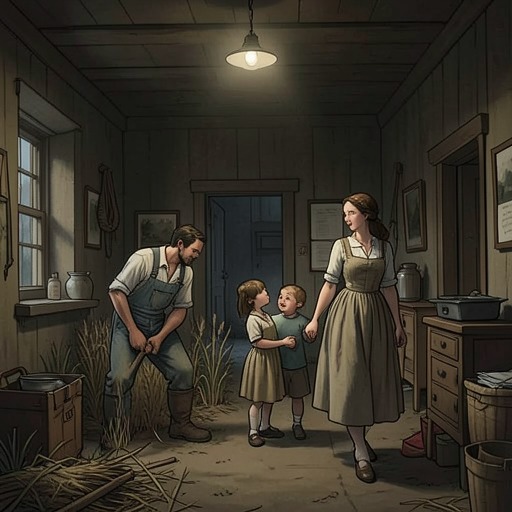
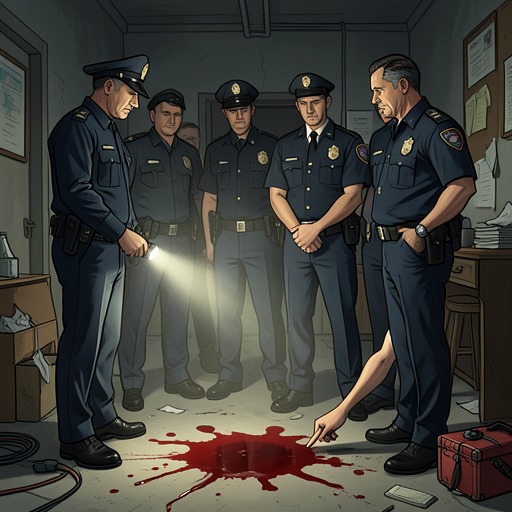
The narrative first situates Holcomb as a small community largely untouched by exceptional events, where residents worked, hunted, attended school socials and choir practice, and seldom felt a need to lock their doors. Against that settled background, four shotgun blasts in the early hours of a November Sunday ended six lives. Afterward, residents repeatedly imagined the sounds they had not heard, and mistrust altered how old neighbors looked at one another. Clutter’s portrait—his public responsibilities, expanding farm, and meticulous habits—makes the disruption legible through the secure, work-built world that preceded it.