Insanity defense
In Cold BloodThe Insanity defense in In Cold Blood turns on a divide between psychiatric descriptions of mental illness and the law’s narrower test for criminal responsibility. In the cases of Richard Eugene Hickock and Perry Smith, the courtroom restricted expert testimony to whether each man knew right from wrong; a contrasting case, that of Lowell Lee Andrews, makes explicit how the same legal standard could override a psychiatric diagnosis and foreclose a different outcome.
The legal test and its limits
The governing M’Naghten Rule asks whether a defendant could distinguish right from wrong in the legal sense. As the narrative explains through the courtroom proceedings, it does not recognize a defense merely because a person’s capacity for judgment or emotional life is abnormal. The distinction is consequential: a psychiatric assessment may describe severe dysfunction, but the trial question reduces that account to a narrow criterion of legal responsibility.
The contrast is sharpened by the Durham Rule, which treats an accused as not criminally responsible if the unlawful act is the product of mental disease or mental defect. The Andrews defense hoped to replace the M’Naghten Rule with this more permissive standard. The book describes that proposed change not as a purely technical dispute, but as the hinge on which a diagnosis could lead either to criminal punishment or to confinement in a hospital for the criminally insane. The rule therefore determines what kinds of psychiatric explanation the court can treat as relevant.
Hickock: a judgment narrowed to yes or no
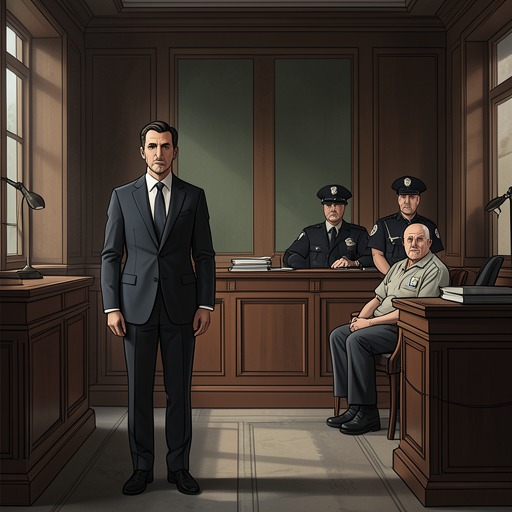
During the trial of Richard Eugene Hickock, Dr. W. Mitchell Jones was asked whether Hickock knew right from wrong when the crime was committed. He answered yes, and clarified that, within the usual definitions, Hickock did know right from wrong. The judge required a yes-or-no response to the initial question, and the prosecution successfully objected when the defense sought to let the doctor qualify his answer. Dr. Jones was dismissed without being allowed to give the fuller clinical account that the narrative then supplies.
That account complicates the legal answer without reversing it. Dr. Jones described Hickock as intelligent, alert, logically organized in his thinking, and in contact with reality. Hospital records confirmed a serious head injury in 1950; Hickock reported subsequent blackout spells, periods of amnesia, and headaches, although he had never undergone the medical tests needed to establish whether lasting brain damage remained. The doctor also described emotional abnormality, impulsive behavior, difficulty tolerating frustration, and an intermittent pattern of productive activity followed by irresponsible conduct. He noted low self-esteem, compensatory fantasies of wealth and power, bragging, and spending sprees, as well as difficulty forming lasting personal attachments. These observations were not heard by the jury as the doctor’s complete testimony. The legal answer—yes—stood where a broader psychiatric explanation had been cut short.
Smith: no opinion admitted, explanation excluded
When Dr. Jones was recalled to address Perry Smith, the court again framed the issue as a yes-or-no question: did he have an opinion on whether Smith knew right from wrong? Dr. Jones answered that he had no opinion. Although the defense was initially permitted to ask why, the prosecution objected, and the explanation was barred. The formal answer thus conveyed uncertainty, while the clinical basis for that uncertainty remained outside the jury’s consideration.
The narrative gives the testimony Dr. Jones would have offered. He considered Smith to show definite signs of severe mental illness and connected his history, as Smith related it and prison records partly verified it, with brutality and lack of care from both parents, a childhood without direction or love, and the absence of a settled moral framework. Dr. Jones described a suspicious, distrustful outlook; intense sensitivity to criticism; a strong desire for friendship coupled with reluctance to confide; and a tendency to anticipate misunderstanding or betrayal. He also identified poorly controlled anger, often directed toward authority figures, and said that when Smith’s anger turned inward it had produced suicidal ideas.
The unpresented account further described difficulty organizing and summarizing thought, a tendency to become lost in detail, and some disregard of reality. Dr. Jones noted that Smith had few close emotional relationships, little concern for people outside a small circle, and limited regard for human life. He cautioned that a more extensive evaluation would be needed for an exact diagnosis, while judging Smith’s personality structure to be very nearly that of a paranoid schizophrenic reaction. Dr. Joseph Satten of the Menninger Clinic later endorsed Dr. Jones’s evaluations of both Smith and Hickock. The juxtaposition matters: the account gives readers a detailed psychiatric interpretation while showing how little of that interpretation the trial procedure allowed the jury to hear.
Andrews and the proposed alternative
The account of Lowell Lee Andrews demonstrates the stakes of changing the legal standard. Before Andrews’s trial, the psychiatric staff of the Menninger Clinic conducted an extensive examination and diagnosed schizophrenia, simple type. In their usage, the diagnosis did not mean that Andrews suffered delusions or hallucinations; it referred instead to a separation of thinking from feeling. The examiners considered him aware of what he had done, that the act was prohibited, and that punishment could follow. Dr. Joseph Satten’s account emphasized the apparent absence of emotion and Andrews’s self-centered view of his own importance.
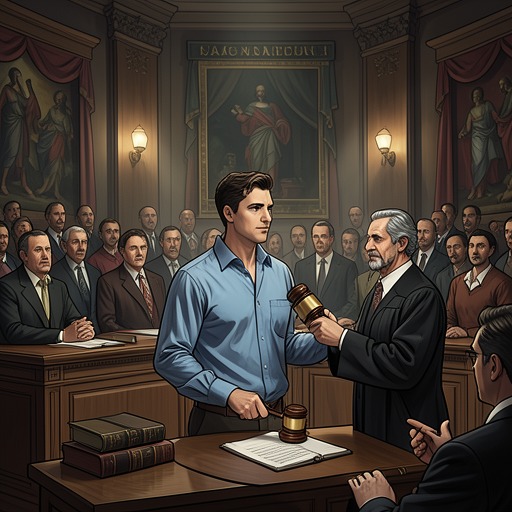
Andrews’s defenders—a team that included Menninger Clinic psychiatrists and two attorneys—sought a landmark ruling substituting the Durham Rule for M’Naghten. They argued that the psychiatric evidence made the case an especially strong opportunity to establish diminished responsibility; under the alternative rule, they expected Andrews to be confined in a state hospital for the criminally insane rather than sentenced to death or prison. The legal test, rather than the existence of a diagnosis alone, was therefore central to the defense’s strategy.
The effort failed. Reverend Virto C. Dameron, Andrews’s former religious counselor, testified for the prosecution, and the narrative identifies his testimony alongside Andrews’s confession as decisive. The judge upheld the M’Naghten Rule, and the jury imposed the death penalty sought by the state. Andrews’s case makes the book’s central legal contrast concrete: a psychiatric diagnosis could be extensive and still fail to change criminal responsibility when the court applied a rule centered on the capacity to distinguish right from wrong.
Narrative and legal significance
Across the three cases, the insanity defense is shown neither as a simple medical verdict nor as an automatic escape from punishment. Hickock’s evaluation recognized organized thought and awareness alongside marked emotional and behavioral problems; Smith’s evaluator declined to give a yes-or-no opinion, but could not explain why before the jury; Andrews had a diagnosis that his defenders believed warranted a different legal result, yet the existing rule remained in force. Each case exposes a different point of friction between clinical judgment and legal procedure.
The book’s structure reinforces that friction by placing the restricted courtroom answers beside fuller accounts of what the experts would have said. The reader encounters a discrepancy between the breadth of psychiatric description and the narrowness of the admissible legal question. The resulting issue is not only whether a defendant was mentally ill, but what a court’s chosen definition of responsibility permits illness to mean. In the Andrews case, that definition carried the starkest consequence: the proposed legal reform failed, the death sentence followed, and the diagnosis did not displace the governing rule.