James E. Post
In Cold BloodJames E. Post is the Protestant chaplain at Kansas State Penitentiary and Perry Smith’s counselor. During the defense case, he offers the court a small but revealing account of Smith: a prisoner who made a portrait of Jesus Christ and gave it to the prison chapel. Post’s testimony also brings a separate moral conflict into view. He opposes capital punishment, yet cannot settle what should be done with a person who has committed grave crimes.
Identity and Role
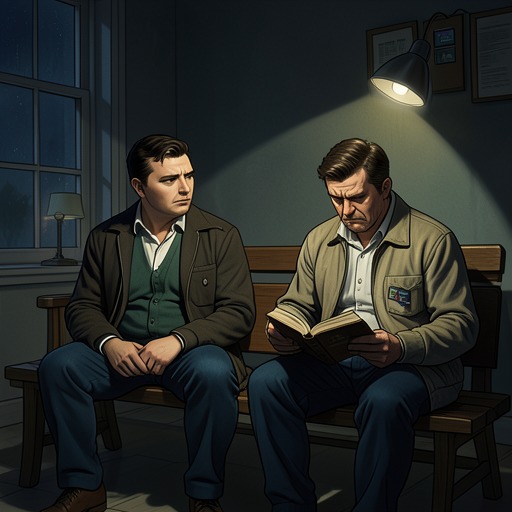
Post is introduced as the prison’s Protestant chaplain and as one of the witnesses called by Smith’s elderly counselor, Arthur Fleming. The defense presents him as a character witness, alongside people who knew Smith in other settings, hoping to place evidence of human qualities before the jury. The prosecution objects to personal character testimony, limiting how much these witnesses can say. Post’s religious office gives his testimony a distinct bearing: he describes not an abstract judgment of Smith, but an encounter grounded in prison life and religious practice.
The Portrait in the Prison Chapel
Post recounts that Smith came to his office carrying a head-and-shoulders portrait of Jesus Christ, made in pastel crayon. Smith wanted the picture for the chapel, and Post accepted it; by the time of the trial, it had remained on the walls of Post’s office. The detail does not erase the crime or establish Smith’s innocence. Instead, it gives the jury a concrete instance of a prisoner making something religious and offering it for communal use.
Fleming asks whether Post has a photograph of the portrait. Post produces an envelope full of photographs, apparently intending to distribute them among the jurors. The prosecutor objects that the display has gone too far, and the judge ends it. The exchange shows both the defense’s effort to make Smith’s painting visible in court and the limits imposed on that effort: the portrait can be described, but its reproduction is prevented from becoming a broader courtroom exhibit.
Judgment, Mercy, and Capital Punishment
After testimony concludes, Post joins a conversation among spectators about punishment. Passing around a snapshot reproduction of the portrait, he argues that a person capable of painting it cannot be wholly bad. Yet this is not a defense of the crime or a simple claim that art proves goodness. Post immediately acknowledges the difficulty of deciding what should follow, and says that execution leaves too little time for a sinner to turn toward God. His religious objection is therefore directed not only at the condemned person’s character but at the finality of the state’s response.
Post admits that he sometimes despairs, then recalls the fictional Doc Savage, who sought to rid the world of criminals by surgically removing the part of the brain associated with wicked thoughts. He wonders aloud whether such an intervention might offer an answer. The speculation is fantastical, not a proposed account of what happened to Smith; in the moment, it reveals Post’s frustration with the stark alternatives of condemnation and execution. A bell announcing the jury’s return interrupts him before he can develop the thought further.
Narrative Significance
Post’s appearances hold together two forms of evidence that the trial cannot easily reconcile. The portrait is a physical object made by Smith and kept in the chaplain’s office; the legal proceeding, by contrast, asks for judgments about responsibility and punishment. Post does not resolve that divide. His testimony gives Smith a human and religious dimension without displacing the gravity of the offense, while his opposition to execution exposes the moral unease that persists even among those who believe the crime demands judgment.