Kansas State Penitentiary
In Cold BloodKansas State Penitentiary is more than the prison where Perry Smith and Dick serve time: it is the setting in which their partnership takes shape, where Perry’s closest friendship develops, and where Floyd Wells’s knowledge of the Clutter family becomes a crucial link in the investigation. The institution gathers the book’s different strands of confinement—friendship, criminal planning, testimony, and the prospect of execution—within one heavily guarded landscape.
Setting and Structure
Built during the American Civil War, Kansas State Penitentiary received its first prisoner in 1864. The book places it in Lansing, Kansas, where its turreted black-and-white buildings stand out against the surrounding rural town. At the time described, the prison population averaged about two thousand. Its grounds form a walled compound of roughly twelve acres, with cell blocks, workshops, and cement streets behind steep, machine-gun-guarded walls. Prisoners are counted and classified in the warden’s daily chart, which records racial categories as well as the total population.
The institution contains distinct spaces for different forms of confinement. A dark, coffin-shaped building in the southern part of the compound houses both the isolation area and Death Row. Difficult prisoners may be sent to the lower floor, known among inmates as The Hole; Death Row occupies the upper story, reached by a circular iron staircase. The building’s shape and internal divisions give the prison a concentrated, almost self-contained geography: ordinary imprisonment, disciplinary isolation, and the approach of execution occupy different levels of the same structure.
The Death Row cells are small and standardized, each measuring seven by ten feet and furnished with a cot, toilet, basin, and an overhead light that remains on continuously. Narrow windows are covered with bars and dark wire mesh. From inside, a condemned prisoner can see a dirt lot used as a baseball diamond in summer, a section of prison wall, and a strip of sky. Nearby, a rusty door opens into a storage room containing prison work materials and an unpainted wooden gallows. The room is therefore both a repository for ordinary supplies and the state’s execution chamber.
Prison Life and Relationships
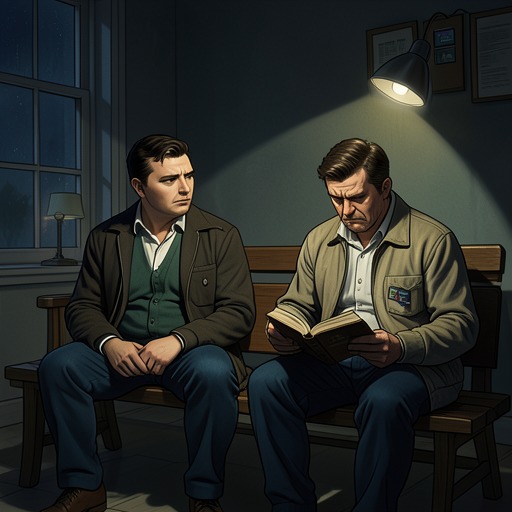
For Perry, the penitentiary is where an initially wary acquaintance with Willie-Jay becomes an unusually important friendship. Perry first watches the chaplain’s clerk from a distance, unsure whether closeness to a religious man will fit the tough identity he wants to project. Willie-Jay’s singing unsettles Perry’s certainty about his own contempt for religious belief. In time, Willie-Jay sees artistic and intellectual promise in Perry, while Perry comes to regard him as the one person who recognizes his worth and potential.
Their friendship survives a fundamental disagreement. Perry makes a drawing of Jesus that the prison’s Protestant chaplain, James E. Post, values enough to hang in his office. Perry later judges his own religious effort to be insincere and tells Willie-Jay that he cannot accept the faith Willie-Jay hopes to share with him. Willie-Jay is disappointed but continues to care for him. Before Perry’s parole, he writes a long farewell letter warning that Perry’s explosive emotional reactions and contempt for others may ultimately turn against him. Perry is flattered by the attention and lets Dick read the letter, even though Dick mocks its religious and moral seriousness.
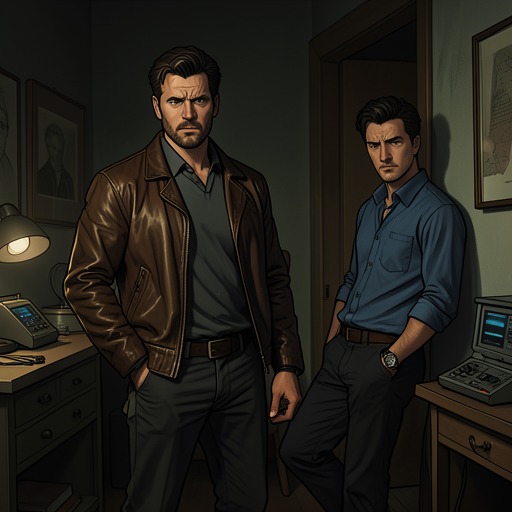
Dick and Perry’s bond develops alongside, and partly in contrast to, Perry’s attachment to Willie-Jay. Dick and Perry had shared a cell during their time at the penitentiary, and Dick later joins Perry in a partnership shaped by talk of schemes and future gains. Perry sees Dick as a practical, entertaining companion who is willing to listen to his ambitions; Dick, for his part, regards Perry as volatile and difficult to understand. Prison gives them a shared history, but it does not make their temperaments alike or their trust secure.
The institution also links Dick to Floyd Wells. Wells had once worked at River Valley Farm and described Herbert William Clutter and his family to Dick while the two men were imprisoned together. Dick asked about the farm, its layout, and the family’s circumstances, then spoke about robbing the house and killing anyone who could identify the intruders. Wells initially treated this talk as prison boasting and did not believe Dick would carry it out. When news of the Clutter murders reached him, fear of retaliation and concern that he might be implicated kept him silent for a time. He eventually arranged to speak to the deputy warden through another prisoner. His knowledge of Dick’s earlier plans made the prison a point of origin for information that would later help authorities identify the suspects.
A Place of Return and Confinement
Release does not end the prison’s influence on Perry and Dick. After leaving Kansas State Penitentiary, Perry drifts through several places before Dick’s letter draws him back into contact with his former cellmate. Perry’s return to Kansas is also tied to his desire to see Willie-Jay, who is due to leave the institution. Dick’s invitation and Perry’s longing for his friend converge around the prison and the relationships formed there, even as the men move toward events outside its walls.
Dick’s own parole is conditioned on his living with his parents near Olathe, Kansas. His family disapproves of his association with former inmates, and he takes care not to let his father see him remove a gun from the house. Perry recognizes the tension between Dick’s parole conditions and his continued connection to prison companions. The institution thus persists beyond the compound as a social boundary: a prison association can shape family trust, parole obligations, and the risks of a new relationship.
Both men are eventually returned to Kansas State Penitentiary after the investigation and trial. In the county jail, Dick secretly constructs a weapon from materials taken from a toilet brush and imagines escaping to a remote cabin in the Colorado mountains. His plan depends on leaving the prison and, in his private vision, does not include a future for Perry. The episode contrasts his outward ease among other inmates with his sustained effort to avoid the outcome he expects from trial. The prison confines him physically while his escape scheme reveals how insistently he continues to imagine a way out.
Death Row and Narrative Significance
After their convictions, Perry and Dick are transferred to Kansas State Penitentiary for Death Row. They arrive after a long drive from Garden City, Kansas, are processed, and are led up the spiral staircase to separate cells. The account emphasizes the abrupt passage from the public world of trial to a narrow, regulated existence: identical rooms, an unextinguished light, a limited view through mesh, and the gallows stored close by. Prison architecture makes the approaching sentence part of the prisoners’ daily surroundings rather than a distant legal abstraction.
Their confinement lasts almost two thousand days. Appeals reach the Supreme Court of the United States three times, but the Court declines to grant full hearings. In March 1965, the Kansas Supreme Court sets the time for the executions, and a clemency appeal to Governor William Avery is denied. On April 14, 1965, Dick dies first at 12:41 a.m.; Perry follows at 1:19 a.m. Alvin Dewey, who had investigated the murders, attends the execution and later reads the news report in a Topeka hotel.
Kansas State Penitentiary therefore frames a cycle that begins before the Clutter case becomes a public investigation and ends with the punishment imposed for it. It is where Perry and Dick meet and form their criminal partnership, where Perry finds and loses the friendship that most affirms his sense of himself, and where Wells’s account of Dick’s plans can eventually be brought into court. The same institution that supplies the setting for those connections ultimately holds both men on Death Row until the legal process reaches its final consequence.