Kenyon Clutter
In Cold BloodKenyon Clutter is the youngest child of Herbert William Clutter and Bonnie Clutter, an inventive, lanky boy whose carpentry, homemade projects, and outdoor pursuits give the family home a distinct life of its own. His murder in the basement playroom of River Valley Farm makes that familiar space—and the cedar chest he had built as a wedding gift—part of the record of the Clutter family killings. Afterward, his abandoned spectacles, empty place in the house, and coyote wagon bought at the farm sale mark the passage from a busy household to a property emptied of its family.
Identity and Background
Kenyon is physically unlike either parent. He is six feet tall and lanky, with hemp-colored crew-cut hair. He is strong enough to carry two full-grown sheep for two miles through a blizzard, but his poor coordination and dependence on glasses make him ill-suited to the team sports popular among boys around him. The mismatch between strength and awkwardness helps explain why he takes only a token part in basketball and baseball rather than making those games the center of his social life.
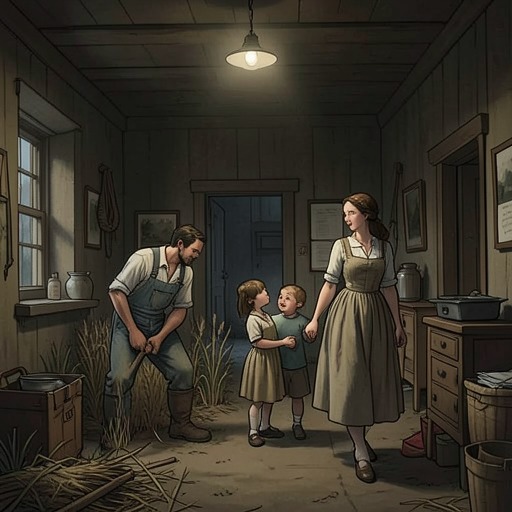
His home life is expressed through making things. In the basement, he and Nancy Clutter have turned a long, cement-floored room into a den, using their own work to soften its gloom. Nancy contributes needlework; Kenyon contributes shelves, tables, stools, and a ping-pong table. He can work there without disturbing the household, banging, sawing, and pursuing inventions. One of his projects is an electric deep-dish frying pan. In the adjoining furnace room, a tool-covered worktable holds an amplifying unit and an old wind-up Victrola that he is trying to restore.
The den’s centerpiece is not a finished object but a promise. Kenyon has built a mahogany hope chest lined with cedar for his sister Beverly Clutter’s wedding present. On the day described in the book, he is applying its final coat of varnish. Its careful construction and intended future use make the chest a particularly concrete measure of the plans that still belong to him: he is not only occupying the family home but making something for a life event yet to come.
Friendship and the Outdoors
Kenyon has one close friend, Bob Jones, whose family ranch lies a mile west of River Valley Farm. At eleven, with money earned from raising sheep, Kenyon is allowed to buy an old truck with a Model A engine. The boys call it the Coyote Wagon. They take it into the Sand Hills, a dune country where coyotes gather and howl at night, and try to outrun the animals across the sand. The truck can reach only thirty-five miles an hour, while even a scrawny coyote can run faster; the chase is therefore more exhilarating than successful.
Their adventures also have a practical side. Kenyon is a good shot, and Bob is better. Together they sometimes bring as many as fifty rabbits to a Garden City processing plant that pays ten cents per animal before quick-freezing them for mink growers. But the boys’ most valued outings are their overnight hunting hikes along the river. They wrap themselves in blankets, wait at sunrise for the sound of wings, and return with ducks for dinner. The landscape is not merely a backdrop to Kenyon’s boyhood: the river, dunes, truck, and hunting trips form the shared routines through which his friendship takes shape.
That friendship begins to change without a quarrel or open rupture. Bob is sixteen and has started going out with girls; the account presents this shift as a quiet alteration in the boys’ closeness rather than a dramatic falling-out. The relationship’s importance remains visible in the detail with which their shared pursuits are recalled, even as their lives begin to move in different directions.
The Murder and the Basement
On the night the Clutter family is attacked, Kenyon is in his bedroom. Perry Smith later recounts that Dick orders him out of bed; when Kenyon does not move quickly enough, Dick strikes him and pulls him up. Perry says he tells Kenyon to put on his pants. Kenyon puts on blue jeans while wearing a T-shirt, and the intruders confine him before the family is killed. This account establishes the ordinary, hurried clothing in which he is later found and places him among the family members held in their own home.
Perry’s recollection connects Kenyon’s last hours to the boy’s handiwork. He describes bringing Kenyon downstairs, first securing him in the room with Herbert William Clutter and then moving him to the playroom, where there is a couch. While working there, Perry sets down a knife on the freshly varnished cedar chest. Kenyon asks him not to put it there, explaining that the chest is a wedding present he has made for someone in his family. The request briefly asserts the chest’s intended meaning against the violence taking place around it: to Kenyon, it remains an object made with care for another person, not a convenient surface.
After the murders, an account of the discovery describes Kenyon in a corner of the basement playroom, on the couch, bound and gagged. He is wearing a T-shirt and blue jeans, and he is barefoot. His head rests on pillows. The investigator who recounts the scene says Kenyon haunts him especially because he remains recognizable as himself. The description gives the basement a double significance: it is the room Kenyon and Nancy had made their own, filled with evidence of their work and interests, and the place where his life ends.
What Remains at River Valley Farm
The house preserves small, incomplete signs of Kenyon’s presence after his death. When Mabel Helm searches his room with an investigator, she notices his old baseball mitt, mud-spattered work boots, and abandoned spectacles. The missing object she identifies is Kenyon’s little gray portable Zenith Portable Radio. The distinction between the objects left behind and the one gone draws attention to the fact that his room has been disturbed, while the surviving possessions make his absence legible through ordinary use: sports, work, and listening.
The family home itself continues to hold traces of a life that has stopped. When Alvin Adams Dewey later enters, Kenyon’s spectacles remain on a shelf above his bed, their lenses catching the light. The house still appears capable of receiving its occupants again, even though the family will not return. These details make the investigation’s search for evidence inseparable from its encounter with the rooms as lived spaces.
At the estate sale, the Coyote Wagon is bought by a young cowboy in pale-yellow boots. Its sale is one transaction among the farm equipment and household remnants, but the book identifies it as the dilapidated vehicle Kenyon used to chase coyotes on moonlit nights. Paul Helm, one of Herbert William Clutter’s longtime employees, sees the dispersal of the family’s possessions as a second funeral. For Kenyon, the wagon carries that loss into public view: an object once tied to his friendship and boyhood freedom becomes property passed to a stranger.
Narrative Significance
Kenyon’s characterization is built less through extended speech than through objects, routines, and the memories of people who knew the farm. The hope chest, electric frying pan, restoration projects, truck, hunting gear, and spectacles distinguish a particular boy rather than an abstract victim. The same details acquire altered meanings after his death: the chest survives as a witness to his care for his sister, the glasses emphasize the familiar person the investigator remembers, and the wagon is sold as the estate is dismantled.
His place in the account also gives the violence a domestic scale. The basement is both a workshop and retreat, a room where Kenyon can build and experiment; it is also the setting of his final confinement. The narrative’s movement between his lively earlier pursuits and the quiet evidence left in the house refuses to reduce him to the circumstances of his death. His unfinished projects and interrupted future remain present precisely because the account shows what he had been making, where he had gone, and whom he had shared those places with.