Lansing prison gallows
In Cold BloodThe Lansing prison gallows was an unpainted wooden structure kept inside the prison’s execution chamber, a storage room called the warehouse by prisoners. It remained largely out of sight from Death Row, yet its presence organized the condemned men’s sense of time: executions were anticipated, watched from cell windows, and ultimately approached through a sequence of official procedures. The narrative makes the gallows consequential not only as the means of execution but as the unseen center of prison life, alternately inferred from a shadow, a sound, and the movement of people toward the warehouse.
Location and Material Setting
The gallows stood in a cavernous storage room beyond a rusty iron door set into the rough stone wall visible from the Death Row cells. The chamber also held license-plate metal, lumber, old machinery, and baseball equipment. That ordinary inventory placed the instrument of execution among the prison’s working and discarded materials, in a room whose storage function concealed its more consequential purpose. Prisoners used euphemistic language for a condemned man’s passage there, making the warehouse both a specific room and a way of naming the event without naming it directly.
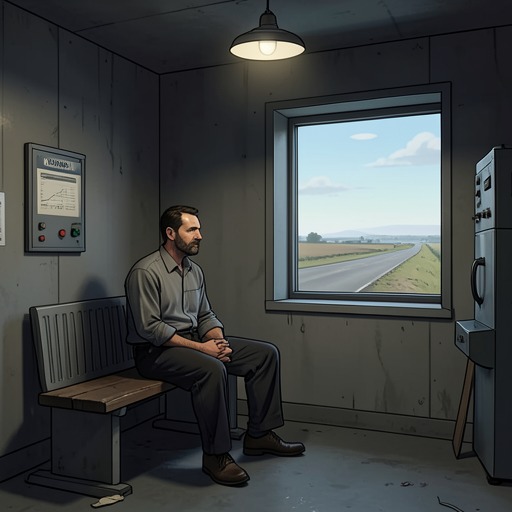
The cells faced an empty dirt lot used as a baseball diamond in summer, a stretch of prison wall, and a narrow portion of sky. The gallows itself could not be seen from the cells. When the warehouse door opened, the pigeons nesting in the wall’s crevices were disturbed; from the Row, the prison’s architecture offered signs of access to the execution chamber without revealing what happened inside. This restricted view is central to the gallows’ narrative presence: it is less a displayed object than a destination whose approach can be watched and whose operation must be inferred.
In April 1960, Perry Smith and Dick were scheduled to be taken there six weeks later, at 12:01 a.m. on Friday, May 13. The scheduled visit belonged to the formal machinery of a death sentence, but the date also made the gallows a fixed horizon in the men’s confinement. The account places this particular timetable alongside the wider uncertainty of execution dates and appeals, distinguishing the certainty of the sentence from the unsettled course by which it might be carried out.
The Execution of Lowell Lee Andrews
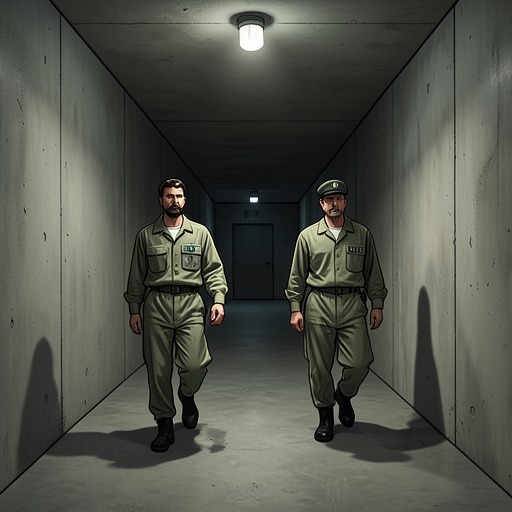
Dick later described watching Lowell Lee Andrews’s execution from a Death Row window with Perry Smith, George Ronald York, and James Douglas Latham. On a cold, wet night, the men could see the warehouse brightly lit and its doors open, along with witnesses, guards, the doctor, and the warden. The gallows itself remained out of their sight; its shadow on a wall was visible instead. The prisoners watched a public procedure from a deliberately incomplete vantage point, able to follow the approach to the chamber but not to see the instrument directly.
According to Dick’s account, a chaplain and four guards brought Andrews to the door. His glasses were removed before he was led inside, a small act Dick recalled as pitiful and as raising the question of how well Andrews could see the steps. The men then heard the trap door. James Douglas Latham asked what the sound was, and Dick identified it. The event reached the watching prisoners through sound rather than sight, while a distant dog’s barking continued during the pauses. In Dick’s recollection, the doctor repeatedly stepped outside, visibly distressed, before returning to check whether Andrews’s heart had stopped. It continued beating for nineteen minutes.
Dick’s Execution
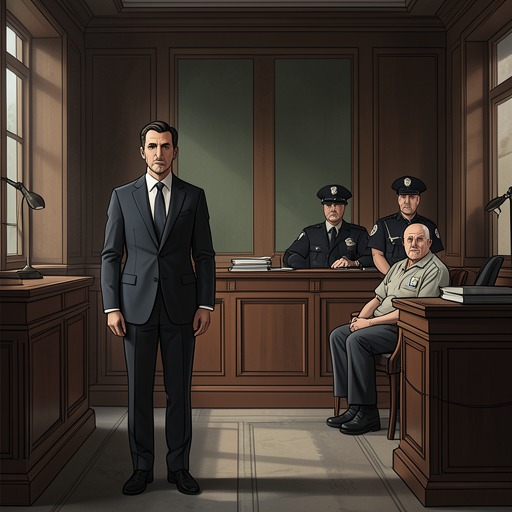
When Dick himself was brought into the warehouse, he looked across the audience for a member of the Clutter family. He asked a nearby guard whether anyone from the family was present and appeared disappointed when told no. The detail connects the gallows ritual to the crime for which Dick had been convicted: even at the place of execution, he expected the family’s absence or presence to matter to the ceremony. After the warden read the execution order and invited a last statement, Dick said he held no hard feelings and regarded the next world as better than this one. He then shook hands with Roy Church, Clarence Duntz, Harold Nye, and Alvin Adams Dewey, the investigators who had helped secure his capture and conviction.
Rain sounded on the warehouse roof as Dick mounted the scaffold. A chaplain prayed, a mask was placed over Dick’s eyes, and the trap door opened. He remained hanging for twenty minutes before the prison doctor pronounced him dead; a hearse then carried his body away. Roy Church said he had not expected Dick to face the execution with such composure, while another detective dismissed him as a criminal who deserved his fate. Their exchange makes the gallows a point at which an observed manner of dying could unsettle one judgment without undoing another: Church revised his estimate of Dick’s courage, but his colleague’s condemnation remained unchanged.
Perry Smith and the Meaning of the Gallows
Perry Smith’s final approach to the gallows is narrated through the response of Alvin Adams Dewey, the detective who had investigated the Clutter killings. Smith recognized Dewey, stopped chewing gum, and grinned and winked; when asked whether he had anything to say, however, he became solemn. In his final statement, Smith objected to capital punishment on moral and legal grounds, said an apology would be meaningless or inappropriate, and apologized nonetheless. The sequence joins defiance, hesitation, and remorse without reducing them to a single final attitude.
Smith’s hands were stained with ink and paint because, during his last three years on Death Row, he had painted self-portraits and pictures of children, often using photographs supplied by other inmates. Before the mask was adjusted, he spat his gum into the chaplain’s outstretched hand. Dewey shut his eyes through the final sound and, when he opened them, recalled Smith as the small, boyish figure he had first encountered in a Las Vegas interrogation room. The gallows thus completes the state’s execution ritual but does not settle Dewey’s response to Smith: unlike Dick, whom he had regarded as empty and worthless, Smith elicited a conflicted recognition that persisted beyond the execution. In these scenes, the wooden structure remains physically screened or withheld from view, while its effects—scheduled dates, watching prisoners, remembered sounds, formal gestures, and the witnesses’ divided judgments—are brought sharply into focus.