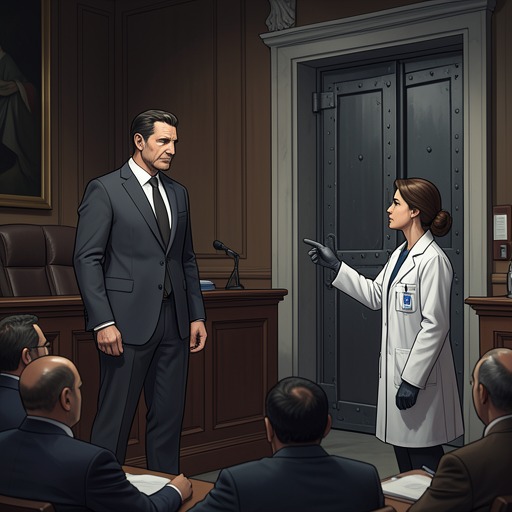
Murder Without Apparent Motive
In Cold BloodMurder Without Apparent Motive is a forensic-psychiatric framework for understanding homicide that appears deliberate and controlled yet resists an ordinary explanation in terms of rational purpose. In In Cold Blood, the concept gives a name to the gap between the practical circumstances of the Clutter killings and Perry Smith’s inability to identify a personal reason for his actions. Its application is presented as a psychological interpretation, not as proof that the crime had no material motive or that one diagnosis settles the question.
Definition and Clinical Framework
Dr. Joseph Satten, a forensic psychiatrist at the Menninger Clinic in Topeka, Kansas, consulted with Dr. W. Mitchell Jones and endorsed the evaluations of Smith and Dick. Satten regarded the crime as the work of both men, shaped by friction between them, but considered it essentially Smith’s act. He connected Smith to a type of offender discussed in an article titled Murder Without Apparent Motive, published in The American Journal of Psychiatry in July 1960 and written by Satten with Karl Menninger, Irwin Rosen, and Martin Mayman.
The article begins from a difficulty in criminal responsibility assessments: the familiar distinction between a supposedly rational offender and an insane one does not readily account for people who seem coherent and controlled but commit acts whose psychological meaning appears bizarre or senseless. The authors proposed that some such cases shared a pattern of severe failures of self-control, allowing primitive aggression to emerge from earlier traumatic experience. The framework thus distinguishes an act’s outward logic from the less accessible psychological process that may have contributed to it.
The study drew on four men convicted of seemingly unmotivated murders. Each had previously been examined and found sane and without psychosis; further assessment followed because lawyers, relatives, or friends remained dissatisfied with the explanations. The men were puzzled by their actions against victims they knew little or not at all. In the authors’ account, some described altered states of consciousness around violent acts, while their histories also showed recurring difficulty controlling aggression. The proposed pattern was not simply a lack of reason, but a mismatch between apparent control and episodes of extreme violence.
Proposed Pattern and Its Limits
The study grouped together several kinds of biographical and emotional evidence. Its subjects had often experienced themselves as physically inadequate, faced anxiety about being considered weak, and shown inhibited or troubled relationships with women. The authors also noted childhood exposure to severe parental violence, emotional deprivation, and unstable or rejecting family circumstances. These were reported patterns across the cases, not a claim that any single experience inevitably produces violence.
In the authors’ account, the men’s relationships were often shallow and isolating, and their emotional responses to victims and to their own futures could be strikingly limited. They proposed that an earlier traumatic conflict might be reactivated when an otherwise ordinary or little-known person unconsciously takes on the role of a figure from the offender’s past. Under mounting tension and weakened impulse control, that displacement could help explain why aggression was directed at a particular victim. The framework therefore treats apparent senselessness as a problem of hidden psychological meaning, not as evidence that the act lacked causes.
The argument remains an interpretation of selected cases, and its explanatory force depends on inferred connections between present actions and past experience. Satten’s formulation is significant in the book because it offers a way to discuss Smith’s act without pretending that his conscious account supplies a complete motive. It does not establish which earlier conflict, if any, determined the crime, and the evidence leaves that question open.
Satten’s Application to Perry Smith
Satten saw parallels between Smith’s background and personality and the four men in the study. He argued that, although the deaths of Nancy Clutter, Kenyon Clutter, and Bonnie Clutter could be understood as following from the initial killing of Herbert William Clutter, the first killing carried the central psychological question. In Satten’s account, Smith may have been in a mental eclipse when he attacked Herbert William Clutter, perceiving him not only as the man before him but as a key figure in an earlier traumatic configuration.
The possible figures Satten named were Smith’s father, the nuns at the orphanage who had mocked and beaten him, the Army sergeant he hated, and the parole officer who had ordered him to stay out of Kansas. The book presents these as alternatives, or potentially overlapping sources, rather than identifying one as the answer. This restraint matters: Satten’s theory provides a psychological structure for considering the act, but does not convert the possible past figures into confirmed motives.
Smith’s own account contains both a practical plan and an unresolved explanation. In his recollection, Dick had summoned him back to Kansas with an offer of a sure-fire score, then described the Clutter home, the family, and a supposed safe. Smith said he wanted the money and hoped to go to Mexico, but also said he had hoped they could avoid violence. He described trusting Dick as practical and wanting the opportunity, even while finding the prospect of a house that might contain as many as twelve people unsettling. Those details make clear that the crime was not without instrumental aims, even as they leave open what drove Smith’s role in the killing itself.
Planning, Confession, and the Question of Motive
Floyd Wells’s account supplies another part of the practical background. While sharing a cell with Dick, Wells said he had told him about working for Herbert William Clutter and had answered questions about the family, the farm, and the house. Wells recalled that Dick repeatedly discussed robbing the home and killing witnesses, though Wells assumed such talk was prison boasting and did not believe Dick would carry it out. His account shows how information and a planned robbery entered the men’s story; it does not by itself explain Smith’s psychological response to the plan.
When questioned after the arrests, Smith recalled that Dick’s letter had described a score but had not specified it. Smith also mentioned a separate personal reason for returning to Kansas, which he declined to disclose and said was unrelated to the deal. At the hotel in Olathe, according to Smith, Dick explained what he had learned from Wells. The distinction between Smith’s undisclosed personal business and the robbery scheme is important: the account records an unknown circumstance, but does not support treating it as the motive for the killings.
Smith later told Donald Cullivan that the Clutters had not harmed him, while suggesting that other people had hurt him throughout his life and that the family may have paid for that history. He also struggled to explain why he had acted and described feeling no remorse, while expressing sorrow for his own confinement. These statements do not confirm Satten’s theory, but they echo its central problem: Smith’s own explanations point toward past injury and displaced grievance without specifying a single cause. His account also assigned Dick a role in the crime while maintaining that Dick had not fired the fatal shots. It is testimony by Smith, and the book places it alongside, rather than above, other evidence.
Narrative and Interpretive Significance
The concept organizes a tension the book repeatedly preserves. Dick’s proposal, Wells’s information, the journey, and Smith’s stated desire for money provide a chain of practical causes. Yet the apparent instrumental purpose does not fully explain why Smith killed people he said had done him no harm, or why he remained unable to identify a clear immediate grievance. Satten’s framework addresses that gap by proposing unconscious displacement, while leaving its specific source uncertain.
The account also sets professional interpretation beside Smith’s own testimony and the recollections of people who knew parts of the plan. No single voice closes the case of motive: psychiatric analysis proposes a pattern, Smith offers incomplete and shifting explanations, and Wells recalls the scheme before it became real. Murder Without Apparent Motive therefore functions less as a final verdict than as a disciplined name for the distance between what the crime was meant to accomplish and what its first killing may have meant psychologically.