Nancy Clutter
In Cold BloodNancy Clutter, not yet seventeen, is remembered both for the extraordinary range of what she could do and for the generous attention she gave to other people. A high-achieving student and capable household organizer, she is also a trusted friend, a teacher to younger girls, and a young musician and horsewoman with plans for college. Her murder ends those plans abruptly; the investigation and the later recollections of Susan Kidwell and Bobby Rupp make the gap between Nancy’s busy everyday life and the future she expected especially stark.
Identity, abilities, and daily life
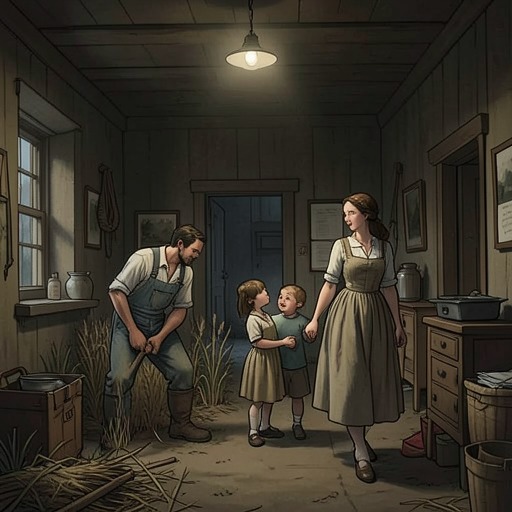
Nancy’s days were crowded with commitments. She was a straight-A student, class president, an active participant in 4-H and the Young Methodists League, and a skilled rider. She played piano and clarinet, and regularly won county-fair prizes for pastry, preserves, needlework, and flower arrangement. At home, she could be relied upon to help run the household. Younger girls came to her for instruction in cooking, sewing, and music, and sometimes simply to confide. She treated that availability as a responsibility, not a performance, and the community saw her accomplishments as evidence of character rather than self-promotion.
Her father, Herbert William Clutter, had passed on one ability that helped make this crowded life manageable: organization. Nancy allotted time to particular tasks and knew how long each would take. That habit was tested when she had already promised to help another child with a trumpet solo, run several errands for her mother, attend a 4-H meeting in Garden City with her father, prepare lunch, and sew bridesmaids’ dresses she had designed for her sister Beverly’s wedding. When a neighbor asked whether Nancy could teach her daughter Jolene to make cherry pie, Nancy had to consider what, if anything, could be canceled. The request suited her usual generosity, but the day already had no open space.
The public picture of competence had a private, youthful counterpart. Nancy valued her cat above her gold watch, and valued Bobby Rupp’s signet ring above both. The ring, too large for her fingers, served as a conspicuous sign of their going-steady relationship; she sometimes took it off when they argued. She was lean and boyishly agile, with short, carefully brushed chestnut hair and a complexion still marked by the previous summer’s freckles. Her wide-set, dark eyes seemed to announce a ready kindness and an absence of suspicion.
Her bedroom gathered the interests and attachments that her packed schedule could not fully express. The smallest and most personal room in the house was decorated in pink, blue, and white. A large Teddy bear that Bobby had won at the county fair sat on her bed. On the bulletin board were dried gardenias, old valentines, recipes, and photographs of family and friends. Pictures of Bobby showed him at different activities, while photographs of the two of them preserved a shared moment of relaxed delight. Her desk also held pictures of horses and cats she had not forgotten.
Family, friendship, and plans
Nancy and Bobby’s relationship had begun when they were twelve. After school, he carried her book satchel along the mile between the Holcomb schoolhouse and her father’s farm. In warm weather they sometimes stopped by the river. Their courtship became part of the pattern of their lives: each Christmas he tried to find a present that would delight her, despite her birthday coming soon after New Year’s. The previous year he had given her a small heart-shaped gold locket. Before her death, he was weighing a choice between perfume and riding boots for the next gift.
Nancy’s friendship with Susan Kidwell occupied a different but equally important place in her life. Susan shared Nancy’s interest in art and music, and the two planned to attend college together and become roommates. Nancy hoped to study music and art at a university. In the later account of her conversation with Perry Smith during the invasion of the house, Nancy spoke about school, horses, and those plans. Perry recalled her as friendly and said that he liked her. His memory is the account of one of the men responsible for her death, but it also preserves a few particulars of what she chose to discuss: the education she expected to pursue and the exhilaration of riding at a gallop.
Her relationship with her father is reflected both in the discipline she inherited from him and in the Gold Wristwatch Hidden in Nancy’s Shoe, a gift she treasured. After the killings, her aunt found the watch tucked into the toe of a shoe among Nancy’s clothes. Alvin Adams Dewey considered whether Nancy, hearing activity in the house and supposing that thieves were present, might have hidden it. That explanation remained his inference, not a confirmed account of what she had done. The discovery nevertheless gave the investigators a concrete reason to reconsider robbery as a possible motive.
The killing and the investigation
Nancy was killed at the family home on November 15, 1959. Her death, together with the deaths of her parents and brother, made the investigation a search not only for the perpetrators but also for the connection between them and the household. Dewey believed the family had known the people who destroyed them. The discovery that Kenyon’s gray portable Zenith radio was missing, alongside Nancy’s hidden watch, brought robbery back into consideration. Dewey struggled to reconcile the possibility of theft with the apparent scale of the crime, and searched for evidence of a more personal motive as well.
A report passed to Dewey through a caller added a small but troubling detail about Nancy’s father: Susan had said that Nancy described Herbert William Clutter as being in a bad mood and worried during the preceding weeks, and that he had taken to smoking cigarettes. The information did not solve the case, but it entered the investigators’ expanding record of what the family’s friends had noticed. Dewey’s approach was to keep testing such fragments against the rest of the evidence rather than treating any one clue as an answer.
Nancy’s room and the other bedrooms also figured in Dewey’s interpretation of the crime. He saw the way the bedcovers had been drawn up around the women as an unsettling sign of consideration amid the killers’ actions. The detail did not identify a perpetrator or establish a motive. Instead, it deepened the contradiction Dewey was trying to understand: the crime appeared deliberate and devastating, yet some details seemed to him to carry a distorted trace of tenderness. The contrast between that speculation and the practical clues—the missing radio, the hidden watch, the records of the family’s lives—shows how little any single interpretation could explain.
Grief and the future that did not arrive
The Christmas after Nancy’s death made the absence tangible to Bobby. On earlier Christmas mornings he had hurried to the Clutter home with a present for her; this time he stayed with his own family. His relatives encouraged him to eat, though he felt that grief had made him ill. Susan, whose loss was different from his but no less bound to Nancy, was the person he could most readily imagine understanding him. For a time they were often together. After about a month, however, their visits became less frequent: remembering Nancy together also forced each of them to face what they wanted, sometimes, to forget.
Bobby found intervals of relief in basketball, fast drives along country roads, and long runs across the fields. The river near Holcomb brought Nancy back in another way. She had once described seeing the Arkansas at its beginning in Colorado: clear, fast, and full of rocks, unlike the slower, muddier stream he knew in Kansas. After her death, Bobby sometimes saw the river through her description. The remembered contrast became an image of Nancy herself as he had known her—energetic and joyful—and a measure of how memory could briefly transform an ordinary landscape.
Dewey’s recognition that Nancy’s birthday was approaching sharpened the sense of time interrupted. He told Perry Smith that the next day would have been Nancy’s seventeenth birthday. Perry, held apart from Dick and under questioning, wondered whether the reference was another tactic by the investigators. For the reader, the remark joins the birthday to the facts that define Nancy’s interrupted future: she had been planning for university, music, art, and a life that her friends and family had expected to continue.
Memory and narrative significance
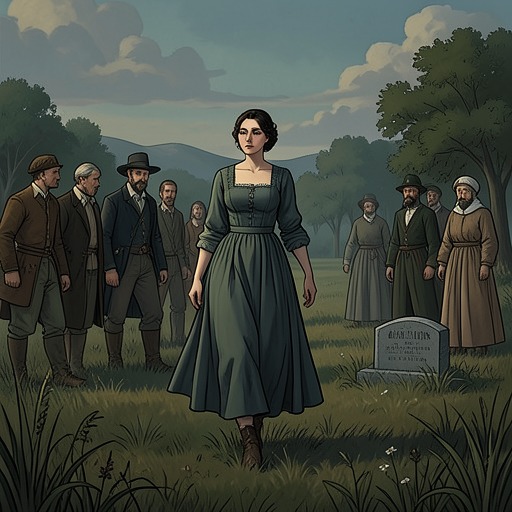
Years later, Dewey encountered Susan at the cemetery, where the four members of the Clutter family lay beneath one gray stone. Susan was now a university student studying art and said she was happy. She and Nancy had planned to go to college together as roommates; even when Susan felt happy, memories of those shared plans could return. Her account makes Nancy’s absence more than a recollection of the crime: it is present in the life Susan built and in the future they had imagined in common.
Susan also told Dewey that Bobby had married Colleen Whitehurst. The news registers the passage of time without suggesting that Nancy has simply been replaced or forgotten. The story first presents her through the exacting rhythm of her days, her practical talents, and the attention she gives to others. After her death, details that once belonged to ordinary life—a ring too large for her hand, an unfinished future, a hidden watch, a river remembered through her words—become traces through which others try to understand and remember her. Nancy’s narrative significance lies in that contrast: the investigation asks what happened in the house, while the survivors’ memories restore the individuality and unrealized possibilities of the person whose life was taken.