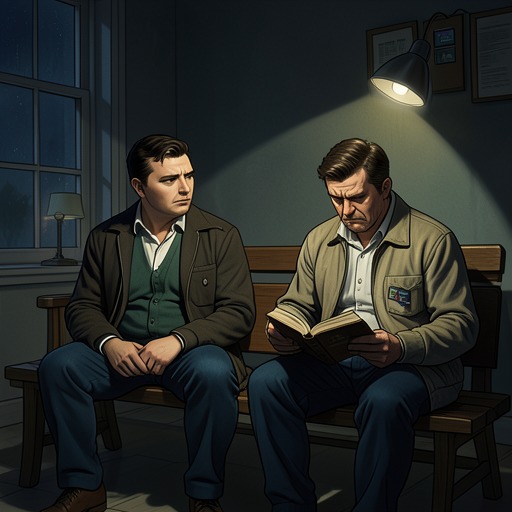
Perry Smith and Willie-Jay’s friendship
In Cold BloodPerry Smith and Willie-Jay’s friendship offered Perry something he had rarely found: the sense that another person could see his intelligence and artistic potential without reducing him to his circumstances. Their bond formed in Lansing State Penitentiary, where Willie-Jay tried to draw Perry toward religion and Perry eventually rejected the faith that had helped bring them together. The friendship survived that disagreement, but parole separated them. When Perry returned to Kansas hoping to see Willie-Jay, he arrived only hours after his friend had left; that missed reunion helped determine the course of his next choices.
Meeting in Lansing
During Perry’s first year at Lansing State Penitentiary, he watched Willie-Jay from a distance. Willie-Jay worked as the chaplain’s clerk, sang tenor in the prison choir, and seemed to Perry an unlikely person to approach if he wanted to be regarded as tough. Perry nevertheless found himself moved by Willie-Jay’s singing of “The Lord’s Prayer.” The experience unsettled his contempt for religious piety and prompted a cautious religious curiosity.
Willie-Jay responded to Perry as someone with unusual promise. He saw a poet in the self-conscious, artistic prisoner, and an ambition to bring Perry to God became central to his attention to him. Their relationship thus began with a mismatch that neither concealed: Willie-Jay hoped Perry might come to share his faith, while Perry was drawn to the unusual seriousness with which Willie-Jay regarded him.
Faith, art, and the limits of agreement
A pastel portrait of Jesus that Perry made became the friendship’s defining object. Reverend James E. Post valued the drawing enough to hang it in his office. For Willie-Jay, the portrait seemed to support his hopes for Perry’s spiritual development. For Perry, however, making it marked the end of his already uncertain religious search. He judged his own work an act of hypocrisy, made to please or deceive Willie-Jay rather than to express belief.
Perry faced a choice: admit that he remained unconvinced and risk losing the one friend he felt had truly understood him, or allow Willie-Jay to believe that their religious hopes were shared. Perry chose to speak honestly. He explained that heaven, hell, and divine mercy were not for him, and that a friendship founded on the expectation of his conversion would be false. Willie-Jay was disheartened but did not withdraw his affection. His persistence after Perry’s admission made the bond more than a religious project, even though faith had been its original framework.
The difference between the two men also appeared in how they understood Willie-Jay’s life. Perry was astonished that a man he considered so perceptive and intellectually gifted had ended up in prison. The explanation was that Willie-Jay was a thief who had served sentences in five states over twenty years. Perry knew this account but regarded it as an evasion of the deeper human question he wanted to ask. His admiration did not depend on Willie-Jay being blameless; instead, he resisted letting the criminal record explain away the qualities he prized in him.
The farewell letter and Perry’s divided loyalties
On the eve of Willie-Jay’s parole, he wrote Perry a farewell letter interpreting his character. He described Perry as passionate and frustrated, caught between self-expression and self-destruction, and warned that disproportionate anger and contempt could turn into forces that ultimately damaged him. The letter framed the friendship as an act of recognition, but also as a relationship in which Willie-Jay could criticize Perry rather than merely flatter him.
Perry was pleased to be the subject of such sustained attention and let Dick read the letter. Dick mocked Willie-Jay’s language and dismissed his religious counsel. Perry had anticipated the reaction and, privately, welcomed it. The episode shows that his attachment to Willie-Jay existed alongside, rather than simply replacing, his emerging partnership with Dick. Perry valued Dick’s humor, practical outlook, and willingness to entertain his ambitions; Willie-Jay supplied a different kind of attention, one that affirmed Perry’s artistic self-image while challenging his anger and resentment. The two relationships answered different needs, and Perry could regard Dick as a companion without ceasing to measure their bond against the more intense friendship he had formed in prison.
After Perry’s parole, four months of drifting passed before Dick’s invitation reached him in Buhl, Idaho. During that time Perry repeatedly considered Willie-Jay’s earlier accusation that he avoided responsibility, faith, friendship, and warmth. Perry rejected the charge as unfair: he believed he did care, but that few people had cared for him. His father had done so only to a point, and other attachments had not given him what Willie-Jay had. Willie-Jay, Perry believed, had recognized his worth and potential and seen him as exceptional and artistic. The distance from that recognition made their reunion more compelling than the treasure-seeking adventures proposed in Dick’s letter.
The missed reunion and its consequences
Perry drove to Las Vegas, sold his old car, packed his maps, letters, manuscripts, and books, and took a Greyhound bus toward Kansas. Dick’s proposed visit roughly coincided with the date Willie-Jay was due to be released from prison. Perry decided to return without telling Willie-Jay he was coming, intending to see what happened and consider Dick’s proposal only if a reunion did not work out.
When Perry reached Kansas City on the evening of November 12, Willie-Jay had already left town. He had departed from the same bus terminal five hours earlier. Perry learned this by calling Reverend James E. Post, who would not disclose Willie-Jay’s destination beyond saying he was headed east toward work and a home with people willing to help him. Perry hung up feeling dizzy with anger and disappointment. The reunion he had organized his return around was no longer possible, and the information available to him offered no way to follow immediately.
Perry later questioned what he had expected from seeing Willie-Jay again. Freedom, he realized, had divided them: outside prison they were opposites and could not have formed the kind of team needed for the adventures he and Dick had imagined. Yet Perry remained convinced that even an hour with Willie-Jay would have changed his immediate situation. He would not, he believed, have been waiting outside the Catholic hospital while Dick tried to obtain black stockings. That counterfactual gives the missed reunion its force: it did not merely disappoint Perry but left him moving forward with Dick, the available partner, after the friend whose recognition had mattered most had passed out of reach.