Perry Smith’s confession
In Cold BloodPerry Smith’s confession is not a single, settled statement but a sequence of oral accounts, a long dictated document, and a proposed correction that changed who he said had killed the Clutter family. It supplied investigators with details they could test against recovered objects and physical evidence, while its revisions revealed how responsibility, loyalty, and self-interpretation shifted in the telling. The book preserves those changes without treating every assertion as equally reliable: Smith’s account is checked against Dick’s confession, Alvin Dewey’s recollections, and the evidence recovered from the places Smith identified.
The Plan as Smith Recounted It
Smith began his account with a letter from Dick, received while he was in Buhl, Idaho. Dick described a supposedly certain opportunity and urged Smith to return to Kansas to become his partner, without initially explaining what the score involved. Smith said he had another, personal reason for returning, but did not disclose it. Dick met him at the bus station in Kansas City, and the two went to his parents’ home before moving to a hotel in Olathe.
There, according to Smith, Dick explained the proposed robbery. He had learned about Herbert William Clutter and the farm from Floyd Wells, who had worked for him. Dick described the house’s layout, including the office and a supposed wall safe, and claimed that the family kept large amounts of cash there. The plan was to take the money and kill anyone who could identify the intruders. Smith recalled Dick repeatedly insisting that there be no witnesses, while estimating that they might encounter four to six people and should be prepared for as many as twelve. Smith said he wanted the money and hoped to go to Mexico, but also hoped they could avoid violence by wearing masks. Their disagreement over disguises continued on the drive: in Emporia they bought rubber gloves and cord, and in Great Bend they bought tape, but Dick resisted Smith’s proposals to find black stockings.
Smith’s account therefore presents the crime as a plan shaped by Dick’s confident assurances and by Smith’s own willingness to proceed. He later said that he had faith in Dick’s practical manner and wanted the money, even as he described hoping for a nonviolent outcome. That explanation is his retrospective account, not an independent confirmation of his motives. Its details establish what he said he had been told and what he said he wanted; they do not, by themselves, resolve how fully he accepted the plan before the two men reached the farm.
The Night at the Clutter Home
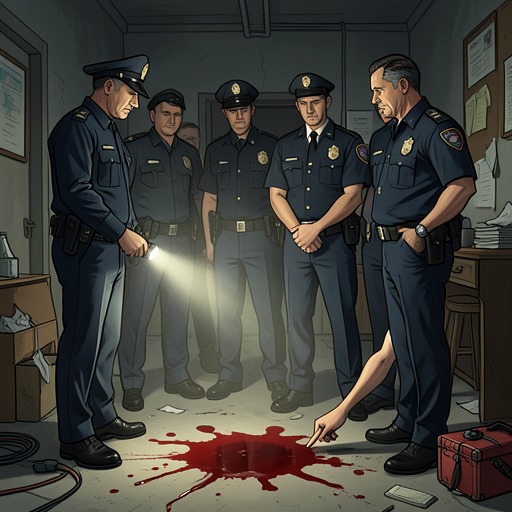
In his account, Smith said the house became completely dark after an upstairs light was switched off, and that they used a flashlight when they went to bind Herbert William Clutter and his son. He recalled Herbert asking whether Bonnie Clutter was all right. Smith said he reassured him and told him that morning would bring discovery, describing the man as gentle and saying he had not wanted to harm him. The account then turns to Smith’s description of the decision that followed: after the family had been bound, he and Dick spoke apart from them, and Smith challenged Dick about whether they should leave the family alive. Smith said Dick did not answer, and that he took the knife from him.
Smith’s telling of what followed was not simply a claim that he acted in a planned, uninterrupted sequence. He described expecting Dick to argue him out of it, and said he did not initially mean the challenge as a settled decision. He recalled the pain of kneeling and a feeling of shame, then said he did not understand what he had done until he heard a sound from Herbert. Smith said Dick tried, or pretended to try, to continue, but panicked; Smith then directed him to hold the flashlight and described using the shotgun. These details form Smith’s account of the division of action between the two men. They must be read alongside his later corrections and the evidence rather than as a neutral transcript of events.
Dictation, Refusal, and Revision
Smith dictated a seventy-eight-page statement to a Finney County court stenographer, recounting admissions he had already made to Alvin Dewey and Clarence Duntz. On January 7, he recorded in his diary-like notes that Dewey had brought typed copies for his signature and that he had declined to sign. Dewey recalled asking why. Smith said that nearly all of the statement was accurate but that he wanted to correct two details. The serious difference between Smith’s and Dick’s accounts concerned who had killed Nancy Clutter and Bonnie Clutter: Smith had previously said that Dick had killed them.
Dewey understood the proposed correction as Smith’s admission that he, not Dick, had shot all four members of the family. Smith said he had earlier blamed Dick because he considered him a coward, and that he now wanted Dick’s parents to know their son had not pulled the trigger. He also maintained that Dick’s idea had brought them to the farm and that Dick had helped him, while distinguishing that participation from firing the weapon. Dewey remained unsure whether to accept Smith’s account to the extent of altering the statement. Investigators did not need a signed confession from Smith, he noted, because they already had substantial evidence and Dick had signed a confession in Las Vegas.
The change had consequences beyond the case file. When Dewey disclosed it during his testimony, Mrs. Hickock began to weep. She had sat through the trial supporting her son and had prayed for the Clutter family as well as for Dick and Smith. In speaking afterward, she said she could not excuse what Dick had done, but was distressed by the possibility that people judged her for how she had raised him. Smith’s correction thus reached the family whose feelings he cited as his reason for changing his account, while exposing the limits of what a late confession could repair.
Corroboration and the Limits of the Account
Smith’s confession also directed investigators toward evidence from the men’s flight. He said they drove east, stopped on the prairie, and buried empty shells, leftover cord, and tape in a place he estimated was about eight miles from where they had turned off the highway. He described burning gloves and his shirt at a roadside rest area near dawn, and said Dick kept the knife and shotgun. The account linked the proposed robbery, the objects used during it, and the effort to discard or destroy evidence afterward.
Investigators tested those particulars. Agents found the knife in a fishing-tackle box at Dick’s home and the shotgun near a kitchen wall. With the help of county-highway employee Virgil Pietz, they located the buried shells, cord, and tape in the area Smith had identified. Tests established that the shells had been fired from Dick’s shotgun, and the recovered materials strengthened the case. A stolen radio and binoculars were also traced to a pawnshop in Mexico City. These recoveries gave the confession evidentiary force, but they did not make every element of Smith’s account independently verified: the book records the conflict between his earlier accusation and later admission, and Dewey’s reservations about accepting the revised statement.
Confession as Self-Explanation
Later, speaking with his friend Don Cullivan, Smith returned to the question of responsibility. He acknowledged that he had killed the family, while saying Dick had proposed the crime, assisted him, held the flashlight, and picked up the shells. Asked why he had done it, Smith said he did not know. He rejected several explanations, including fear of identification and harm done to him by the Clutters, whom he said had never hurt him. He wondered whether the family had simply been made to pay for what other people had done to him, but presented this as uncertainty, not a resolved motive.
Smith also recalled Willie-Jay’s idea that all crimes were varieties of theft, including murder because it takes a person’s life. The formulation gave Smith a way to name the enormity of what he had done, but did not amount to an expression of remorse. He told Cullivan that he did not feel sorry, wished that he did, and regretted his own confinement more than the deaths. The confession’s significance lies partly in that unresolved contrast: it helped establish facts about planning and evidence, yet Smith’s explanations shifted between blame, loyalty, uncertainty, and emotional detachment. The account documents not only what he admitted, but also the distance between admitting an act and making its motive—or its moral meaning—clear.