Perry Smith’s treasure-hunting fantasy
In Cold BloodPerry Smith’s treasure-hunting fantasy turns a restless appetite for travel into a succession of imagined futures: diving for the cargo of a sunken Spanish galleon, prospecting for gold in the Sierra Madre, or sailing with Dick toward Japan. It is more than a single plan. Maps, advertisements, remembered instruction from his father, and conversations with Dick repeatedly give the fantasy new destinations, while its promise of a life beyond ordinary limits helps draw Perry toward partnership with Dick.
Maps, travel, and imagined escape
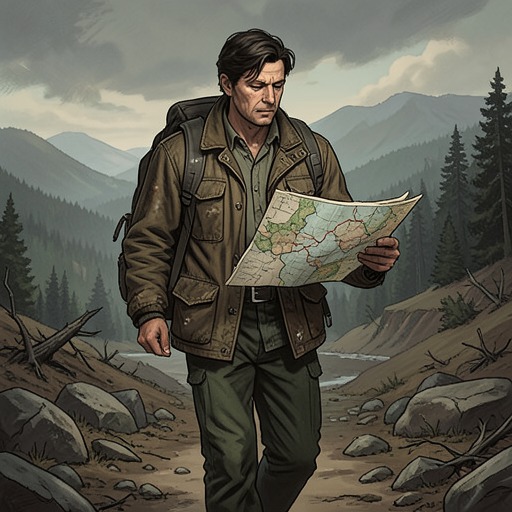
As Perry waits for Dick in a small Kansas café, he studies a well-worn map of Mexico. Its ink-circled names make distant places seem available for selection: Cozumel, Acapulco, and the Sierra Madre each suggest a different version of escape. Cozumel appeals through Perry’s reading about an inexpensive, permissive island and the annual arrival of parrots from the mainland. Acapulco evokes deep-sea fishing and casinos. The Sierra Madre, by contrast, means gold and the adventure of a film Perry has watched eight times. These destinations are not yet a route so much as a catalogue of possible lives.
The Mexican map belongs to a much larger collection. In his hotel room are maps of every state in the Union, every Canadian province, and every South American country. Perry has also kept books, songs, poems, old letters, and manuscripts, possessions that travel with him in two large boxes alongside a cardboard suitcase and a guitar. The bulk and variety of this collection show how thoroughly he invests in journeys before they begin: he gathers material for possible departures even when the immediate plan is still unsettled. His return to Kansas comes only four months after he had resolved, upon parole, never to enter the state again. He treats the return as temporary, another stop in a life that he expects to move onward.
That expectation has a history. Since childhood, for more than half of his thirty-one years, Perry has sent away for booklets and answered advertisements promising instruction or maps connected with diving and sunken treasure. The advertisements repeatedly feed an adventure he can experience in imagination: descending through unfamiliar water toward a wreck, where a Spanish galleon holds diamonds, pearls, and chests of gold. The image is unusually durable because it supplies both a destination and a dramatic journey toward it. Before he has found a ship or a treasure, he can rehearse the descent and arrival in his mind.
The sea and the prospect of treasure
Perry’s imagined underwater journey is distinct from the gold prospecting he discusses with Dick, but both fantasies share the promise that a fortune lies somewhere beyond ordinary life. Perry believes he knows how to hunt for gold because his father, Tex John Smith, was a professional prospector and taught him the trade. The inheritance is practical in form: unlike a purely borrowed adventure, prospecting is something Perry understands himself to have learned. He proposes that he and Dick buy pack horses and try their luck in the Sierra Madre, joining his knowledge of the method to the film-shaped image of a remote gold country.
Dick answers as a skeptic. He recalls that the film’s prospectors lose their composure amid hardship and that the wind carries away the gold they find. His response punctures the uncomplicated promise of the expedition without extinguishing it. The exchange makes visible a persistent difference between the two men: Perry supplies expansive possibility, while Dick tests a plan against its dangers and practical demands. Yet the fantasy survives that test as a topic they can return to. Its attraction does not depend on a settled itinerary or a demonstrated likelihood of success; the prospect of escape and discovery is itself part of its value to Perry.
The fantasy also extends beyond prospecting. Perry imagines buying a cheap but sturdy boat in Mexico and sailing across the Pacific to Japan. He presents the voyage as achievable and describes the country through idealized expectations of considerate people and appealing experiences. He also revisits a story about a bathing establishment called the Dream Pool, where attendants would provide a full-body scrub. Dick’s curt reminder that Perry has told him about it before marks the recurrence of the vision: Perry repeats details as though their appeal might be renewed by telling them again. The proposed boat journey thus belongs to the same imaginative pattern as diving and prospecting, making faraway places into openings toward a transformed life.
Dick as listener and counterweight
Perry’s treasure schemes help explain why Dick’s invitation can hold his attention after parole. Four months of drifting take Perry through Reno and Las Vegas, then Bellingham, Washington, and Buhl, Idaho, where he finds temporary work as a truck driver. A letter from Dick reaches him in Buhl and proposes a criminal opportunity. Before receiving it, Perry had not expected to see Dick again, though both Dick and Willie-Jay remained in his thoughts. Perry’s eventual journey back toward Kansas follows a moment of indecision: he hopes first to reconnect with Willie-Jay and will consider Dick’s proposal if that hope fails.
Willie-Jay’s importance to Perry is bound up with recognition and self-image. Perry remembers him as the one person who acknowledged his potential and treated him as exceptional and artistic, even while criticizing his destructive tendencies. Dick occupies a different place. Perry expects him to dismiss the chaplain’s clerk, and Dick does so with mockery, but Perry welcomes the reaction in private. He values Dick as amusing, shrewd, realistic, and unclouded by what he regards as impractical idealism. More importantly for the treasure fantasy, Dick is willing to listen to visions of riches in Mexican waters and Brazilian jungles. His willingness to share the visions makes him a companion for them, even when he challenges their details.
That companionship persists despite friction. Later, Perry and Dick still regard a life of skin-diving and treasure-hunting among islands or along coasts south of Mexico as a possible future. Their criminal partnership and their imagined travel partnership are therefore entangled: Perry does not regard Dick only as an accomplice in an immediate scheme, but also as someone with whom the distant adventure might still be attempted. When Dick says that they should remain together if they are caught, the practical need to coordinate their accounts coexists with this continuing shared horizon. The fantasy supplies a prospect beyond the consequences they fear, without erasing the dependence and conflict within their actual relationship.
The fantasy’s narrative significance
Perry’s plans remain prospective in the evidence: a boat has not been bought, the Pacific has not been crossed, and the treasure has not been found. Their recurrence matters precisely because the imagined journeys keep multiplying while Perry’s circumstances remain unsettled. The worn maps, the boxes of books and papers, the childhood advertisements, and the repeated descriptions of distant places give material form to a mind continually preparing to go elsewhere. Yet preparation does not become arrival. A map can be folded; a destination can be named; a voyage can be described to Dick and revisited in conversation. None of these acts guarantees that the envisioned life will take shape.
The fantasy also brings together two sources of authority in Perry’s imagination. His father’s instruction gives prospecting a personal basis, while popular advertisements, magazine accounts, and a repeatedly watched film supply alluring pictures of places and fortunes. Perry draws from these sources to make adventures that feel both familiar and boundless. At the same time, Dick’s practical objections keep the imagined quest from becoming a simple romance of guaranteed success. The gold may be lost; the voyage may meet resistance; the plans may be postponed for an immediate scheme. The tension between limitless imagined travel and constrained action makes the treasure-hunting fantasy a recurring measure of what Perry wants: not simply wealth, but a life of movement, discovery, and shared possibility that remains just beyond his reach.